

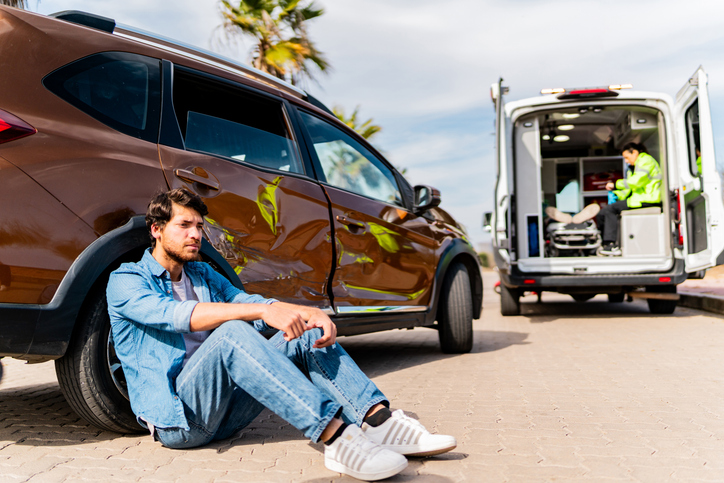
What to Do After a Hit-and-Run in Bonita Springs: A Victim’s Guide
Someone is rear-ended on Bonita Beach Road, sideswiped on Old 41, or clipped in a parking lot off Imperial Parkway — and the other driver just leaves. The first call to our Windsor Place office is rarely about money. It is about disbelief. “How is that legal?” “What do I do now?” “If they never find the driver, am I just stuck?”
It is a fair set of questions, and the answers are not as bleak as they feel in the first 24 hours. Florida has a fairly aggressive criminal statute against drivers who flee, and the civil side of a hit-and-run case is usually built on your own Uninsured Motorist coverage rather than a chase to identify the missing driver. The work, in our office, is mostly about evidence preservation in the first week and a careful UM claim after that. Below is what I would tell a friend or a family member who just got hit and watched the other car drive away.
What Florida law actually says about hit-and-run crashes
Three statutes carry most of the weight in a Florida hit-and-run case, and it is worth knowing what each one does.
§316.027, Florida Statutes — leaving the scene of an injury crash. In plain English: if a driver is in a crash that injures someone and they leave the scene without stopping and providing information, that is a felony. If someone dies, the Aaron Cohen Life Protection Act adds a mandatory minimum four-year prison sentence. This is the criminal side. The State Attorney prosecutes it. You, as the injured person, are a witness in that case, not the plaintiff.
§627.727, Florida Statutes — Uninsured Motorist coverage. This is the civil side, and it is usually where your recovery actually comes from. Florida treats a hit-and-run driver as an “uninsured motorist” for UM purposes, which means your own UM policy stands in for the missing driver’s liability insurance. UM pays for medical bills beyond PIP, lost wages, and pain and suffering. It is the single most undervalued coverage on a Florida auto policy, and on hit-and-run cases it is often the only meaningful source of money.
§627.736, Florida Statutes — Personal Injury Protection. PIP pays the first $10,000 of medical bills and wage loss regardless of who caused the crash, and regardless of whether the other driver is ever identified. You have 14 days from the date of the crash to see a qualifying medical provider, or you lose PIP entirely. That 14-day rule is the single most common way I see people accidentally walk away from their own benefits.
There is also §316.061, the property-damage-only version of the leave-the-scene statute, which is a second-degree misdemeanor. Most parking-lot fender-benders fall under that one.
Five hit-and-run patterns from Bonita Springs and the surrounding area
In my thirty-some years practicing injury law here in Lee and Collier Counties, the hit-and-run calls into our office tend to cluster into five recognizable patterns. Knowing which one you are dealing with usually tells me what the case is going to look like.
- The rear-end on a stoplight stretch. Bonita Beach Road approaching Old 41, US-41 through downtown, Imperial Parkway near the Coconut Road interchange. The other driver taps you, panics, and runs the next light. These are the cases where a partial plate plus a paint transfer plus a nearby business camera usually gets us an identification within a week.
- The parking-lot strike-and-flee. Promenade at Bonita Bay, the Publix on Bonita Beach Road, the resort lots along the Pelican Landing corridor. Property-damage misdemeanor under §316.061, but the injury comes later — passengers with neck and back strains that surface 48 to 72 hours after a low-speed impact.
- The phantom-vehicle sideswipe. A driver runs you off the road on Imperial Parkway or the Bonita Beach Road bridge and never actually makes contact. These are the hardest UM cases. Without a witness, debris, or video, the carrier will argue there was no other car. We have won these, but the evidence work has to start the same day.
- The pedestrian or cyclist hit at a crosswalk. The crosswalk at Bonita Beach Road and Old 41 is one I have looked at on photographs more times than I can count. The driver almost never stops. These cases are felonies under §316.027 and tend to draw real police effort.
- The DUI runner. A driver under the influence who realizes mid-crash what their blood alcohol level is going to read, and chooses jail for leaving the scene over jail for DUI manslaughter. Sad and ugly, but a recognizable pattern in Lee County.
Why hit-and-run claims turn complicated
On paper, a hit-and-run claim sounds almost easier than a regular car-accident case. The fleeing driver is, by definition, in the wrong. PIP applies regardless of fault. UM stands in for the missing driver. Three statutes do the work, and you go home.
The reality in our office is different. The two practical complications I see most often are these.
First, your own insurer becomes the opposing party. On a UM claim, the adjuster you have been paying premiums to for fifteen years is now the carrier you are suing. They are polite about it, but their job is to minimize the payout, and the recorded statement they ask for in the first 48 hours is the single biggest landmine. People who are concussed, on pain medication, or simply rattled will say things that do not match the medical records two weeks later — and that mismatch becomes the argument used against them at mediation. I tell every client the same thing: cooperate with your carrier, but do it in writing or with a lawyer in the room.
Second, the evidence window is short. Doorbell cameras along the residential streets off Old 41 typically overwrite in 24 to 72 hours. Business surveillance on Bonita Beach Road runs on a 7- to 14-day loop. Paint transfer washes off in the next afternoon thunderstorm. Witnesses who gave you a name and a phone number at the scene stop answering by the end of the week. If you have not locked in the evidence by day three, much of it is gone for good.
The third complication is more legal than practical. UM carriers in Florida have learned to dispute “phantom vehicle” claims aggressively — meaning any crash where the other driver did not physically touch your car. The statute and the case law allow phantom-vehicle UM recovery, but the carrier will require independent corroboration. A 911 call you made from the shoulder, naming the other car in real time, is often the single best piece of evidence we have to build that kind of case.
A hit-and-run client we represented in North Fort Myers
A few years back our firm represented a client who was hit on a connector road between US-41 and the I-75 interchange up in North Fort Myers. The other driver did not stop. She did not get a plate. She was alone in the car and the closest witnesses were two lanes over and could only tell the deputy the other vehicle was “a dark pickup.” On paper, this was the worst kind of UM claim — a single-driver report, no plate, no contact witness, and a carrier that had every incentive to call it a phantom vehicle.
What she did have was a 911 call she made within ninety seconds of being hit, in which she described the pickup, the direction it was traveling, and the panel damage on her own car. She also had a body in real distress. The ER imaging showed two ruptured discs, and the neurologist she saw the following week diagnosed a concussion that would need months of monitoring. Her primary care doctor referred her into physical therapy three times a week.
The 911 recording, the contemporaneous photographs of the panel damage, and the medical chronology made the phantom-vehicle argument hard for the UM carrier to sustain. The case settled inside policy limits without a lawsuit being filed. The recovery covered her past medical bills, her future treatment plan, lost wages from the months she could not work, and an amount for the daily reality of living with a concussed brain and a damaged spine. Her closing line to me, when we wrapped the case, was that she felt she had not been “hit twice” — once by the driver, once by the medical debt. That is the phrase I keep coming back to.
What to do if you are the one who just got hit
This is the action list I give to family and friends, in the order I actually tell them to do it.
- Get safe, then call 911 from the scene. Not from home an hour later. The 911 recording is sometimes the single best piece of evidence in a phantom-vehicle UM case, because it captures what you saw before time and stress and the carrier’s questions reshape the memory. Describe the other vehicle out loud — color, body style, partial plate, direction of travel — while the dispatcher is on the line.
- Look down at the road before you look up. Paint chips, plastic bumper fragments, a side mirror, a license plate frame, broken headlight glass. Take photographs of all of it where it sits. Do not pick anything up yet. Once the deputy arrives, point it out.
- Photograph your own car from every angle, including the underside if you can. Paint transfer on the rocker panel is the kind of detail that wins a phantom-vehicle case six months later.
- Get names and phone numbers from anyone who stopped. Two lines on a phone notes app: name, number. That is it. Do not interview them. The deputy and your lawyer will do that later.
- Note every camera you can see. Doorbells. Business signs. Gas pump canopies. Then drive back the next morning with a written request asking those owners to preserve their footage. Most will say yes if you ask politely and in writing within 48 hours.
- See a doctor inside 14 days, no exceptions. §627.736 PIP requires it. If you wait past day 14, you lose PIP. I have watched people give up $10,000 in benefits because they thought they would “shake it off.”
- Do not give your insurer a recorded statement before you talk to a lawyer. Cooperate, answer basic questions in writing, but do not sit for a recorded interview in the first week. There is no statute that requires it on that timeline.
- Pull your declarations page and find your UM limits. Most clients have no idea what they carry. The number on that page is, in most hit-and-run cases, the ceiling on what we can recover for you.
Key Takeaways
- In Florida, leaving the scene of an injury crash is a felony under §316.027, and a fatal hit-and-run carries a four-year mandatory minimum prison sentence under the Aaron Cohen Life Protection Act.
- Your own Uninsured Motorist coverage under §627.727 is the primary civil recovery path when the driver flees and is never identified — not a side option, the main avenue.
- PIP under §627.736 pays the first $10,000 of medical and wage loss regardless of who caused the crash, but you must see a qualifying provider within 14 days or you lose the benefit.
- Evidence on hit-and-run cases disappears fast — most business and doorbell camera systems around Bonita Beach Road and Old 41 overwrite within 24 to 72 hours.
- Your own insurer is the opposing party on a UM claim. Cooperate, but do not give a recorded statement in the first 48 hours without a lawyer in the room.
Frequently Asked Questions
Q1. What is the first thing I should do after a hit-and-run on Bonita Beach Road or Old 41?
Get yourself and your passengers off the travel lane if the car can move, turn on your hazards, and call 911. Do not chase the other driver. While you wait for the deputy, write down everything you remember about the fleeing vehicle — color, body style, partial plate, direction of travel, any dent or sticker — because in a hit-and-run case those details are often what eventually identifies the driver.
Q2. What does Florida law say about drivers who leave the scene?
Under §316.027, Florida Statutes, leaving the scene of a crash that involves injury is a felony. If someone is killed, it carries a mandatory minimum four-year prison sentence under the Aaron Cohen Life Protection Act. Property-damage-only hit-and-runs are charged under §316.061 as a second-degree misdemeanor. The statute is a separate criminal matter from your civil injury claim, but a successful prosecution can help on the civil side.
Q3. If the driver is never found, can I still recover money for my injuries?
Yes, in most cases. Your own Uninsured Motorist (UM) coverage under §627.727 is the primary recovery path when the at-fault driver flees and is never identified. UM pays for medical bills past your PIP limits, lost wages, and pain and suffering, as if the missing driver had a policy. Your PIP under §627.736 also pays the first $10,000 of medical and wage loss regardless of fault.
Q4. My insurer is calling the missing car a “phantom vehicle” and denying my claim. What does that mean?
Florida UM carriers will sometimes dispute single-vehicle or no-contact crashes by arguing there is no proof another car was involved. To pursue a phantom vehicle claim you generally need independent corroboration — a witness, surveillance video, paint transfer, debris, or a contemporaneous 911 call. Get that evidence locked down quickly. Doorbell and business cameras around Bonita Beach Road and Old 41 often overwrite within 24 to 72 hours.
Q5. Should I give my own insurance company a recorded statement?
Not before you talk to a lawyer. Even your own carrier is the opposing party on a UM claim, and a recorded statement taken in the first 48 hours — when you are sore, on pain medication, and missing details — often gets used later to argue your injuries are inconsistent or exaggerated. You are required to cooperate with your insurer, but cooperation does not mean an immediate recorded interview on their terms.
Talk to our firm before you talk to the insurance company
If you or someone in your family has been the victim of a hit-and-run in Bonita Springs, Fort Myers, Naples, Estero, Cape Coral, or anywhere across Lee and Collier Counties, call our office before you give a statement to any carrier — yours or theirs. We will walk through the police report, the camera coverage, the medical timeline, and your UM limits with you on the first call.
Call 239-992-8259 for a free consultation. There is no fee unless we recover for you.
About the Author

David B. Pittman, Esq. founded Pittman Law Firm, P.L. and has practiced personal injury law from the firm’s Windsor Place office on Bonita Beach Road since. Bonita Springs is home for the firm, and most of its child-pedestrian, premises, and family-injury cases come from the residential corridors off Old 41 and Imperial Parkway, the school zones around the Bonita Beach Road corridor, and the surrounding Lee County neighborhoods. David represents injured clients across Lee and Collier Counties, with a particular focus on commercial-vehicle, complex-liability, and serious-injury cases.
After undergraduate work at The Citadel, The Military College of South Carolina, David earned his JD at the University of South Carolina School of Law. He is AV-Preeminent at Martindale-Hubbell and a member of the Multi-Million Dollar Advocates Forum.
David has held a Florida real estate broker license for twenty-five years, a credential that shapes how the firm reads the property side of premises cases. The firm handles personal injury cases across Lee and Collier Counties, serving Fort Myers, Bonita Springs, Naples, Cape Coral, Estero, and Lehigh Acres, with offices at Windsor Place in Bonita Springs (main) and Fort Myers (satellite). Call 239-992-8259 for a free consultation.
The information on this page is for general information only and is not legal advice for any particular case or situation. Reading this page does not create an attorney-client relationship with Pittman Law Firm, P.L. This page may be considered attorney advertising under the Rules Regulating The Florida Bar.