

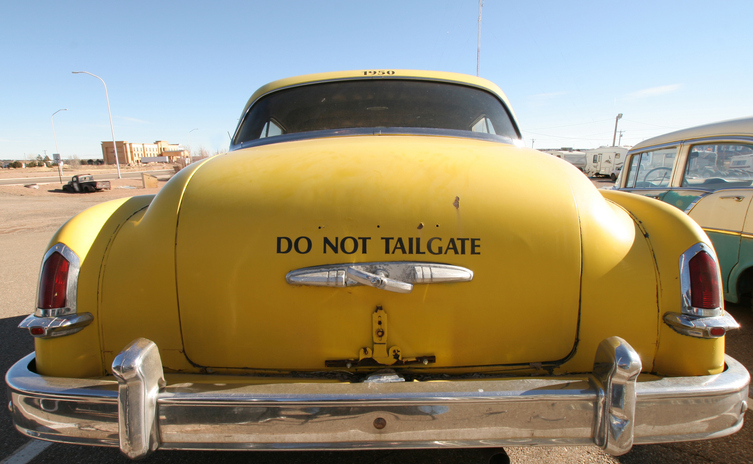
Stop Tailgaters Safely: Smart Driving Tips to Prevent Fort Myers Car Accidents
Fort Myers drivers see tailgating every day — on Cleveland Avenue, on Colonial Boulevard, on the stretch of I-75 near Alico Road where traffic stacks at rush hour, on Summerlin Road as it feeds beach traffic on the weekends. People want to know what to do in the moment, and they also want to know what happens legally if the worst occurs. Both are worth understanding before you need them.
What follows is the same plain-English explanation I give our clients when they sit down at our office. Florida law, what we actually see in cases, and what you can do behind the wheel so you do not end up as our next client.
What Florida law actually says about tailgating
Florida does not use the word tailgating in the statute book. The rule lives in section 316.0895 of the Florida Statutes, which tells drivers not to follow another vehicle more closely than is reasonable and prudent. Reasonable and prudent is a deliberately flexible phrase. It takes into account how fast traffic is moving, what the road surface looks like, and what the weather is doing. Five car lengths at forty miles an hour on dry pavement may be fine. The same five car lengths at seventy on wet pavement on I-75 is not.
For commercial trucks and vehicles towing trailers on rural roads, the statute sets a hard floor of 300 feet. Plain English: a tractor-trailer running behind another tractor-trailer south of Alico Road on the open highway has to keep about a football field between them.
Three other Florida statutes drive almost every rear-end case we handle. They are worth knowing before you ever need them.
- Section 768.81 — modified comparative negligence. Plain English: a jury assigns a percentage of fault to everyone involved. If you are more than 50 percent at fault, you recover nothing. If you are 30 percent at fault on a $100,000 verdict, you take home $70,000. The 50 percent bar came in with the 2023 reform.
- Section 95.11(4)(a) — the two-year deadline. Plain English: you have two years from the day of the crash to file suit. The same 2023 reform cut the old four-year window in half. Miss the date and the courthouse door closes.
- Section 627.736 — PIP coverage. Plain English: every Florida auto policy carries $10,000 of personal injury protection that pays your medical bills regardless of who caused the crash, as long as you see a doctor within fourteen days of the wreck.
- Section 627.727 — uninsured and underinsured motorist coverage. Plain English: if the driver who hit you has no insurance, too little insurance, or runs from the scene, your own UM policy pays for your injuries. Hit-and-run drivers are treated as uninsured under this statute.
Penalties for a Florida tailgating citation alone are modest. A non-criminal moving violation, a fine in the $60 range plus court costs, and points on your license. The real exposure is civil. A driver who has been cited for following too closely walks into a deposition with that ticket already in the file.
Six rear-end patterns we see on Fort Myers roads
If you handed me a stack of our rear-end files from the last year, almost all of them would fit one of these six patterns. None of them are unusual on Fort Myers roads.
- Stop-and-go congestion on Colonial Boulevard or Daniels Parkway. Driver behind looks down at a phone for three seconds, looks up, brake lights are already on, no time to react.
- Sudden tropical downpour on I-75 near Alico Road. Visibility drops to a few car lengths in under a minute. The driver behind never adjusted speed or following distance.
- Snowbird-season aggression on US-41. Out-of-state plates, unfamiliar driver, a half-mile of frustration, and a tap that turns into a six-figure injury.
- Construction-zone stacking on Six Mile Cypress Parkway and Cleveland Avenue. Speed limit drops, brake lights ripple back, the driver four cars deep does not look up in time.
- Beach-traffic squeeze on Summerlin Road and McGregor Boulevard. Heavy weekend volume, sudden pedestrian crossings, the car behind is following at suburban distances on a beach-traffic day.
- Hit-and-run rear-ends. A driver clips the back of a stopped car at a light, panics, and flees. We see this more often than the public realizes, especially on US-41 north of Page Field.
Three things that make rear-end cases tougher than people expect
People assume a rear-end case is automatic. The driver behind hit the driver in front. End of story. In practice, the case is rarely that simple.
The first complication is the brake-check defense. After the 2023 comparative-negligence reform, defense lawyers have a stronger reason to argue that the front driver hit the brakes for no good reason. If a jury puts even 20 or 30 percent of the fault on you, the case gets smaller. If they put you over 50 percent, the case disappears entirely. That is why what happened in the five seconds before impact matters so much more now than it did three years ago.
The second complication is the soft-tissue injury problem. A rear-end at twenty-five miles an hour can produce a chronic cervical strain that does not show up on an x-ray and does not announce itself for a day or two. Insurance carriers know this and routinely lowball cases where the property damage looks minor. We have learned, over a couple thousand of these files, that the medical documentation in the first thirty days drives the outcome more than almost anything else.
The third complication is identifying the driver. In a hit-and-run rear-end, the case is not over — it shifts. Section 627.727 lets you go after your own uninsured-motorist policy, but only if you have UM coverage and only if you reported the crash properly under section 316.066. The crash-report rule is not a technicality. It is often what makes or breaks the claim.
A Fort Myers client we represented
I think about this one often. A client of ours was sitting in stop-and-go traffic on US-41 in Fort Myers when a driver came in from behind, struck the back of the car hard enough to push it into the vehicle ahead, and then pulled around and kept going. By the time the deputies arrived, the other driver was long gone. No plate, no description beyond a general color.
Our client thought she was fine. She wasn’t. The neck pain showed up the next morning, the headaches started a few days after that, and by the end of the second week she could not turn her head to check a blind spot without flinching. The ER had documented a cervical strain. Her primary doctor sent her to physical therapy. Pain management got involved when the therapy alone wasn’t enough.
Because the other driver fled, this looked at first like a case with nowhere to go. It wasn’t. Her own auto policy had uninsured-motorist coverage, which under §627.727 covers hit-and-run drivers the same as drivers with no insurance at all. We pulled the medical records, documented the chronic strain and the ongoing treatment, and ultimately recovered the full policy limits for our client.
The takeaway from that file is simple. A rear-end by a driver who runs is not the end of the case. It is the beginning of a different case, run against your own carrier, and how the first thirty days are documented decides most of it.
What to do if a tailgater is on you right now
This is the list I give our clients and our own family. It is shorter than most lists you will see, because most of those lists are written by someone who has never sat with an injured person in a hospital room. Two things matter — get the tailgater out from behind you, and do not give the defense any ammunition for the brake-check argument.
- Move right. On a multi-lane road, signal and ease into the right lane. On a single-lane road, find a safe place to pull off — a turn lane, a shopping plaza, a wide shoulder. Having the aggressive driver in front of you is always safer than behind you.
- Do not brake-check. I have watched this single decision turn a routine ticket into a six-figure exposure for the front driver. Under the new 50-percent bar, a brake-check can wipe out your case.
- Open up the space ahead of you. If a tailgater is on you, you now need stopping distance for two cars instead of one. Drop back from the car in front. Three seconds becomes four. Four becomes five in rain.
- Signal earlier and longer than you normally would. Give the driver behind you more warning than they deserve. It is the cheapest insurance there is.
- If the driver is genuinely dangerous, call *FHP (star-FHP) or 911. Give the dispatcher the road, the direction, and the plate if you have it. The Florida Highway Patrol takes these calls seriously.
- If you are rear-ended, get checked the same day. Section 627.736 gives you fourteen days to see a doctor for PIP to apply, but the strongest cases are the ones where treatment starts the same day. A delay of even a week gives the carrier an argument that the injury came from something else.
One last practical recommendation. If you live in Lee County and you do not carry uninsured-motorist coverage on your auto policy, look at it again. The hit-and-run case I described above had a happy ending because the client had UM. Half of the rear-end clients who walk into our office do not realize they have it; the other half wish they had bought more of it.
Key Takeaways
- Florida law puts the burden on the driver behind. Section 316.0895 requires reasonable and prudent following distance, and rear-end fault almost always starts with the trailing driver.
- The 2023 reform raised the stakes for the front driver too. Under §768.81, if your share of fault tops 50 percent — including for a brake-check — you recover nothing.
- Two years, not four. Section 95.11(4)(a) gives you two years from the crash date to file suit on a Florida negligence claim. Mark the calendar the day of the wreck.
- Hit-and-run is not a dead end. Section 627.727 lets your own UM policy stand in for the driver who fled. Carry UM, and carry as much as you can afford.
- The first thirty days of medical care drive the case. See a doctor the same day. Keep every record. Tell every provider about every symptom, even the small ones.
Frequently Asked Questions
Q1. If someone tailgates me and I have to brake, am I at fault for the rear-end crash?
In almost every rear-end case in Florida, the following driver is presumed at fault. That presumption can be rebutted, but the driver behind has to do the rebutting with evidence. If you braked for a legitimate reason — debris on Daniels Parkway, a deer crossing on Summerlin, brake lights two cars ahead — and they hit you, the law starts on your side.
Q2. What does Florida Statute 316.0895 actually require?
Section 316.0895 tells drivers not to follow another vehicle more closely than is reasonable and prudent given the speed of traffic and the condition of the road. For trucks and trailers on rural roads, the statute sets a hard 300-foot minimum. Most tailgating cases turn on what reasonable and prudent meant at that speed and on that day.
Q3. How does Florida’s 2023 comparative negligence reform affect rear-end cases?
Under the revised §768.81, a plaintiff who is more than 50 percent at fault recovers nothing. In a rear-end case the front driver is usually well under that threshold, but defense lawyers now have a strong incentive to argue brake checking or sudden lane changes. That is why what you did in the seconds before impact matters so much now.
Q4. How long do I have to file a Florida rear-end injury claim?
Two years from the date of the crash under §95.11(4)(a), which was cut down from four years in the 2023 reform. Wrongful-death cases also run on a two-year clock. The shorter window catches a lot of injured Floridians off guard, so call early rather than late.
Q5. The driver who rear-ended me took off. Am I out of luck?
Not at all. Florida’s uninsured motorist coverage under §627.727 treats a hit-and-run driver as an uninsured driver, so your own UM policy can step in. We have recovered policy-limit settlements for clients who never learned the name of the person who hit them.
If a tailgater put you in the hospital, call our office
If you were rear-ended in Fort Myers, Bonita Springs, Naples, Estero, Cape Coral, or anywhere in Lee or Collier County, I would be glad to look at your case. Most of these files have more options than the client realizes, even when the other driver fled. There is no charge for the first conversation, and there is no fee unless we recover for you.
Call 239-992-8259 for a free consultation, or reach us through our contact page.
About the Author

David B. Pittman, Esq. is a thirty-plus-year personal injury attorney in Fort Myers and across Lee County and the founder of Pittman Law Firm, P.L., with a sustained focus on serious-injury auto and complex-liability cases. The firm’s Fort Myers presence handles a steady stream of serious-injury work along the Daniels Parkway, Six Mile Cypress, McGregor Boulevard, Cleveland Avenue, and Summerlin Road corridors, and along I-75 between Estero and Bell Tower.
David started at The Citadel, The Military College of South Carolina, then the University of South Carolina School of Law. He is AV-Preeminent at Martindale-Hubbell and a member of the Multi-Million Dollar Advocates Forum.
David has held a Florida real estate broker license for twenty-five years, a credential that shapes how the firm reads the property side of premises cases. The firm handles personal injury cases across Lee and Collier Counties, serving Fort Myers, Bonita Springs, Naples, Cape Coral, Estero, and Lehigh Acres, with offices at Windsor Place in Bonita Springs (main) and Fort Myers (satellite). Call 239-992-8259 for a free consultation.
This article is for general information only and does not constitute legal advice. Reading it does not create an attorney-client relationship with Pittman Law Firm, P.L. Each case turns on its own facts, and prior results do not guarantee a similar outcome. Attorney advertising.