

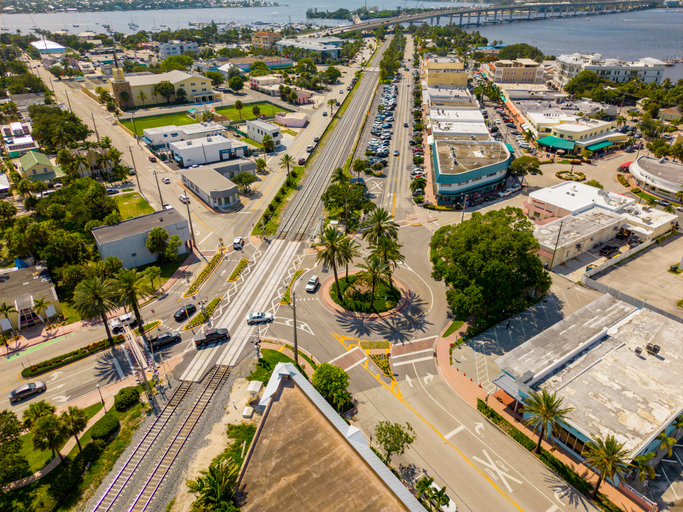
Top 5 Most Dangerous Intersections in Bonita Springs for Car Accidents
Our Windsor Place office sits on Bonita Beach Road, two minutes from US-41. I drive through or past most of these intersections on the way to the courthouse in Fort Myers. I know which corners generate calls because I hear about them every week — not because of a crash-data study, but because the same five intersections show up in our intake notes year after year.
The rankings do not change much. The roads get widened and signal timing gets adjusted, but the same intersections stay at the top because the underlying problems are population growth, seasonal traffic, and a road grid built for a smaller town than the one Bonita Springs has become.
The five intersections that keep generating the calls
Here are the five that come up most often in our intake notes, in roughly the order we see them. I am drawing on what walks through our door, on Florida Department of Highway Safety crash data we pull when we are working a case, and on what Bonita Springs police officers have told me in deposition and at the scene over the years.
- US-41 and Bonita Beach Road. The middle of town. Six lanes meet six lanes, with turn pockets that fill up fast on a Friday afternoon. Heavy left-turn volume off Bonita Beach Road westbound is where most of our broadside cases originate.
- Old 41 and Terry Street. The roundabout. A genuinely safer design than the old signalized intersection it replaced, but the learning curve has been steep, particularly for seasonal residents who hit it for the first time in November.
- US-41 and Corkscrew Road. A high-speed corridor pushing into a high-volume retail corner. Left-turn-across-traffic cases dominate here, and the speed differentials make the injuries worse than at slower intersections.
- US-41 and Williams Road. Smaller intersection, but it sees a disproportionate number of rear-end and angle crashes because of how traffic stacks up between signals on the US-41 corridor.
- US-41 and Estero Parkway. Technically the Bonita Springs/Estero line. Long signal cycles, lots of impatient drivers, and a steady volume of crashes that pulls our office north on a regular basis.
What Florida law actually says about intersection fault and recovery
Before I get into the specific intersections, it helps to lay out the legal framework, because almost every intersection case we handle turns on three or four Florida statutes.
Modified comparative negligence (§768.81). Since the 2023 tort reform, Florida is what lawyers call a modified comparative negligence state. If a jury or insurance adjuster finds you more than 50 percent at fault for the crash, you recover nothing. If you are 50 percent or less at fault, your recovery is reduced by your percentage of fault. Plain English: at a signalized intersection where two drivers each claim the green, the fault split is the whole ballgame. Five percentage points can be the difference between a meaningful settlement and a closed file. (§768.81, Fla. Stat.)
Two-year statute of limitations (§95.11(4)(a)). That same 2023 reform cut the negligence statute of limitations in half. Florida used to give you four years to file an intersection-crash lawsuit. Now you have two. We have already turned away callers who waited too long under the new clock because they assumed the old four-year rule still applied. It does not. (§95.11(4)(a), Fla. Stat.)
PIP and the no-fault $10,000 (§627.736). Personal Injury Protection is what Florida calls no-fault coverage. Your own auto policy pays the first $10,000 of medical bills and lost wages after a crash, regardless of who caused it, as long as you get to a doctor within fourteen days. The fourteen-day rule is unforgiving. Miss it, and the PIP carrier denies the bills. (§627.736, Fla. Stat.)
Uninsured motorist coverage (§627.727). Florida does not require drivers to carry bodily injury liability coverage. That sounds shocking the first time someone hears it, and then it makes sense when you remember how many uninsured drivers we have on our roads. UM is the coverage that protects you when the other driver has no insurance or not enough to cover your injuries. Stacking UM is one of the most important decisions a SWFL driver makes before a crash ever happens. (§627.727, Fla. Stat.)
The crash report requirement (§316.066). Florida law requires a long-form crash report any time there is injury, a vehicle has to be towed, or property damage looks like it will exceed $500. At the high-volume Bonita intersections we are talking about, almost every crash meets one of those thresholds. (§316.066, Fla. Stat.)
Five crash patterns at Bonita Springs intersections
If you grouped every Bonita Springs intersection case we have handled in the last decade, almost all of them fall into one of five patterns:
- Left-turn across traffic. The classic broadside. Driver A turns left on a yellow or stale green, Driver B comes through the intersection straight, and the impact lands on the passenger door. These are the worst injury cases at US-41 and Bonita Beach Road and at US-41 and Corkscrew Road because of the speeds involved.
- Rear-end at the signal. Lead car stops for the red, following car does not. We see a lot of these at US-41 and Williams Road, where traffic backs up between signals and the following driver assumes the lead car is going to keep moving.
- Roundabout entry. A driver entering the Old 41/Terry Street roundabout fails to yield to traffic already circulating. Some of these are seasonal-resident confusion, and some are locals who have decided the rules do not apply to them.
- Hit-and-run. Far more common than people realize on the US-41 corridor. Often a minor sideswipe that turns into a major problem because the at-fault driver leaves and the injured driver is left chasing a phantom. UM coverage is the answer.
- Pedestrian and bicycle. The hardest cases of all. The corridors off Old 41, Imperial Parkway, and the Bonita Beach Road school-zone stretch produce a steady stream of pedestrian and cyclist injuries, and the consequences are almost always severe.
Intersection cases — why these are harder than they look
People sometimes assume an intersection crash is a simple case. Two cars, one signal, somebody ran the light. In our experience, it is almost never that simple.
First, signal timing is contested. At a signalized intersection, the question of who had the green is rarely answered by an independent witness. Both drivers are equally sure they had the light. Without a video — and most Bonita Springs intersections do not have continuously recording cameras — the case turns on signal-timing data pulled from the Florida Department of Transportation controller, scene physics, and damage profile. That is engineering work, not lawyer work, and getting the right reconstruction engineer involved early matters more than most people understand.
Second, fault is rarely 100/0. The 2023 comparative negligence reform makes the percentage allocation matter more than it ever has. An insurance adjuster who can push the injured plaintiff to 51 percent at fault wipes out the claim entirely. We see adjusters reach for that 51 percent number on intersection cases more aggressively than on any other type of case we handle.
Third, the injuries lag. A cervical disc injury at 45 mph from a US-41 broadside often does not present at the scene. The adrenaline masks it. The client tells the responding officer they are fine, declines transport, goes home, and wakes up the next morning unable to turn their head. By then the official crash report says “no injuries reported,” and the carrier uses that report against the claim for the next two years. Going to the emergency room or to an urgent care after a crash, even when you feel okay, is not overreacting. It is protecting the record.
Fourth, the medical authorization fights start fast. Once a claim is opened, the at-fault carrier sends a broad medical-release form asking for years of prior records. We almost never sign those as drafted. The carrier is allowed to see what is relevant to the crash injury, not your entire medical history.
A child-pedestrian intersection case from early in my career
One of the cases I think about often from earlier in my career involved a six-year-old boy who chased a ball into the road. He was hit hard enough that he flew across the road, out of his shoes, and landed on his head. He was in the hospital for months and came out with moderate, permanent brain damage. His mom was a single parent. There was no second household to lean on.
I would go to the hospital to see him. Sometimes we brought food, because his mother was not in a place to think about cooking. That is not a billable thing. It is just what you do when a family is going through something like that and you are the lawyers who answered the phone.
The case settled at the at-fault driver’s policy limit. Because the client was a minor, the settlement had to go through what Florida calls a minor-court settlement — a judge has to review and approve the deal, and the money goes into a court-supervised account that the child cannot touch until they turn eighteen. That structure exists to protect kids from settlements being spent before they are old enough to make decisions about them. In this case, it worked exactly the way it was supposed to. When the boy turned eighteen, the now-young-man had enough in that account to pay for college and get a real start in life. He did.
That case has shaped how I look at every child-injury intersection call we get. The legal mechanics — Florida’s Rule of 6, which says a jury is not allowed to assign any percentage of fault to a child under six; the minor-court approval process; the structured payout — are the framework. But the framework only matters if somebody is willing to stay close to the family for the years it takes to see one of these cases through. That part is not in the statute book.
What to do if you are in a crash at one of these intersections
Some of this is generic advice you have read a hundred times. Some of it is specific to the Bonita Springs intersections I have been describing and to what we have watched go wrong in cases we later took over from other firms.
- Call 911, even if it seems minor. The crash report is the foundation of the claim. At a busy intersection like US-41 and Bonita Beach Road, the responding officer often does not arrive for thirty or forty minutes. Wait for them anyway.
- Take wide photos before the cars are moved. Not just the dents. The lane positions. The signal head. The skid marks. The debris field. Three or four photos from twenty feet back are worth more than twenty photos of the bumper.
- Get the other driver’s insurance card photo, not just the policy number. Coverage gets misquoted at the scene more often than you would think. A photo of the card resolves the dispute later.
- Get to a doctor within fourteen days. PIP requires it. Even if you are not sure you are hurt, an urgent care or ER visit inside that window preserves the coverage. After day fourteen, the PIP carrier can deny the bills entirely.
- Do not give a recorded statement to the other driver’s insurer. You are not required to. They will call within forty-eight hours and ask “just to clear up a few details.” Politely decline. Let your own carrier handle their side of the communication, or let your lawyer.
- Save the dashcam footage immediately. If you have a dashcam, pull the SD card and back the file up to a second device that day. Dashcams overwrite themselves on a loop, and the most useful piece of evidence in your case can vanish in seventy-two hours.
- Write down what you remember that night. Direction of travel, signal color, the other car’s lane, what the other driver said at the scene. By week three the details start to blur. A contemporaneous note in your own handwriting holds up better than a deposition recollection eighteen months later.
Key Takeaways
- The same five Bonita Springs intersections — US-41 and Bonita Beach Road, Old 41 and Terry, US-41 and Corkscrew, US-41 and Williams, and US-41 and Estero Parkway — generate most of the serious-injury calls our office takes.
- Florida’s 2023 modified comparative negligence rule under §768.81 means any plaintiff found more than 50 percent at fault recovers nothing. On intersection cases, the percentage split is often the whole case.
- The statute of limitations for a negligence claim is now two years under §95.11(4)(a), not the old four years. The new clock is unforgiving.
- PIP covers the first $10,000 of medical and lost wages under §627.736, but only if you see a doctor within fourteen days. UM coverage under §627.727 is what protects you when the other driver has no insurance or not enough.
- Signal timing, fault percentage, and delayed-onset injuries are the three places intersection cases most often go sideways. Photos at the scene, a same-day medical visit, and a written note that night make all three harder for the carrier to dispute.
Frequently Asked Questions
Q: Which Bonita Springs intersection produces the most calls to your office?
A: US-41 and Bonita Beach Road generates more crash calls than any other single intersection in our service area. Old 41 and Terry Street is a close second since the roundabout reconfiguration confused a lot of seasonal drivers, and the Corkscrew Road corridor produces a steady stream of serious cases.
Q: If I am partly at fault for a Bonita Springs intersection crash, can I still recover?
A: Yes, if you are 50 percent or less at fault. Florida’s 2023 modified comparative negligence rule under §768.81 says any plaintiff found more than 50 percent at fault recovers nothing, and a plaintiff found 50 percent or less at fault has their recovery reduced by that percentage. Intersection cases often turn on small percentage swings, so the fault analysis matters a great deal.
Q: How long do I have to file a claim after a crash at one of these intersections?
A: Two years from the date of the crash, in most cases. The 2023 tort reform cut Florida’s negligence statute of limitations under §95.11(4)(a) from four years to two. Wrongful death claims are also generally two years. Waiting is the single most common avoidable mistake we see.
Q: Do I have to call the police if the crash seems minor?
A: If anyone is hurt, if a vehicle has to be towed, or if property damage looks like it will exceed $500, Florida law under §316.066 requires a crash report. At a busy intersection like US-41 and Bonita Beach Road we always recommend calling, because injuries that feel like soreness at the scene often turn out to be cervical or lumbar disc injuries by the next morning.
Q: What if the other driver has no insurance or not enough?
A: Your own uninsured/underinsured motorist coverage under §627.727 stacks on top of the other driver’s policy. PIP under §627.736 also pays the first $10,000 of medical and lost wages regardless of fault. Hit-and-run crashes at the US-41 corridor intersections are common enough that we strongly recommend carrying UM coverage.
Talk to our office
If you or someone in your family was hurt at one of these Bonita Springs intersections — or any other corner on the US-41 corridor, Imperial Parkway, or Old 41 — our office is two minutes from most of them. Call 239-992-8259 for a free consultation. There is no fee unless we recover for you. I take the call ourselves when we can, and when we cannot, somebody from our office will get back to you the same day.
About the Author

Since founding Pittman Law Firm, P.L., David B. Pittman, Esq. has spent more than thirty years representing injured clients from the firm’s Windsor Place office on Bonita Beach Road, with a sustained focus on serious-injury auto and complex-liability cases. Bonita Springs is home for the firm, and most of its child-pedestrian, premises, and family-injury cases come from the residential corridors off Old 41 and Imperial Parkway, the school zones around the Bonita Beach Road corridor, and the surrounding Lee County neighborhoods near Pelican Landing, Bonita Bay, and Spanish Wells.
His education: The Citadel, The Military College of South Carolina, followed by the University of South Carolina School of Law. His honors: AV-Preeminent at Martindale-Hubbell, and membership in the Multi-Million Dollar Advocates Forum.
David has held a Florida real estate broker license for twenty-five years, a credential that shapes how the firm reads the property side of premises cases. The firm handles personal injury cases across Lee and Collier Counties, serving Fort Myers, Bonita Springs, Naples, Cape Coral, Estero, and Lehigh Acres, with offices at Windsor Place in Bonita Springs (main) and Fort Myers (satellite). Call 239-992-8259 for a free consultation.
Attorney advertising. The information in this article is general and is not legal advice for any particular case. Reading this article does not create an attorney-client relationship with Pittman Law Firm, P.L. Past results do not guarantee a similar outcome in any future case. For advice about your situation, contact our office directly.