

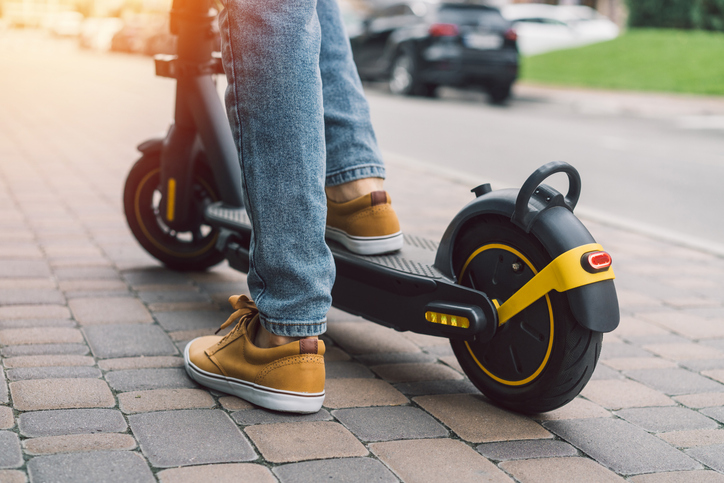
The Dangers of Micromobility: Florida Electric Scooter Laws You Must Know
Two calls come into our office about e-scooters, and they sound nothing alike. The first is a parent asking whether their college student needs a license to ride one outside downtown Fort Myers. The second is a call we get about a week after the crash, from a rider whose hospital bill is already past twenty thousand dollars and whose own car insurance company just said the scooter is not covered. The first caller has not been hurt yet. The second has, and the gap between what they assumed the law said and what it actually says is costing them real money.
Micromobility has spread fast in Southwest Florida — scooters lined up outside hotels on US-41, clusters near downtown Fort Myers offices, riders on the shoulder of Bonita Beach Road on Saturday mornings. The legal framework has not kept pace. Florida wrote the core scooter statute years ago, the cities have layered their own rules on top, and the insurance industry has spent the last few years writing scooter use out of one policy after another. The result is a gap, and riders fall into it every week. What follows is what Florida law actually says, the scenarios our office sees most often, and the practical steps that protect a rider when a ride goes wrong.
What Florida law actually says about e-scooters
Florida Statute 316.003 defines a motorized scooter as a vehicle that has no seat, has no more than three wheels, and cannot exceed twenty miles per hour on level ground. If your scooter has a seat or breaks twenty miles per hour, the law treats it as something else, usually a moped or a low-speed vehicle, and the rules change completely. The first question I ask any rider who calls us is what the scooter looked like and how fast it went. The answer routes the entire case.
Florida Statute 316.2128 is the operating rule. It treats scooter riders the way it treats cyclists. That means a scooter rider has the rights and duties of a vehicle on the road. You yield to pedestrians. You obey traffic signals. You can be cited for running a red light the same way a car can. In plain English, the scooter is a vehicle when it is convenient for the driver who hit you and a toy when it is convenient for the insurance company writing the check. Our job is to make sure it is treated as a vehicle when that helps the injured client.
Florida Statute 316.008 hands sidewalk and pilot-program authority to the cities and counties. That is why the rules change every few miles. Fort Myers Beach has taken a hard line, the City of Fort Myers has run pilot programs through specific operators, and Naples has its own ordinances for the Fifth Avenue corridor. There is no statewide answer to where you can legally ride. There is only a local answer.
Two more numbers matter. Riders under sixteen must wear a helmet under 316.2128(3). And the 2023 amendment to Florida’s comparative fault statute, 768.81, changed the math on every scooter case in this state. Before 2023, a rider who was sixty percent at fault could still recover forty percent of the damages. After the 2023 amendment, a rider who is more than fifty percent at fault recovers nothing. Anyone who tells you a scooter case is a slam dunk has not read that statute.
Five scooter crash patterns our office handles in Lee and Collier Counties
Across three decades of injury work in Lee and Collier Counties, I can tell you that most micromobility cases fall into one of five patterns. Knowing which pattern you are in changes the strategy.
- Driveway and parking-lot strikes. A car pulls out of a strip-mall driveway on US-41 or Tamiami Trail and clips a scooter rider on the sidewalk. The driver almost never sees the scooter because scooters move faster than pedestrians and arrive in the driver’s peripheral vision a second sooner. Liability usually sits with the driver, but the comparative-fault argument is always about speed.
- Door-opening collisions. A scooter is riding the bike lane or the road shoulder, a parked driver opens a door, the rider goes over the bars. Florida Statute 316.2005 puts the duty on the person opening the door. Most insurance adjusters do not know that statute exists.
- Defective-equipment crashes. Brakes that did not grab. A throttle that stuck. A wheel that locked at speed. These are product-liability cases against the manufacturer or the rental operator. They are the hardest scooter cases to prove because the scooter often disappears back into the rental fleet before anyone can inspect it.
- Pavement and pothole cases. A rider hits a pothole on a Lee County road, a torn-up section of sidewalk in Bonita Springs, or a piece of road debris on I-75. Sovereign-immunity rules under Section 768.28 cap claims against a government and add notice requirements with hard deadlines. Miss the notice deadline and the case is over.
- Private-community and golf-cart-overlap cases. Inside a gated community, the rules of the road do not always apply the same way. The community has its own safety standards, the homeowner association has its own duty, and the driver of the scooter or cart has personal liability that is rarely insured the way a car driver’s liability is insured.
Three reasons scooter claims are harder to win than they look
Scooter cases look simple on the surface and almost never are. Three things make them difficult.
First, the coverage problem. A standard Florida auto policy generally excludes vehicles with fewer than four wheels unless the policy was specifically endorsed for scooters or motorcycles. A homeowners policy almost always excludes injuries arising out of the use of a motorized vehicle. When the rider is hit by a car, the car’s bodily injury liability coverage applies, and that is usually the main source of recovery. When the rider falls on a defective scooter, finding insurance is a scavenger hunt through rental agreements, manufacturer policies, and umbrella coverage. We have had cases where the actual recovery came from a piece of paper nobody else thought to read.
Second, the arbitration and waiver problem. Every rental scooter app makes the rider click through an arbitration clause and a liability waiver before the first ride. Florida courts have been mixed on enforcing these waivers, especially when the claim is for gross negligence or for a defective product rather than an ordinary rider error. The arbitration clause is the one that more often holds up. We read the click-through agreement on every rental case before we file anything.
Third, the comparative-fault problem. Defense lawyers in scooter cases will push every percentage point of fault onto the rider. Was the rider on the sidewalk where the ordinance prohibited it? Was the rider wearing earbuds? Was the rider on a phone? Had the rider been drinking? Under the 2023 amendment to Section 768.81, every percentage point past fifty wipes the entire case out. That is why the documentation in the first forty-eight hours after a crash matters so much, and why the cases that come to us late are harder to win than the cases that come to us early.
Why private-community scooter and cart cases are their own category — a Pelican Landing example
A case I think about often involved a scooter-adjacent fact pattern inside a gated community in Bonita Springs. Our client was a passenger in a golf cart inside Pelican Landing. The driver took a sharp interior turn too quickly and ejected our client onto a concrete pad. The injuries were severe. A pelvic fracture and a subdural hematoma, which is a bleed on the surface of the brain. The client spent time in the ICU and then several months in assisted living during recovery.
The case was difficult because the driver was a personal friend of the client. Almost nobody wants to sue a friend. What we explained, and what is true in most of these intra-community cases, is that the lawsuit is really against the friend’s personal liability coverage, not the friend personally. Once that was clear, the client could move forward.
The harder layer was the community’s own standards for cart operation. Communities like Pelican Landing publish rules on cart speed, on permitted operators, on the obligations of the operator toward passengers. Those rules are not just decorations. They establish the standard of care, and a deviation from them is evidence of negligence.
The reason I tell this story in an e-scooter article is that the legal mechanics are nearly identical. Inside a private community, on a scooter or a cart, the case turns on personal liability coverage and on the community’s published safety standards. Riders and their families almost never think of those two layers until after the fact.
What to do if you are hurt on an e-scooter
I have walked dozens of riders through the first week after a scooter crash, and the steps below are the ones I have seen actually change outcomes. They are not a generic checklist.
- Photograph the scooter before it leaves the scene. If you are conscious, get the serial number and the rental QR code. Rental fleets cycle equipment in and out fast. The scooter you rode today may be three counties away by Friday.
- Pull the ride log from the app, then screenshot it. The app stores the ride start time, the speed log, and the location pings. Rental operators sometimes purge that data after a complaint. A screenshot saved to your own phone the day of the crash is evidence nobody can erase.
- Ask the ER specifically to image your head, even if you walked in. I have seen too many subdural hematomas missed on initial visits because the rider seemed alert and oriented. A head CT in the first six hours is cheap insurance.
- Do not give a recorded statement to the at-fault driver’s insurance carrier. Adjusters call within forty-eight hours. They are friendly. They are not on your side. Tell them you will call back through your attorney, then call us.
- Save the gear. Helmet, shoes, the clothes you were wearing. If the helmet cracked, the helmet is the single best piece of physical evidence for a head injury claim. Do not throw it out.
- Check every policy in your household. Auto policies, umbrella policies, the homeowners policy, any uninsured-motorist coverage you carry. We have found coverage in policies clients did not realize would apply.
Key Takeaways
- Florida Statute 316.2128 treats e-scooter riders the same as cyclists. No license, no registration, no insurance required at the state level, but riders under sixteen must wear a helmet.
- Local ordinances across Lee and Collier Counties decide where you can ride. Bonita Springs, Fort Myers, Fort Myers Beach, and Naples each handle sidewalks and pilot programs differently. Check the city, not the state.
- The 2023 amendment to Section 768.81 means a rider who is more than fifty percent at fault recovers nothing. Comparative fault is the single most contested issue in any scooter case.
- Standard auto and homeowners policies often exclude scooter injuries. The recovery usually comes from the at-fault driver’s bodily injury liability coverage, a product-liability claim against the manufacturer or rental operator, or an umbrella policy nobody initially noticed.
- Evidence dies fast in scooter cases. Photograph the scooter, screenshot the ride log, image your head at the ER, save the helmet, and call a lawyer before you call the other driver’s insurance carrier.
Frequently Asked Questions
Q1. Do I need a driver’s license or insurance to ride an e-scooter in Florida? Florida Statute 316.2128 does not require a driver’s license, registration, or insurance to operate a motorized scooter that tops out at twenty miles per hour on level ground. Riders under sixteen must wear a helmet. The bigger problem is what happens when you get hurt, because most personal auto policies treat scooter injuries differently than car injuries, and many homeowners policies carve scooter use out entirely.
Q2. Can I ride my e-scooter on the sidewalk in Bonita Springs or Fort Myers? It depends on the city block. Florida law lets local governments set their own sidewalk rules under Section 316.008, and each municipality across Lee and Collier Counties handles it differently. Downtown Fort Myers, parts of Bonita Springs near Old 41, and the Naples Fifth Avenue South corridor each have their own ordinances. Check the city’s code before you ride, not after.
Q3. If a car hits me while I am on an e-scooter, can I recover from the driver’s insurance? Yes, generally. The driver’s bodily injury liability coverage applies to a scooter rider the same way it applies to a pedestrian or cyclist. Florida’s comparative fault rule (Section 768.81, as amended in 2023) means your recovery is reduced by your share of fault, and if a jury finds you more than fifty percent at fault, you recover nothing. That fifty-percent line is the single most important number in any scooter case.
Q4. What if the e-scooter itself was defective? Brake failures, throttle sticking, and battery fires happen, and product liability law in Florida lets an injured rider pursue the manufacturer, the rental company, or the maintenance contractor. The rental apps generally make you click through an arbitration agreement and a liability waiver before your first ride. Those waivers are not always enforceable, especially against a gross negligence claim, but the language matters and a lawyer needs to read it.
Q5. I was riding after a few drinks. Does that kill my case? Not automatically. Florida does not have a DUI statute that cleanly covers e-scooters, but a defense lawyer will still try to use alcohol against you on comparative fault. We have represented riders who were partially impaired and still recovered, because the driver who hit them was more at fault. the answer is that drinking complicates the case, it does not always end it.
Talk to our firm before you talk to the insurance carrier
If you or someone in your family has been hurt on an e-scooter, a rental scooter, an e-bike, or inside a community on a cart, call our office before the at-fault driver’s adjuster calls you. The first forty-eight hours decide most of what happens later. I have been doing this work in Bonita Springs, Fort Myers, Naples, Estero, Cape Coral, and Lehigh Acres for a long time, and the consultation is free. Call 239-992-8259. There is no fee unless we recover for you.
About the Author

Pittman Law Firm, P.L. is led by founder David B. Pittman, Esq., who has practiced personal injury law across Southwest Florida for more than thirty years. The firm represents injured clients across Lee and Collier Counties from the firm’s main office at Windsor Place on Bonita Beach Road through Fort Myers, Naples, Estero, Cape Coral, and Lehigh Acres, with a particular focus on commercial-vehicle, complex-liability, and serious-injury cases.
David’s undergraduate years were at The Citadel, The Military College of South Carolina, and his legal education was at the University of South Carolina School of Law. He is AV-Preeminent rated at Martindale-Hubbell and a member of the Multi-Million Dollar Advocates Forum.
David has held a Florida real estate broker license for twenty-five years. That background shapes how the firm reads premises-liability questions in private communities — from golf-cart-path safety standards inside gated neighborhoods like Pelican Landing to the duty obligations of homeowner associations across Bonita Springs and Estero. Call 239-992-8259 for a free consultation. Offices at Windsor Place in Bonita Springs (main) and Fort Myers (satellite).
The information on this website is for general information purposes only. Nothing on this site should be taken as legal advice for any individual case or situation. This information is not intended to create, and receipt or viewing does not constitute, an attorney-client relationship with Pittman Law Firm, P.L. This is attorney advertising.