

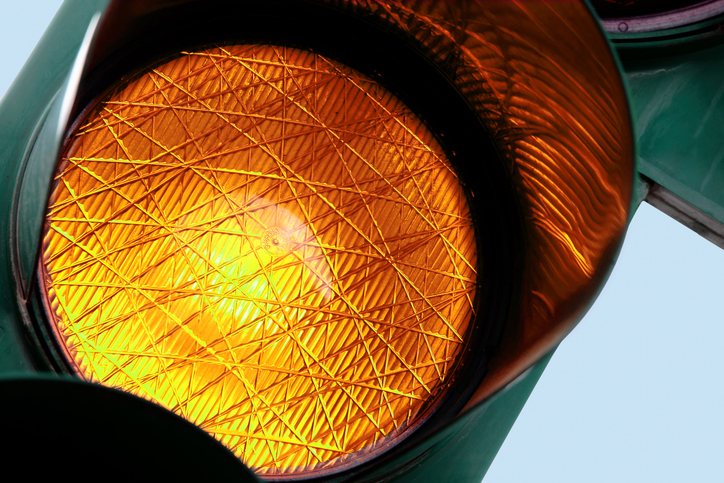
Is Running a Yellow Light in Southwest Florida Legal?
People want a clean yes or no on the yellow-light rule, and Florida law does not quite give them one. What follows is the answer I give friends, family, and clients who call our office in Bonita Springs after an intersection wreck on US-41 or somewhere along the I-75 corridor. The short answer is that yes, running a yellow is generally legal in Florida. The longer answer — the one that decides whether you recover for an injury or end up paying for someone else’s — has more moving parts.
Yellow-light crashes are usually settled in the gray inch between what is legal and what is reasonable. Both matter, and after thirty years of injury practice across Lee and Collier Counties, I can tell you the cases turn on timing, speed, and sight lines — not on the statute alone.
What Florida Law Actually Says About Yellow Lights
Florida is what traffic engineers call a permissive yellow state. The rule sits in Chapter 316 of the Florida Statutes, our uniform traffic control law. A steady yellow signal is a warning that the red is coming. It is not, by itself, a command to stop. If your vehicle enters the intersection while the light is yellow, you have not run the light, even if it turns red before you clear the far side.
Plain English: the question is where your front bumper crossed the stop line, not where it was when the light finally turned red. That is the entire pivot of these cases.
Two other statutes show up in almost every yellow-light crash file we open:
- Florida’s modified comparative negligence rule — §768.81, Fla. Stat. After the 2023 tort reform, a driver found more than 50% at fault for a crash recovers nothing. At exactly 50% or less, your recovery is reduced by your share. So even if the other driver clearly ran red, if a jury thinks you sped up to beat the yellow and contributed half the harm, the math can wipe you out.
- Two-year statute of limitations — §95.11(4)(a). The same 2023 reform cut the window for most negligence claims from four years to two. People still call us thinking they have four. They do not.
- Crash report — §316.066. If anyone is hurt, anyone is killed, or property damage looks like $500 or more, a written report is required. Call law enforcement at the scene. Do not let the other driver talk you into a private exchange of numbers.
- PIP medical — §627.736. Florida is a no-fault state for the first $10,000 of medical bills. To keep that benefit, you have to see a doctor within fourteen days. Miss that window and you can lose the PIP coverage entirely.
The Yellow-Light Scenarios We Actually See
Here is the part you do not get from a statute book. After three decades of these cases, the same handful of fact patterns repeats. When a yellow-light crash comes through our office, it almost always sits in one of five buckets:
- The late-yellow gambler. Driver sees yellow, calculates they can make it, hits the gas, and crosses the stop line a beat after red. They are now a red-light runner under Florida law. Camera footage from a nearby business often tells the story.
- The hard-brake rear-ender. Driver decides at the last second to stop on yellow and the car behind, expecting them to go, rear-ends them. Yellow-light decisions cause rear-end crashes far more often than people realize.
- The left-turn yellow. A driver waiting in the intersection for a gap turns on yellow without yielding to oncoming traffic that also has a yellow and is closing the intersection. The left-turning driver almost always carries the larger share of fault.
- The pedestrian in the crosswalk. Driver legally enters on yellow but is so focused on the signal head that they miss the person already in the crosswalk on the far side. Legal entry does not erase the duty to yield to people on foot.
- The commercial vehicle with sight-line issues. Box trucks, dump trucks, construction equipment. The operator did not have a clean view of the intersection, did not slow appropriately on the yellow, and the cab geometry hid a vehicle, a cyclist, or a pedestrian. These cases tend to be the most serious by injury severity.
If you live anywhere in Southwest Florida — Bonita Springs, Fort Myers, Naples, Estero, or further out toward Cape Coral and Lehigh Acres — you have driven through every one of these intersections. Pine Ridge and Goodlette in Naples. Daniels and Six Mile Cypress in Fort Myers. Bonita Beach Road and Old 41 right outside our office. The five patterns hold.
Yellow-Light Crashes — Why These Cases Are Harder Than They Look
People assume a yellow-light file is simple because the answer to “was it legal?” is usually yes. That is exactly why these cases are harder than they look.
The fight is rarely over the statute. It is over the timing, the speed, and what the driver could see. Three things tend to drive the outcome:
Timing. A signal cycle in Florida usually allots three to six seconds for yellow, depending on the speed limit at the approach. We pull signal timing data from the county or the Florida Department of Transportation early in the file. If the yellow ran short, that changes everything about who is responsible.
Speed. A driver legally entering on yellow at 35 mph is one case. A driver crossing the stop line at 52 mph in a 35 zone — even if technically still on yellow — is a different case. Reckless driving and “legal entry” can live in the same intersection. We bring in a reconstruction engineer when the speed question matters, which it usually does.
Sight lines. Especially in commercial-vehicle cases. The operator’s cab height, their mirror coverage, whether a spotter was present on a job site, whether the company trained the driver on intersection blind spots. The duty of care is not just on the driver — it runs back to the company that put that driver behind the wheel.
Then comes the comparative-fault pressure. Insurance carriers know the 2023 reform gave them a real weapon. If they can move a jury to 51% on you, you walk away with nothing. Every yellow-light defense I have seen since 2023 leans on that math. Our job is to keep your share at zero or as close to it as the evidence allows.
What operator duty looks like in a serious case
A Bonita Springs woman, on foot, was crossing through a work zone when a backhoe rolled over her. The operator was a commercial driver running heavy equipment on a job site. He did not check his blind spots. There was no ground spotter assigned to that movement. By the time he realized what had happened, the damage to her lower extremities was catastrophic — crushing injuries that put her through a series of emergency surgeries, internal fixation with rods and screws, and many months of focused wound care after that.
The carrier wanted to treat it as a one-off operator mistake. We did not see it that way. On the legal side, we built the file around the construction company’s own failures. Their safety manual called for a spotter on backhoe movements in pedestrian areas. They did not have one that day. Their operator-training records had gaps. The duty of care a contractor owes to people on foot inside a work zone is not optional.
The case resolved in the low seven figures. Money does not undo what a backhoe does to a human leg. What it does is fund the next round of care, replace lost income, and put a family in a position to plan rather than panic. That is the work, and it is a privilege to do it.
What to Do If You Are in a Yellow-Light Crash
I have walked a lot of clients through the day-after-the-crash phone call. The steps below are not a checklist I copied off the internet. They are what I have learned actually matters when an intersection case comes through our office.
- Photograph the signal head from the driver’s seat angle. Most people photograph their car damage and stop. Take three or four shots of the actual traffic light from where your eyes were. Time-stamped photos help us match the signal phase to the second of the crash.
- Walk the corners and look for cameras. Gas station canopies, drive-throughs, banks, school zones. Note which businesses are on each corner. Surveillance video at most retail locations overwrites in 7 to 30 days. We send preservation letters within the first week. If you wait a month, the footage is gone.
- Get the dashcam, even if it is the other driver’s. If a passing motorist stops to help, ask whether they had a dashcam running. Get the phone number on a piece of paper. I have had dashcam footage from a Good Samaritan two cars back decide an entire case.
- See a doctor inside fourteen days. PIP requires it under §627.736. Even if you feel “shaken but okay,” go. Adrenaline hides soft-tissue and head injuries for days. The medical record from that first visit anchors the whole claim.
- Do not give the other carrier a recorded statement. Their adjuster will call quickly and pleasantly. Politely decline until you have spoken with an attorney. A recorded statement given before you have read the police report or seen your own MRI can be replayed against you in negotiation a year later.
- Save the crash report number. Officers will give you a sheet with an exchange-of-information form and a case number. The full §316.066 report usually posts within 7 to 10 days through FLHSMV. Pull it. Read it. Mistakes on these reports happen, and they can be amended.
Key Takeaways
- Florida is a permissive yellow state — entering an intersection on yellow is legal, even if the light turns red before you cross the far side.
- Legal entry on yellow does not mean you cannot be assigned fault. Speeding, hard braking, or missing a pedestrian can still put you on the hook.
- Under §768.81 (2023 reform), being more than 50% at fault in Florida means zero recovery. The math punishes both drivers in close cases.
- The negligence statute of limitations is now two years under §95.11(4)(a) — not the old four. Do not sit on a claim.
- Signal timing data, intersection camera footage, and reconstruction work — not the statute alone — usually decide who pays.
Frequently Asked Questions
Is it actually legal to enter an intersection on yellow in Florida?
Yes. Florida follows a permissive yellow rule. If your vehicle enters the intersection while the light is still yellow, you have not run the light, even if it turns red while you are crossing. The trouble starts when any part of your car crosses the stop line after red has already taken over.
Can I still be at fault for a crash if I entered legally on yellow?
Yes. Legal entry on yellow does not eliminate a duty of reasonable care. If you accelerated hard, ignored a pedestrian, or could not stop because you were following too close, a jury can still assign you a share of fault under Florida’s modified comparative negligence statute, §768.81.
What does the 50% bar under §768.81 mean for my case?
After the 2023 tort reform, a person found more than 50% at fault for a crash in Florida recovers nothing. At exactly 50% or less, recovery is reduced by your percentage. That math matters in yellow-light cases because the other driver will often argue you punched through when you should have stopped.
How long do I have to file a claim after a Southwest Florida intersection crash?
For most negligence claims, two years from the date of the crash under §95.11(4)(a). The old four-year window was cut in half by the 2023 reform. Wrongful death is also two years. PIP medical paperwork has its own shorter clock — usually 14 days to see a doctor under §627.736.
Do I have to file a crash report after a yellow-light accident?
Under §316.066, a written report is required when there is an injury, a death, or property damage that appears to be $500 or more. Call law enforcement at the scene. The officer’s report is one of the first documents we read when we open a file.
Talk to Our Office
If you were hit at an intersection anywhere in Lee or Collier County — Bonita Springs, Fort Myers, Naples, Estero, Cape Coral, or Lehigh Acres — and the carrier is already pushing a yellow-light story onto you, call our office before you sign or say anything. Consultations are free. There is no fee unless we recover for you.
Pittman Law Firm, P.L. — 239-992-8259. Windsor Place, 3525 Bonita Beach Rd, Suite 107, Bonita Springs, FL 34134. You can also reach us through our contact page.
About the Author

Pittman Law Firm, P.L. — a personal injury practice that has operated across Southwest Florida for more than thirty years — is led by founder David B. Pittman, Esq. The firm represents injured clients across Lee and Collier Counties — from the firm’s main office at Windsor Place on Bonita Beach Road through Fort Myers, Naples, Estero, Cape Coral, and Lehigh Acres — with a particular focus on commercial-vehicle, complex-liability, and serious-injury cases.
David started at The Citadel, The Military College of South Carolina, then the University of South Carolina School of Law. He is AV-Preeminent at Martindale-Hubbell and a member of the Multi-Million Dollar Advocates Forum.
David has held a Florida real estate broker license for twenty-five years, a credential that shapes how the firm reads the property side of premises cases. The firm handles personal injury cases across Lee and Collier Counties, serving Fort Myers, Bonita Springs, Naples, Cape Coral, Estero, and Lehigh Acres, with offices at Windsor Place in Bonita Springs (main) and Fort Myers (satellite). Call 239-992-8259 for a free consultation.
The information on this website is for general information purposes only. Nothing on this page is legal advice for any particular case or situation. Reading this page does not create an attorney-client relationship with Pittman Law Firm, P.L. This is attorney advertising.