

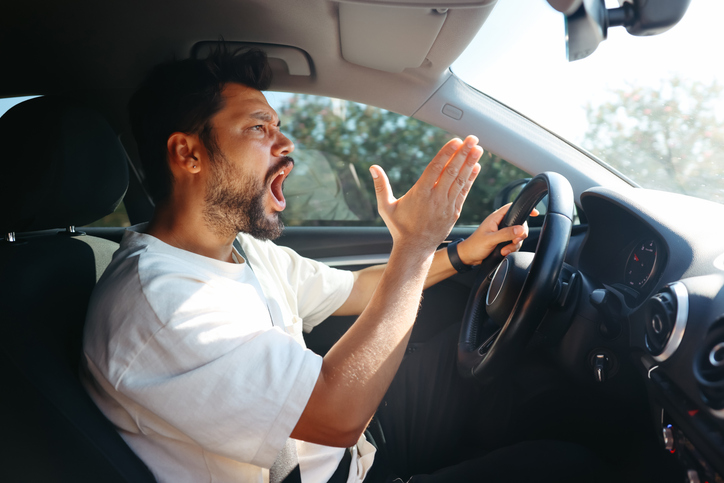
How to Stay Safe When an Aggressive Driver Confronts You at a Fort Myers Accident Scene
Picture it: the crash has just happened on Colonial Boulevard, you are still gripping the wheel, and before you have even checked yourself for injuries the driver of the other vehicle is out of his truck and walking hard toward your window. That moment — not the wreck itself — is what ends up in the police report, the deposition, and sometimes the ER. In three decades of representing crash victims in Lee and Collier Counties, I can tell you the seconds right after a crash are where people get hurt twice.
This piece is the answer I give in our office, written down. It is what I tell clients to do, what the Florida statutes actually require of you, and how aggressive-driver behavior plays out in a real injury claim after the dust settles.
What Florida law actually says about your duties at the scene
Before any de-escalation talk, you need to know what the state requires of you. Two statutes do most of the work.
Florida Statute §316.066 — the crash report requirement. If the wreck caused injury, death, or apparent property damage at or above the statutory threshold, a long-form report by a law enforcement officer is mandatory. Plain English: if anyone is hurt or a vehicle is more than scuffed, you call the police and you wait. You do not negotiate “let’s just exchange info and move on” with an angry stranger at the side of Cleveland Avenue. The statute tells you what to do, and the statute wins.
Florida Statute §768.81 — modified comparative negligence. After the 2023 reform, an injured plaintiff in Florida recovers nothing if a jury assigns him more than 50 percent of the fault. Plain English: if you got out of your car and threw the first punch, even a sympathetic injury claim against an aggressive driver can collapse. The defense lawyer will play your conduct back to the jury frame by frame. Keep your hands at ten and two, your seatbelt on, and your mouth closed.
Two other statutes belong in the conversation because they decide who pays for what afterward. §627.736 is Florida’s PIP statute, the $10,000 no-fault medical pot that follows your tag. §627.727 is uninsured-motorist coverage, the layer that matters most when the angry driver turns out to have no insurance, which we see more often than people would guess. And under §95.11(4)(a), the clock to file suit on a negligence claim is now two years, not four. People still walk into our office at month thirty thinking they have time. They do not.
Five confrontation types we see at Fort Myers crash scenes
The aggressive-driver case is not one situation. It is five, and they call for different responses. After three decades of these intakes, the patterns are clean enough to put on a list.
- The shouter who stays at his car. Loud, profane, gesturing, but not closing the distance. This is the most common one and the one that resolves itself if you do not feed it. Stay inside your vehicle. Do not roll the window down. Wait for the officer.
- The approacher. The other driver leaves his vehicle, walks at your door, and tries the handle. Doors locked, hand on the horn, phone on 911 with the speaker on. The dispatcher can hear what is happening and that recording becomes evidence later.
- The follower. The wreck happens, you pull away to find a safe spot to stop on Daniels Parkway or McGregor Boulevard, and you realize a vehicle is staying on your bumper. Do not drive home. Drive to the nearest Fort Myers Police Department substation or a gas station with a manned booth and obvious cameras.
- The weapon-shower. Anything that looks like a firearm, a knife, a tire iron, or a clenched fist coming for the window. This is no longer a traffic incident. It is an aggravated assault, and you tell the 911 operator exactly that, in those words. The response priority changes the second you say “he has a gun.”
- The post-scene aggressor. Everything seemed fine at the scene, exchange of information was civil, and then a week later the other driver starts calling your cell, showing up at your work, or posting your license plate online. This one rolls into a stalking or harassment claim and into your injury case at the same time, and it absolutely belongs in your lawyer’s file.
What makes road-rage injury claims harder than they look
A garden-variety rear-end on Six Mile Cypress Parkway is a clean liability case. Add an angry driver who took a swing at the windshield, and three new layers appear that an ordinary attorney can miss.
First, the auto liability carrier will try to recharacterize the conduct as intentional and therefore excluded under the policy. Most auto policies exclude intentional acts. The plaintiff’s lawyer has to plead the case carefully so that the negligence claim survives even if the intentional-tort claim is hived off into a separate pursuit. That is doable, but only if you frame the complaint before the carrier locks its position.
Second, punitive damages are on the table in a way they are not in a normal fender-bender, but only with the right evidentiary record. Florida requires clear-and-convincing evidence of intentional misconduct or gross negligence to get a punitive instruction. That means dash-cam, witness statements, prior incident reports against the same driver, and sometimes a careful subpoena of social-media posts where road-rage drivers very often brag about what they did.
Third, the comparative-negligence defense becomes the centerpiece of the defense’s case. Anything you did at the scene that looks reactive — getting out, walking toward the other car, even a profane gesture caught on a doorbell camera at the corner — will be used to push your fault percentage past 50 and out the door. Under §768.81 as amended, that is now a total bar to recovery. We have seen cases where the injury was real and the other driver was clearly the aggressor, but the plaintiff’s own behavior gave the jury a reason to apportion the loss in a way that ended the case.
What to do if an aggressive driver confronts you at a Fort Myers crash scene
I have given this same set of instructions hundreds of times in the conference room, often to a client who was still shaking. Here is the version I want every reader of this blog to carry in his head.
- Stay in the vehicle. Doors locked, windows up. Your car is two thousand pounds of steel between you and the threat. Do not voluntarily give that up. I have had clients who stepped out because they thought it was polite, and the next thing they remember is the ambulance.
- Dial 911 on speakerphone and leave the line open. The dispatcher can hear and record everything that follows. That recording has won more than one case for our clients. If you are too rattled to talk, set the phone in the cup holder and let the audio do the work.
- Move the car if you can do so safely. §316.061 says you can move out of the travel lane if there is no serious injury and no incapacitating damage. Pulling into the parking lot of a well-lit business on Cleveland Avenue is better than sitting in the median with an angry stranger on your bumper.
- Take pictures from inside the car. Other driver’s face, license plate, vehicle, damage. Through the glass is fine. Time-stamped phone photos have anchored more aggressive-driver cases for us than any other single piece of evidence.
- Do not engage. Do not apologize. Do not negotiate. An apology at the scene gets played back at deposition as an admission. A “let me just give you cash and we’ll forget it” gets played back as evidence the other driver was trying to avoid reporting because he was intoxicated, uninsured, or wanted. Say nothing about fault.
- Get the names and numbers of every witness on the sidewalk. The pedestrian on Summerlin Road who saw the whole thing from the bus bench is your single most valuable trial asset. People scatter. Get the phone number before they do.
- Get medical care that day, not next week. Adrenaline masks injuries. The neck stiffness on Tuesday is the cervical strain that was always there. Under §627.736, you have 14 days from the crash to seek initial treatment or you lose your PIP benefits entirely.
- Call our office before you call the other driver’s insurance company. The carrier’s adjuster will call you, often within hours, and will record the call. Anything you say in that statement — including “I’m fine, thanks” — becomes a defense exhibit. Let us handle the call.
That is the list. It is not the eighteen-item generic safety checklist you find on the rest of the internet because eighteen items is more than anyone remembers in the moment. Eight is what fits.
Key Takeaways
- Stay in the vehicle. Florida law does not require you to step out of your car to “handle” an aggressive driver. Doors locked, 911 dialed, wait for police.
- The 2023 negligence reform tightened two clocks at once. Two years to sue under §95.11(4)(a), and a 50-percent fault bar under §768.81. Both shorter than what most people think.
- Conduct at the scene is the case. Anything you do that looks reactive gets used to push your comparative-fault number past 50 and out of court. Stay in the car and stay quiet.
- PIP covers you in most road-rage scenarios. The $10,000 no-fault layer under §627.736 still pays the medical bills when you stay in your vehicle and the other driver is the one who escalated.
- Get a lawyer involved before the other carrier calls. The recorded statement an adjuster takes in the first 72 hours is the single most damaging thing in most files we inherit from clients who tried to handle it themselves.
Frequently Asked Questions
Q1: Should I get out of my vehicle if the other driver is yelling at me after a crash?
No. If the other driver is yelling, gesturing, or approaching aggressively, stay inside with doors locked and windows up. Roll the window down only an inch if you need to speak. Florida law requires you to exchange information and remain at the scene, but it does not require you to step out into a confrontation. Call 911 and let dispatch decide whether to send police, paramedics, or both.
Q2: Do I still have to call the police if the other driver is hostile and there is no visible damage?
Yes, and the hostility itself is a reason to. Under Florida Statute §316.066, a crash report is required for any wreck that causes injury, death, or property damage above the statutory threshold. When the other driver is acting threatening, a documented police presence protects you whether the injury shows up that day or a week later.
Q3: Can road rage affect my injury claim in Florida?
It can help and it can hurt. If the other driver’s aggression rises to an intentional act, that opens up arguments around punitive damages that a routine negligence case does not have. On the other side, if you respond in kind, a defense lawyer will use that conduct against you under Florida’s modified comparative negligence rule in §768.81. After the 2023 reform, a plaintiff found more than 50 percent at fault recovers nothing.
Q4: How long do I have to file a personal injury lawsuit in Florida after an aggressive-driver crash?
Two years from the date of the crash for most negligence claims, under §95.11(4)(a) as amended in 2023. That window used to be four years. Many people still think they have four. They do not, and waiting hurts evidence. Witnesses move, dash-cam files get overwritten, and the bruise pattern that proved an assault is gone.
Q5: Will my PIP cover me if I was injured during a road-rage incident?
In most situations yes. Florida’s PIP statute, §627.736, provides $10,000 of no-fault medical and wage benefits regardless of who caused the crash. PIP can be denied if the carrier proves you committed an intentional act that caused your own injury, which is why we tell clients never to escalate. If you stayed in your vehicle and the other driver came at you, PIP normally pays.
If you were hurt in a Fort Myers crash with an aggressive driver, call our office
I have spent thirty years sitting across the conference table from folks who were not just rear-ended on Colonial Boulevard or sideswiped on I-75 near Alico Road, but were also screamed at, threatened, or followed afterward. Those cases are workable when they are handled early and carefully. They get harder the longer they sit.
If that is your situation, call Pittman Law Firm, P.L. at 239-992-8259 for a free consultation. We handle Fort Myers car accident cases across Lee and Collier Counties, and there is no fee unless we recover for you.
About the Author

Pittman Law Firm, P.L. — founded by David B. Pittman, Esq. — has handled personal injury cases in Fort Myers and across Lee County for more than thirty years, representing injured clients across Lee and Collier Counties, with a particular focus on commercial-vehicle, complex-liability, and serious-injury cases. The firm’s Fort Myers presence handles a steady stream of serious-injury work along the Daniels Parkway, Six Mile Cypress, McGregor Boulevard, Cleveland Avenue, and Summerlin Road corridors, and along I-75 between Estero and Bell Tower.
David’s academic record begins with undergraduate study at The Citadel, The Military College of South Carolina, followed by a JD at the University of South Carolina School of Law. His professional record includes an AV-Preeminent rating from Martindale-Hubbell and membership in the Multi-Million Dollar Advocates Forum, a recognition reserved for attorneys who have secured verdicts or settlements above the million-dollar mark. Thirty-plus years of personal injury practice in Southwest Florida sit behind every file the office takes on.
David has held a Florida real estate broker license for twenty-five years, a credential that shapes how the firm reads the property side of premises cases. The firm handles personal injury cases across Lee and Collier Counties, serving Fort Myers, Bonita Springs, Naples, Cape Coral, Estero, and Lehigh Acres, with offices at Windsor Place in Bonita Springs (main) and Fort Myers (satellite). Call 239-992-8259 for a free consultation.
Disclaimer: The information in this blog post is general legal information about Florida personal injury law and is not legal advice for any individual case. Reading this post does not create an attorney-client relationship with Pittman Law Firm, P.L. Every case turns on its own facts. If you have been injured, contact our office directly to discuss your situation. The hiring of an attorney is an important decision that should not be based solely on advertising.