

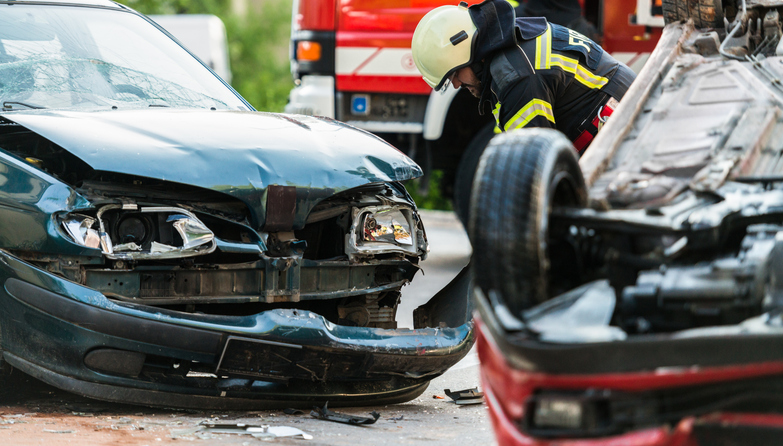
Here is the thing about the 2023 tort reform that most people do not realize until they need to: Florida moved from a system where you could recover something even at 90% fault to one where the line is 50%. Cross that line by one point and you recover nothing. That one change made the fight over your percentage of fault the most important part of the case — and it is a fight the insurance carrier now has strong financial incentive to win completely rather than just partially.
When someone calls our office after a wreck on I-75 or US-41 and says they may have contributed to the crash — tapping the brakes late, looking away for a moment, catching a yellow light — I want to hear all of it. Because what matters is not whether you were partially at fault. What matters is whether the carrier can convince a jury your share clears that 50% threshold. Most of the time, they cannot. But we have to build the case that keeps you below it.
What Florida law actually says about partial fault
Three statutes do most of the heavy lifting in a partial-fault case. They are not light reading, so let me unpack each one in plain English.
Section 768.81, Florida Statutes — modified comparative negligence. Before March 24, 2023, Florida ran a pure comparative-fault system. If a jury put you at 80 percent of the fault and the other driver at 20, you still collected 20 percent of your damages. That is gone. Under the rewritten section 768.81, if a jury puts you at more than 50 percent of the fault, you recover zero. At 50 percent or less, you collect your damages reduced by your percentage. Plain English: a $100,000 case with you at 30 percent fault pays $70,000. The same case at 51 percent fault pays nothing at all. That cliff at 51 is where the insurance industry now lives.
Section 95.11(4)(a), Florida Statutes — two-year deadline. The 2023 reform also cut the negligence statute of limitations in half. Under section 95.11(4)(a), you now have two years from the date of the crash to file suit, not four. If your wreck was on or after March 24, 2023, that two-year clock is running. People who wait, thinking they have time to heal and then call a lawyer, lose cases on this point every month.
Section 627.736, Florida Statutes — PIP. Florida is still a no-fault state for the first layer of medical bills. Section 627.736 requires your own auto insurer to pay 80 percent of reasonable medical bills and 60 percent of lost wages, up to $10,000, regardless of who caused the wreck. PIP runs on its own track. Whether you were 0 percent or 49 percent at fault, your PIP still pays. What PIP does not cover is pain and suffering, and that is where the comparative-fault statute comes back into the picture.
Four partial-fault scenarios from Lee and Collier County roads
Most partial-fault arguments in our office fall into one of these shapes:
- Rear-end with a sudden stop. The lead driver brakes hard on US-41 because a pedestrian steps off the curb or a delivery van cuts the lane. The trailing driver hits them. The trailing driver is usually 80 to 100 percent at fault, but the adjuster will float 20 to 30 percent against the lead driver for the sudden stop. Most of the time that argument loses, but it gets used as a discount lever.
- Left turn across oncoming traffic. A driver turns left at a Bonita Springs intersection and gets hit by an oncoming driver who was speeding. Florida law generally puts the burden on the left-turning driver, but if the oncoming car was twenty over the limit, the percentage can shift meaningfully. These cases live and die on the police report, the dash-cam if there is one, and the speed math.
- Lane change on I-75. One driver merges, the other was in the blind spot, both swear they signaled. With no video, fault often splits 60 to 40 or 70 to 30. These are the cases where a witness phone number jotted down at the scene is worth tens of thousands of dollars later.
- Intersection with a yellow signal. Both drivers enter the intersection, both claim they had the green or a fresh yellow. Without a traffic-camera pull, the case turns on physical evidence — where the impact was on each vehicle, where the cars came to rest, where the debris field landed.
In every one of these patterns the insurance company’s opening offer is built on a fault percentage they invented. Our job is to put a real number in its place, supported by evidence.
What makes shared-fault cases difficult to resolve
The math on comparative negligence sounds clean on paper. The reality is messier, for three reasons.
First, the percentage is not a fact. It is an argument. The police officer’s report assigns a violation, not a percentage. The adjuster’s number is a guess. The final percentage only exists when a jury writes it on a verdict form, or when the parties agree to a number to settle. Everything before that is positioning. Insurers know this, which is why they push hard early, before the injured driver has hired counsel or pulled together the evidence.
Second, the 51 percent cliff distorts every negotiation. Before 2023, an offer at 60-40 against our client still meant a 40 percent recovery. After 2023, the insurer only has to convince a jury that our client is 51 percent at fault and they pay nothing. So they fight harder on percentage than they used to, because the upside for them is now total, not partial.
Third, the things that hurt a partial-fault case the most are things the client does in the first two weeks: admit fault at the scene to be polite, delay medical treatment because they think they will feel better in a day or two, post a video on social media of a family trip, give a recorded statement to the other driver’s adjuster without counsel. Each of these gets used to push the percentage up. None of them are obvious mistakes to the person making them.
How the same principle played out in one of our cases
The way we won her case was by proving the surgeon deviated from the standard of care by failing to do a thorough post-operative inspection before closing. That is the kind of point you cannot make with a brochure and a demand letter. We used a board-qualified general surgeon as our medical witness, walked through the operative notes line by line, and demonstrated what a reasonable post-op inspection looks like and what the surgeon skipped. The case settled at $900,000.
I tell that story in the context of a car accident article because the dynamic is the same. The insurer assumes a percentage of the blame falls on the injured person. Our job is to walk in with evidence that puts the percentage where it actually belongs.
What to do if you think you may be partly at fault
Here is what I tell people when they call our office in that first week, scared they hurt their own case:
- Stop talking to the other driver’s insurance company. Be polite, give them your name, and tell them your attorney will be in touch. Do not give a recorded statement. Adjusters are trained to ask questions that round your fault percentage upward.
- Get to a doctor in the first 14 days. Florida PIP has a hard 14-day rule under section 627.736. Miss that window and you lose your no-fault medical coverage entirely. Use an urgent care, an emergency room, or a primary care doctor — but go.
- Write down what you remember while it is fresh. Sequence of events, weather, what you saw before impact, what each driver said at the scene. I have used this approach with clients for years and noticed that the ones who put it on paper in the first 48 hours testify cleaner six months later, because the memory is locked in.
- Save every receipt and every medical bill. Pharmacy, parking at the doctor’s office, mileage to and from physical therapy. These are recoverable, and they add up faster than people expect.
- Stay off social media about the wreck. Not just the crash itself. A photo of you smiling at a grandchild’s birthday three weeks later gets used to argue your back is not really hurt. Insurers run social media checks now as standard practice.
- Pull the crash report. Under section 316.066, the investigating officer’s report is available through the Florida Department of Highway Safety at flhsmv.gov ten days after the crash. Read it. If it gets the lane direction wrong, or names the wrong driver as the violator, that is fixable, but only if someone notices.
- Call a lawyer before you call the adjuster back. Not because we are going to file a lawsuit on day one. Because the first thirty days of a partial-fault case shape everything that comes after.
Key Takeaways
- Under section 768.81, partial fault of 50 percent or less still allows recovery; 51 percent or more recovers nothing. The cliff is the whole game.
- The negligence statute of limitations in Florida is now two years from the date of the crash under section 95.11(4)(a). The old four-year rule is gone for post-March 2023 wrecks.
- PIP under section 627.736 pays the first layer of medical bills regardless of fault, but only if you see a doctor within 14 days.
- The fault percentage is not a fact; it is an argument. What the adjuster says in week one is not what a jury would put on a verdict form.
- The biggest damage to a partial-fault case happens in the first two weeks, usually through a recorded statement, a missed doctor visit, or a social media post.
Frequently Asked Questions
If I was partly to blame, can I still recover anything in Florida?
Yes, as long as a jury would put you at 50 percent or less of the fault. Under the 2023 rewrite of section 768.81 of the Florida Statutes, you collect your damages reduced by your share. At 51 percent or more, you collect nothing. Most partial-fault cases turn on pushing back against the insurer’s first guess at your percentage.
How long do I have to file a Florida car accident lawsuit now?
Two years from the date of the crash for negligence claims that arose on or after March 24, 2023, under section 95.11(4)(a) of the Florida Statutes. The old four-year window is gone. If your crash was before that date, the four-year rule may still apply, but do not assume it. Call a lawyer early.
Does my PIP pay even if the crash was partly my fault?
Yes. Personal Injury Protection under section 627.736 of the Florida Statutes is no-fault coverage. It pays 80 percent of reasonable medical bills and 60 percent of lost wages up to $10,000, regardless of who caused the wreck. Use it for early treatment. PIP does not cover pain and suffering.
Should I give the other driver’s insurance company a recorded statement?
Not before you talk to a lawyer. Adjusters are friendly on the phone, but the recorded statement is being used to build a fault percentage against you. Anything that sounds like “I wasn’t really looking” or “I might have been going a little fast” will be quoted back to a jury.
What does it cost to hire Pittman Law Firm if my case has a fault problem?
Nothing up front. We work on a contingency fee for personal injury cases, which means there is no fee unless we recover for you. The initial consultation is free. If we take the case and lose, you owe us nothing.
Injured in a Florida Car Accident? Call Us.
If you were hit on I-75, US-41, or any road across Lee or Collier County, and you are worried that something you said or did has hurt your case, call our office before you call the insurance company back. The conversation is free, it is confidential, and it commits you to nothing. We work on contingency: there is no fee unless we recover for you.
Call Pittman Law Firm, P.L. at 239-992-8259 for a free consultation. Our main office is at Windsor Place, 3525 Bonita Beach Road, Suite 107, in Bonita Springs, with a satellite office in Fort Myers.
About the Author

Pittman Law Firm, P.L., founded by David B. Pittman, Esq., has built thirty-plus years of personal injury practice across Southwest Florida, with a sustained focus on serious-injury auto and complex-liability cases. The firm represents injured clients across Lee and Collier Counties, from the firm’s main office at Windsor Place on Bonita Beach Road through Fort Myers, Naples, Estero, Cape Coral, and Lehigh Acres.
David trained at The Citadel, The Military College of South Carolina, before earning his JD at the University of South Carolina School of Law. He is AV-Preeminent at Martindale-Hubbell and a Multi-Million Dollar Advocates Forum member.
David has held a Florida real estate broker license for twenty-five years, a credential that shapes how the firm reads the property side of premises cases. The firm handles personal injury cases across Lee and Collier Counties, serving Fort Myers, Bonita Springs, Naples, Cape Coral, Estero, and Lehigh Acres, with offices at Windsor Place in Bonita Springs (main) and Fort Myers (satellite). Call 239-992-8259 for a free consultation.
The information on this page is general information about Florida personal injury law and is not legal advice for any individual case. Reading this article, contacting our office, or sending us information does not create an attorney-client relationship with Pittman Law Firm, P.L. This is attorney advertising.