

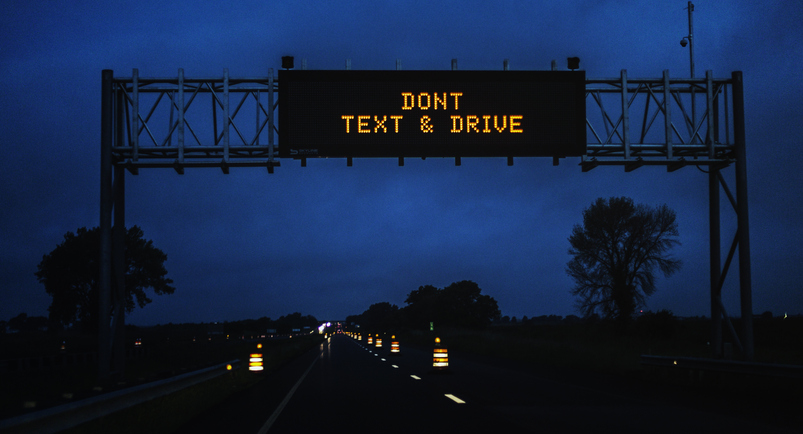
Texting While Driving: Your Cape Coral Motorcycle Accident Risk Doubles
Here is the thing riders get wrong about the distracted-driver statistic: the doubling figure is real enough, but it is not what wins a Cape Coral motorcycle case. A rider with a healing collarbone and a totaled bike in a Cape Coral storage yard does not need to argue about a national study. What moves a claim is what the at-fault driver’s phone was doing in the four seconds before impact, and whether we can prove it.
That is the whole game on a distracted-driver motorcycle claim. Riders already lose the visibility argument before they get on the bike. A texting driver makes that worse and gives us something to prove. The work is in proving it.
What the data actually shows on texting and motorcycle crashes
The most-cited figure says a driver who is texting roughly doubles the risk of a crash. That comes from naturalistic driving studies that measured eyes-off-road time, not from a Cape Coral-specific dataset, so I treat it as a sound order of magnitude rather than a courtroom number. The Florida Department of Highway Safety and Motor Vehicles tracks distracted-driving crashes statewide every year, and the numbers stay stubbornly high (flhsmv.gov). Lee County contributes its share.
For a motorcycle rider, the underlying physics is worse than the headline. The Insurance Institute for Highway Safety puts the per-mile fatality rate for motorcycle riders far higher than for car occupants (iihs.org). When the other driver looks down at a phone for two or three seconds at 45 miles per hour on Pine Island Road, that is roughly the length of a basketball court traveled blind. A car driver may absorb that error in a fender bender. A rider on a bike absorbs it with a body.
So yes, distraction roughly doubles risk. The point I want a Cape Coral rider to take from that is not the statistic. The point is that distracted-driver crashes are some of the most provable claims we handle, because the proof lives on a phone and in a vehicle’s onboard data, and we know where to look for it.
Florida law that actually determines your case
Three Florida statutes do most of the work on a motorcycle claim. They are the ones I sit down and walk through with a rider on the first call.
Section 627.736, Florida Statutes — PIP and the motorcycle exclusion. Florida is a no-fault state for cars. Drivers carry $10,000 in Personal Injury Protection that pays early medical bills regardless of fault. The statute defines “motor vehicle” in a way that excludes motorcycles. In plain English: if you were hit on your bike, you do not get PIP. The ambulance ride, the ER bill, the orthopedist—none of it is covered by no-fault. That bill goes to your health insurance, or it sits and accrues until we recover from the at-fault driver. Read the statute yourself if you want the full text (leg.state.fl.us — §627.736). This single exclusion is the most important fact in Florida motorcycle law and most riders do not know it until they need to.
Section 316.211, Florida Statutes — the helmet law. Florida lets riders 21 and older ride without a helmet as long as they carry at least $10,000 in medical coverage. Riders under 21 must wear a helmet. The statute is here (leg.state.fl.us — §316.211). The practical impact on a claim is narrower than the carrier wants you to think. The absence of a helmet does not bar a claim and is only relevant to head injuries. A rider with a shoulder labral tear and no head trauma is not vulnerable to the helmet argument at all.
Section 768.81, Florida Statutes — comparative negligence. Florida is a modified comparative negligence state. If a jury finds you more than 50 percent at fault for your own injuries, you recover nothing. Otherwise, your award is reduced by your percentage of fault. That is the statute the carrier will lean on when it tries to blame the rider for speeding, lane position, or not wearing a helmet (leg.state.fl.us — §768.81). Anticipating the comparative-fault argument is most of the early defense work in a motorcycle case.
Why your own UM coverage matters so much
Here is the conversation I wish every Cape Coral rider had with their agent before the crash instead of after. Florida’s minimum bodily injury liability limit on a passenger car is low, and a fair number of drivers carry none at all because Florida does not require bodily injury coverage to register a vehicle. That is why the at-fault driver in a serious motorcycle case very often has $10,000 or $25,000 in coverage against a claim worth ten times that.
Section 627.727, Florida Statutes, lets you carry uninsured and underinsured motorist coverage (UM) on your own auto policy that steps in when the other driver does not have enough (leg.state.fl.us — §627.727). For a motorcycle rider in Cape Coral, UM is the lifeline. I tell every rider I meet, whether or not they are a client, to go home and check their declarations page. If you have UM, raise the limit. If you do not have it, add it. The premium difference is small compared to the protection.
On a labral tear case with surgery, on a fractured tibia case with hardware, on a head-injury case with a long rehab, the difference between $25,000 in available coverage and $250,000 in stacked UM is the difference between paying the medical bills and rebuilding your life. That is not theoretical; that is what we see at intake.
How these files actually come together at our office
A Cape Coral rider came to us after he was hit by a driver who changed lanes on Del Prado Boulevard without checking the blind spot. He went down on his right side, landed hard on his shoulder, and made it to Cape Coral Hospital under his own power. The pain in the shoulder did not match the first set of X-rays, which read clean. The orthopedist ordered an MRI. The MRI showed a labral tear. Surgery followed a few weeks later.
The carrier opened its file the way these files usually get opened. The adjuster argued the rider had been speeding, that the lane change was reasonable, that the shoulder injury was preexisting from years of riding. None of those arguments were well-founded, but each had to be defeated rather than ignored. We tracked down two witnesses from a nearby business who saw the lane change clearly and would say so on the record. We pulled the at-fault driver’s phone data through the litigation. The combination of the witnesses, the timing of the MRI, and the surgeon’s narrative report on causation undid the carrier’s position.
The case resolved in a high six-figure settlement. The rider was back on a bike inside a year. What I want a Cape Coral rider reading this to take from it: a clean rear-impact case is rare. Most motorcycle cases come with a fault dispute baked in by the carrier. The work is in dismantling it, piece by piece, with witnesses and records, before the carrier ever sees a demand letter.
What to do after a Cape Coral motorcycle crash
The advice list for riders is different from the advice list for car drivers. A few of these only make sense once you have been through it.
- Get medical attention the same day, even if you feel fine. Adrenaline masks injuries that show up forty-eight hours later. Soft-tissue damage in the shoulder and neck almost always presents late. If the ambulance asks, go in it. If it does not, drive yourself to Cape Coral Hospital or your urgent care that afternoon. The medical record from day one is the spine of the case.
- Save the gear — helmet, jacket, gloves, boots, bike. Do not let the bike get repaired before we see it. Do not throw away the helmet because it is scuffed. The damage pattern on the gear and the bike is physical evidence of speed, angle, and impact. We have used helmet damage to defeat speeding allegations more than once.
- Photograph the scene, the vehicles, the road, and the gear. Get the other driver’s plate, insurance, and driver’s license. Get the names and phone numbers of any witnesses standing on the sidewalk. Witnesses scatter within ten minutes of the police arriving.
- Do not give a recorded statement to the at-fault carrier. Their adjuster will be polite. The questions are designed to elicit fault. You are not required to give a statement before you have counsel, and you should not.
- Pull your own auto policy declarations page. Confirm your UM limits before you talk to anyone. If you have UM, your own insurance company is now also looking at the claim, and the dynamic of that relationship matters.
- Call a lawyer who handles motorcycle cases, not generic auto cases. The PIP exclusion, the helmet defense, and the UM coverage analysis are not standard car-crash work. Get someone who lives in this part of the law.
Key Takeaways
- The “texting doubles your crash risk” figure is roughly right but is not what wins a Cape Coral motorcycle case. The phone records, dash cam, and infotainment data of the at-fault driver are what win it.
- Florida’s PIP statute excludes motorcycles. There is no $10,000 in no-fault medical benefits for a rider. Health insurance and UM coverage carry the early bills.
- Florida’s helmet law allows riders 21 and older with $10,000 in medical coverage to ride without a helmet. The carrier’s helmet argument is limited to head injuries and is often weaker than it sounds.
- Uninsured/underinsured motorist coverage on your own auto policy is usually the difference between a real recovery and a token settlement on a serious motorcycle case. Check your limits before you need them.
- Florida’s personal injury statute of limitations for crashes on or after March 24, 2023 is two years. Phone records, video, and witnesses disappear long before that.
Frequently Asked Questions
Q1. Does texting really double a Cape Coral motorcycle rider’s crash risk?
The doubling number comes from driver-side distraction studies and is fair as a rough order of magnitude. What matters more for your case is that a texting driver’s phone records, dash cam, and infotainment data can prove the distraction, and that proof is what changes the value of the claim, not the statistic.
Q2. Does my PIP cover me if I was hit on my motorcycle in Cape Coral?
No. Section 627.736, Florida Statutes, excludes motorcycles from the definition of motor vehicle for PIP purposes. Riders do not get the $10,000 in no-fault medical benefits that car drivers get. Your health insurance and your own uninsured/underinsured motorist coverage usually carry the early medical bills.
Q3. I was not wearing a helmet. Can the insurance company use that against me?
Florida law under section 316.211 allows riders 21 and older with at least $10,000 in medical coverage to ride without a helmet. The carrier may still try to argue under section 768.81 that the absence of a helmet contributed to head injuries. That argument is limited to head injuries and has to be supported by medical evidence. It does not reduce recovery on a shoulder, leg, or back injury.
Q4. Why does my own UM coverage matter so much on a motorcycle claim?
Florida’s minimum auto liability limits are low and many drivers carry no bodily injury coverage at all. Section 627.727 lets you carry uninsured/underinsured motorist coverage that pays you when the at-fault driver does not have enough. On a serious motorcycle injury, UM is often the difference between a real recovery and a token settlement.
Q5. How long do I have to bring a Cape Coral motorcycle injury claim?
For crashes occurring on or after March 24, 2023, Florida shortened the personal injury statute of limitations to two years. Different rules apply to claims against a government entity and to wrongful death. The sooner we get involved, the better the chance of locking down phone records, video, and witness statements before they disappear.
Talk to our firm
If you or someone in your family was hurt on a motorcycle in Cape Coral — on Cape Coral Parkway, Pine Island Road, Del Prado Boulevard, the Cape Coral Bridge, or anywhere in Lee County — I would like to hear what happened. Call our office at 239-992-8259 for a free consultation. There is no fee unless we recover for you.
About the Author

David B. Pittman, Esq., the founder of Pittman Law Firm, P.L., has spent more than three decades representing injured Floridians in Cape Coral and the Lee County waterfront, with a sustained focus on serious-injury and uninsured-motorist motorcycle claims. Cape Coral cases concentrate along Cape Coral Parkway, Pine Island Road, Del Prado Boulevard, and Veterans Parkway, with steady serious-injury auto work feeding in from the Cape Coral Bridge corridor.
David’s training is The Citadel, the Military College of South Carolina, for his undergraduate work, and the University of South Carolina School of Law for his JD. His professional standing includes an AV-Preeminent rating from Martindale-Hubbell and membership in the Multi-Million Dollar Advocates Forum, a recognition reserved for attorneys who have recovered multi-million-dollar verdicts and settlements for their clients.
David has held a Florida real estate broker license for twenty-five years, a credential that shapes how the firm reads the property side of premises cases. The firm handles personal injury cases across Lee and Collier Counties, serving Fort Myers, Bonita Springs, Naples, Cape Coral, Estero, and Lehigh Acres, with offices at Windsor Place in Bonita Springs (main) and Fort Myers (satellite). Call 239-992-8259 for a free consultation.
Disclaimer: The information on this page is general information about Florida personal injury law and is not legal advice for any particular case. Reading this page does not create an attorney-client relationship with Pittman Law Firm, P.L. The hiring of an attorney is an important decision that should not be based solely on advertising. Past results do not guarantee a similar outcome in any future case.