

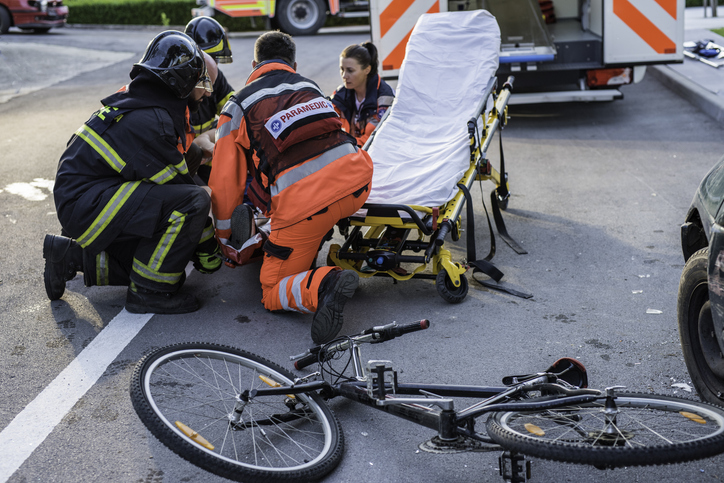
Hurt in a Bicycle Crash? An Estero Bicycle Accident Lawyer Walks Through Your Rights
Two numbers decide whether a seriously injured cyclist in Estero recovers what they deserve or gets a partial check and a polite close-out letter from the carrier. The first is the PIP limit on the household auto policy — which applies even though you were on a bike. The second is the UM limit, because the at-fault driver’s bodily injury policy is almost never large enough to cover a real cycling injury on its own. Those two questions decide cases. Road safety statistics do not.
So if you have just been hit on a bike on Corkscrew Road, on Three Oaks Parkway, near Coconut Point Mall, or anywhere along the US-41 corridor, the rest of this is what I would actually want you to know. Not the generic injury-attorney version. The version that reflects how these files play out in our office.
What the data actually shows about bike crashes around Estero
Lee County does sit at the wrong end of national cycling-fatality rankings. That part of the headline is real. What gets lost is that the at-fault party in serious Florida bicycle crashes is the driver, not the cyclist, in the strong majority of cases. Florida Highway Patrol crash reports we have reviewed over the last several years follow the same pattern: a driver makes a right turn across an active bike lane, a driver misjudges a left across oncoming traffic and clips a rider, a driver opens a door into a passing cyclist. The cyclist is rarely the proximate cause. Jurors, in our experience, tend to see that the moment they hear the facts laid out plainly.
Locally, the spots where our office sees the most cycling files cluster in a few places: the Three Oaks Parkway and Coconut Road area, the Corkscrew Road stretch near Grandezza and the Estero residential communities, and the US-41 frontage near Coconut Point Mall where drivers cut across bike lanes to make their turn into the shopping center. None of that is theoretical. Those are the case-file pins on the wall.
The Florida law that actually decides your bicycle case
I want to walk through five statutes, because each one comes up on almost every cycling file we handle. I will give you the plain-English version first and the citation second.
You have the rights and duties of a driver. Under §316.2065, Florida Statutes, a person on a bicycle has the same rights on the road as the driver of any other vehicle. That sounds obvious, but it is the legal hook for treating you as a lawful road user — not an obstacle a driver gets to maneuver around. When a defense lawyer starts implying you should not have been there, this is the statute we cite first.
The 3-foot rule. Under §316.083, a driver passing a cyclist has to leave at least three feet of clearance. Any closer is a traffic violation. In a side-swipe or buzz-pass case, this statute is often the whole liability story.
The crosswalk-yield duty. Under §316.130, drivers have to yield to pedestrians and cyclists lawfully using a crosswalk. We see this most often on the US-41 crossings where a driver turning right on red rolls through a marked crosswalk without ever truly looking.
PIP covers you on the bike. This is the one almost nobody knows about until we tell them. Under §627.736, if there is a Florida auto policy in your household, that policy’s PIP typically pays your initial medical bills (80%) and lost wages (60%), even though you were on a bicycle when you were hurt. Riders walk in assuming they have to fight the driver’s carrier for every dollar. They often do not — at least not for the first round of bills.
UM is your safety net. Under §627.727, Uninsured/Underinsured Motorist coverage on your own auto policy sits behind the at-fault driver’s policy. If their limits are too small for what your injuries cost, your UM is what closes the gap. I will say more about this in the next section because it is genuinely the difference between full recovery and a partial one on a lot of our serious bike files.
One more piece of Florida law worth knowing. Our comparative-negligence statute, after the 2023 reforms, is now modified — meaning if a jury finds you more than 50% at fault, your recovery is barred. Below that threshold, your award is reduced by your assigned percentage. And the deadline to file suit is now two years from the crash date, not four. That tightening matters. We have turned away cases where someone called us a month too late.
Why your own UM coverage matters so much on a bicycle case
This is the conversation I wish every cyclist had with their insurance agent before they ever needed to have it with me.
The at-fault driver in a serious cycling crash is, far more often than not, carrying minimum or near-minimum Florida bodily injury limits. A typical Florida policy might carry 10,000 or 25,000 dollars in bodily injury coverage per person. That is the entire pool of money the at-fault driver’s carrier will pay out of, no matter how bad the injury is.
Now compare that to the actual cost of a real cycling injury. A shoulder reconstruction with hardware, a few nights inpatient for a head injury workup, an MRI series, weeks of physical therapy, and a course of cognitive rehabilitation can pass 25,000 dollars before you get out of the second month. I can tell you the driver’s limits are almost never the whole answer on a serious bike case.
UM, governed by §627.727, is what fills the gap. Your own auto policy’s UM coverage pays you — the injured rider — when the at-fault driver’s policy runs out or never existed at all. The carrier you fight on the UM claim is your own, which feels strange the first time you experience it, but it is the deal you paid for when you bought the coverage. The single most useful thing a Florida household can do to protect itself against a catastrophic cycling outcome is stack and increase its UM limits. If you do nothing else after reading this, ask your agent what your UM limits are.
A right-hook on Corkscrew Road near Grandezza
A rider was traveling east in the designated bike lane on Corkscrew Road, near the entrance to Grandezza in Estero, on a routine morning ride. A vehicle approaching from behind signaled and turned right into the community entrance without yielding — a classic right-hook across an active bike lane. The driver’s front quarter-panel caught the cyclist’s rear wheel and threw the rider off the bike onto the shoulder.
The injuries told the story of how violent even a low-speed right-hook can be: a Grade 3 AC joint separation in the shoulder, requiring orthopedic surgery to repair the torn ligaments, and a mild traumatic brain injury despite a properly fitted helmet. That kind of organized claims handling matters. Insurance carriers do not pay full value on a file that looks disorganized.
The driver’s bodily injury limits were predictably small. We exhausted them quickly, then turned to our client’s own household auto policy and pursued the Underinsured Motorist coverage. The result: full policy limits from the at-fault driver’s carrier, plus an additional UM settlement from our client’s own policy. The UM piece, in this case, was larger than the at-fault driver’s piece. That is what UM is for, and it is the reason I keep saying it.
What to do after a bicycle crash in Estero — the version that actually helps your case
I am going to skip the standard “call 911, take photos” list, because if you needed to be told that, you would not be reading this. Here is what I tell our cycling clients to do that most attorneys do not mention:
- Save the gear. Do not throw away the helmet, the jersey, the gloves, or the shoes. Especially not the helmet. If the helmet cracked or absorbed an impact, that is direct physical evidence of head trauma — a real defense to the “you were not really hurt” argument the carrier will float. Bag it, label it with the date, and put it somewhere safe.
- Do not let the bike get fixed yet. The bike itself is evidence. The angle of impact, the paint transfer, the bent fork — all of it tells the reconstruction story. Photograph it from every angle the day of the crash and store it as-is until we have looked at it.
- Pull your own auto policy out and read the declarations page. Look for two numbers: PIP (it will be there if you live in Florida) and UM. If UM says “rejected” or “0/0,” call your agent and ask what it would cost to add it. That conversation, today, is worth more than any single thing your lawyer will do for you next month.
- Get the head injury checked, even if you feel fine. Mild TBIs do not announce themselves on day one. They show up at the seven-to-fourteen-day mark as headaches, light sensitivity, word-finding trouble, sleep disturbance. If you wait until those symptoms peak to first see a doctor, the carrier will argue the symptoms came from something else. Get the baseline imaging done early.
- Do not give the at-fault driver’s carrier a recorded statement. Their adjuster will call within 48 hours and sound friendly. The recording is not for your benefit. Tell them you are represented or that you are not giving a statement, and route them to your attorney.
Key Takeaways
- Florida’s PIP statute (§627.736) often covers a cyclist through their own household auto policy — your first medical dollars frequently come from your own carrier, not the driver’s.
- Under §316.2065 and §316.083, you have the same road rights as a vehicle driver, and a passing driver owes you a minimum of three feet of clearance.
- UM coverage on your own auto policy (§627.727) is the single most important number on a serious bike file — it is what pays when the at-fault driver’s limits run out.
- The 2023 amendment cut Florida’s negligence statute of limitations to two years. If your crash was on or after March 24, 2023, you have two years from the crash date — no exceptions for being polite.
- Save the helmet, save the bike, photograph everything, and do not give a recorded statement to the other driver’s carrier before talking to an attorney.
Frequently Asked Questions
Q1. Does my own auto insurance pay if I get hit while riding my bicycle in Estero?
In most cases, yes. Florida’s PIP statute, §627.736, treats a cyclist who lives in a household with a Florida auto policy as covered under that policy’s PIP — even though you were on a bike, not in the car. PIP pays 80% of reasonable medical bills and 60% of lost wages up to the policy limits. Many of our cycling clients are surprised to learn their own car policy is the first money in.
Q2. If a driver right-hooks me into a bike lane, who is at fault under Florida law?
A driver turning across an active bike lane has a duty to yield to a cyclist already in that lane. §316.083 also requires the driver to give at least three feet of clearance when passing. A right-hook into a yielded bike lane is, in almost every case we have worked, a clear duty-of-care breach by the driver.
Q3. How long do I have to file a bicycle injury lawsuit in Florida after a 2025 crash?
Two years. The 2023 amendment to Florida’s negligence statute of limitations cut the old four-year window in half. If your crash happened on or after March 24, 2023, you have two years from the date of the wreck to file suit. Miss it by one day and the case is gone.
Q4. What if I was not wearing a helmet — does that wipe out my case?
No. Florida only requires helmets for riders under sixteen. For an adult cyclist, the lack of a helmet is not a bar to recovery, though the defense will often argue it should reduce the head-injury portion of your damages. We push back hard on that argument and have settled head-injury cases for full policy limits on adult riders who were not helmeted.
Q5. Why does my Uninsured/Underinsured Motorist coverage matter so much in a bike crash?
Because the at-fault driver’s policy is very often too small to cover a serious cycling injury. A shoulder reconstruction, a mild TBI, and weeks of cognitive therapy can run past a 25,000-dollar bodily injury limit by the second hospital bill. Your own UM coverage, governed by §627.727, sits behind that and pays when the at-fault driver runs out. We use UM on a real majority of our serious bike files.
Talk to our office before you talk to the other driver’s insurance company
If you or someone in your family has been hit while cycling in Estero, Bonita Springs, Fort Myers, or anywhere in Lee or Collier County, call our office. We will sit with you, look at the police report, look at your own policy’s PIP and UM declarations page, and tell you straight what your case looks like. The consultation is free, and there is no fee unless we recover for you.
Call Pittman Law Firm, P.L. at 239-992-8259 for a free consultation.
About the Author

David B. Pittman, Esq. is a thirty-plus-year personal injury attorney in Estero and the surrounding Lee County corridor, and the founder of Pittman Law Firm, P.L., with a sustained focus on cyclist-injury cases and the insurance-coverage complexities specific to riders. Estero cases tend to come from the Three Oaks Parkway and Coconut Road corridor, the Corkscrew Road communities near Grandezza, and the US-41 / Coconut Point Mall area.
Two South Carolina institutions shaped David’s path: The Citadel, The Military College of South Carolina for undergraduate and the University of South Carolina School of Law for his JD. He is AV-Preeminent at Martindale-Hubbell and a Multi-Million Dollar Advocates Forum member.
David has held a Florida real estate broker license for twenty-five years, a credential that shapes how the firm reads the property side of premises cases. The firm handles personal injury cases across Lee and Collier Counties, serving Fort Myers, Bonita Springs, Naples, Cape Coral, Estero, and Lehigh Acres, with offices at Windsor Place in Bonita Springs (main) and Fort Myers (satellite). Call 239-992-8259 for a free consultation.
The information on this page is provided for general information only and is not legal advice for any individual case. Reviewing or contacting this page does not create an attorney-client relationship. Pittman Law Firm, P.L. is a Florida law firm; this content is attorney advertising under the rules of The Florida Bar.