

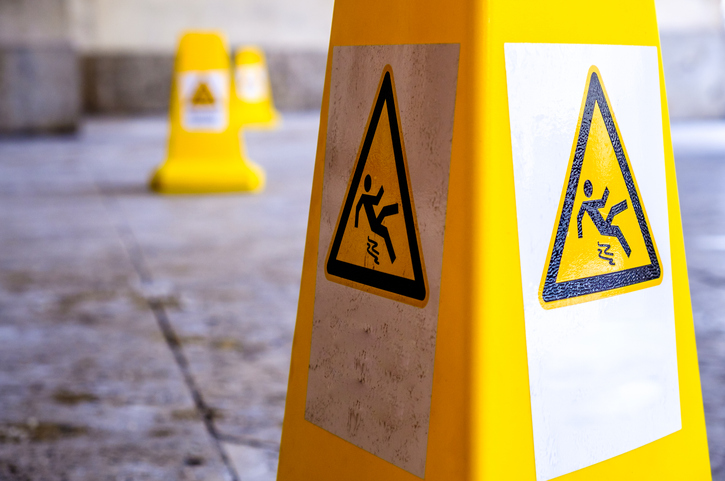
Slip and Fall vs. Trip and Fall in Fort Myers: Why the Difference Actually Changes Your Case
Florida built two separate legal doctrines — slip and fall, trip and fall — around the physics of how a person actually goes down. They look the same from the emergency room. They produce very different cases in court. The statute that applies, the proof you have to present, and the defenses you will face all depend on whether your foot slid on something that did not belong on the floor, or caught on something that was part of the floor itself.
People call our Fort Myers office with the terms mixed up all the time. They will say “I slipped on a broken piece of sidewalk.” That is a trip. Or they will tell me they tripped on a wet floor near a produce display. That is a slip. The terminology matters, because the law treats them differently and so do the carriers.
For the last twenty-five years, in addition to practicing law, I have held a Florida real estate broker license, and that broker work has shaped how we read property cases. We have sat across the table from property managers, watched how leases allocate maintenance duties between landlord and tenant, and learned what a reasonably prudent owner is supposed to be doing on a Tuesday morning before the public walks in. When I read a premises file now, I am reading it through both lenses at once: what the law requires, and what the property side actually does in practice. Those two things do not always line up, and the gap between them is often where a case lives.
What Florida Law Requires of a Property Owner
Florida premises liability is not one statute. It is a family of them, and the one that applies depends on what you fell on.
Section 768.075 sets the baseline. It defines what a property owner owes to people who come onto the property. The duty depends on the visitor’s status. An invitee, like a customer in a grocery store or a patient walking into a medical plaza, gets the highest duty: the owner has to keep the premises in reasonably safe condition and warn of hazards the owner knows or should know about. A licensee, like a social guest, gets a lower duty. A trespasser, almost none. Most of the cases we handle involve invitees.
Section 768.0755 is the slip statute. If you fell because of a transitory foreign substance, water, oil, a piece of fruit, a spilled drink, on the floor of a business, you have to prove the business had either actual knowledge that the substance was there, or constructive knowledge. Constructive knowledge means the substance had been there long enough that a reasonable inspection schedule would have caught it, or that the spill happened so regularly that the business should have been ready for it. The 2010 amendment to this statute shifted the burden onto injured people in a way that makes these cases harder than most clients expect.
Section 768.0710 is the trip statute. It covers negligent maintenance involving conditions of the premises themselves, the structural stuff. Cracked sidewalks. Uneven thresholds. Missing handrails. Pavers that have heaved up from root pressure. Loose carpet seams. The injured person still has to prove negligence, but the proof problem is different because the defect is usually still there after the fall. You can photograph it, measure it, show how long it has been broken.
Section 768.28 kicks in when the property is government-owned. County sidewalks, municipal parking lots, city park walkways. There are notice rules, deadlines, and damage caps that do not exist in private-property cases. Miss the notice window and the claim is gone.
Factors a Court Considers
Whether your fall ends up in front of a jury or settles before suit is filed, the same handful of factors drive the value of the case.
- How long the hazard was there. Five minutes hurts the case. Two hours, with footprints through the spill or smeared cart tracks, helps it.
- What the inspection schedule actually looked like. Most stores have a written sweep log. Whether they actually followed it is usually the fight.
- Whether prior complaints were on file. A cracked walkway with three prior incident reports is a different case from a fresh defect nobody had reported.
- Lighting and visibility. A one-inch sidewalk lip in a sunlit parking lot at noon reads differently than the same lip at a stairwell at 8 p.m.
- The visitor’s reason for being there. Invitee, licensee, trespasser. The duty owed depends on the answer.
- Whether the hazard was open and obvious. Florida still lets owners argue that a hazard so visible the injured person should have seen it cuts against liability. We push back on this constantly, because something being visible after the fall is not the same as being noticeable a half-second before you stepped on it.
The Trivial-Defect Doctrine and Why It Is Not as Clean as It Sounds
Florida courts have a long history of declining to hold property owners liable for sidewalk and pavement defects judged too small to matter. The traditional rule of thumb, and it is a rule of thumb, not a statute, has been that defects under roughly one inch are often treated as trivial and not actionable.
That sounds like a clean line. It is not.
What actually happens in a Lee County courtroom is that the judge looks at the totality. A three-quarter-inch lip in a well-lit, recently inspected parking lot might be trivial. The exact same three-quarter-inch lip on a darkened walkway at a medical plaza, with prior complaints in the management company’s file, often is not. I have had cases turn on prior-complaint logs we pulled in discovery, where the management company had been told about the broken concrete two and three times before our client ever set foot on it. Once that history is in the record, the trivial-defect argument tends to lose its grip.
The other thing the doctrine does not account for is who fell. A vigorous thirty-year-old stepping on a small lip in daylight is one case. An eighty-year-old client with a cane, stepping on the same lip in shade after a rain, is another. Foreseeability of harm to the actual class of visitors the owner invites onto the property is part of the analysis, and it is part we lean on.
What We See Most in Fort Myers
Geography matters. The kinds of slip and trip cases we see along the Daniels Parkway and Six Mile Cypress retail corridors are not the same ones we see at the older shopping plazas off Cleveland Avenue or the medical buildings off Summerlin Road.
Along the newer Daniels Parkway and Six Mile Cypress developments, we see a lot of transitory-substance slips: produce departments, freezer cases that drip, condensation tracked in from outside during a summer thunderstorm, and cleaning crews mopping during business hours without warning cones out. The buildings are newer, the structural defects are fewer, but the housekeeping problems are constant.
Along Cleveland Avenue and the older strip centers off Colonial Boulevard and Pine Island Road, we see more trip-and-fall trip cases. Older parking lots, asphalt patches done badly, root-heaved sidewalks, broken concrete at curb cuts, missing or rusted handrails on small step-downs between the lot and the storefront. The structural decay is visible to anyone who walks the property with their eyes open.
Along Summerlin Road, where a lot of medical and professional offices cluster, we see a mix, plus the added complication of older patients, many of whom are walking with assistive devices. A defect that a twenty-five-year-old would step right over puts a seventy-year-old in the hospital.
How the proof ran in a Summerlin Road walkway case
One that comes to mind involved an older client who fell at a medical plaza off Summerlin Road. She was leaving an appointment, walking to her car along a walkway between two buildings, and her toe caught on a jagged broken section of concrete where a slab had cracked and lifted. She went down hard, fractured the femoral neck of her left hip, and ended up in surgery for a partial hip replacement that same evening, followed by weeks of inpatient rehabilitation.
We pulled their maintenance and incident records in discovery. The walkway had been broken for months. There were prior complaints, in writing, from at least two other tenants in the plaza asking the management company to fix it. Nothing had been done.
Once those prior-complaint records were on the table, the trivial-defect argument quietly went away. The case settled in the six figures, with the management company carrying the responsibility for the negligent maintenance of a walkway it had been warned about and ignored. Our client used the recovery to cover the surgery costs her insurance had not, and to fund the rehabilitation she needed to walk again without assistance.
It is the kind of case that is not unusual in our practice. An older client, a property condition the owner had every chance to fix, and an injury that changes how the rest of someone’s life works.
What a Property Owner Is Supposed to Be Doing
Twenty-five years as a Florida real estate broker has taught me what the property side is supposed to look like when it is run well, and what it looks like when it is not. The basics are not complicated.
A reasonably prudent commercial property owner walks the property on a written schedule, documents what is seen, and fixes what is broken. Sweep logs in retail stores get initialed every fifteen to thirty minutes during open hours. Outdoor walkways, parking lots, and stairwells get inspected at least daily, and after every significant rain. Prior complaints get logged, prioritized, and closed out, in writing, with a date of repair. Cones, mats, and warning signs come out during cleaning, not after.
What we see in litigation is the opposite. Sweep logs filled out in the same handwriting at the end of a shift. Walkways nobody has inspected in months. Tenant complaints that go to a manager’s voicemail and die there. Wet-floor cones still in the storage room while a porter mops. None of that excuses an injury. All of it shows up in discovery when we know where to look.
The broker training also helps with the lease side of a case. Commercial leases allocate maintenance responsibilities between landlord and tenant in ways that determine who actually had the duty to fix the walkway, light the stairwell, or repair the handrail. When the landlord points at the tenant and the tenant points at the landlord, the lease decides. Knowing how to read those provisions, and knowing how property managers think about them, is part of how we build these cases.
What to Do If You Fell
If you have just been hurt in a slip or trip on someone else’s property in Fort Myers, here is what I would tell a family member to do, in order.
- Get medical care the same day. Hip, back, wrist, and head injuries from falls often look minor for the first twenty-four hours and then declare themselves. A documented emergency room visit on the date of the fall is the single most important record in the case.
- Photograph the hazard before you leave, if you can. A wide shot showing where you fell, a close-up of the defect or substance, and a photograph of your shoes are worth more than ten witness statements. If you are too hurt to do it, ask whoever is with you.
- Report it to the property in writing. An incident report drafted by the store gets written to protect the store. Ask for a copy. If they will not give you one, send a follow-up email to whoever was on duty so there is a date-stamped record.
- Save what you were wearing. Shoes especially. The tread, the sole, and whether they had any substance on them after the fall can defeat a comparative-fault argument later.
- Do not give a recorded statement to the insurance adjuster. Their first call is friendly and the questions sound innocent. They are not. Politely tell them you will respond once you have spoken with an attorney.
- Call a lawyer before video gets overwritten. Most commercial surveillance cycles run seven to thirty days. After that, the footage is gone. A preservation-of-evidence letter from a law office, sent within days of the fall, is sometimes the difference between a winnable case and a guess.
Key Takeaways
- Slip and fall and trip and fall are two different legal categories in Florida, governed by different statutes and different proof burdens.
- Slip cases under Section 768.0755 require proof that the business knew or should have known about the substance on the floor. That constructive-knowledge piece is where most of these cases turn.
- Trip cases under Section 768.0710 focus on structural defects, cracked concrete, uneven thresholds, missing handrails, and tend to be easier to document because the defect is usually still there after the fall.
- The trivial-defect doctrine is not a bright-line rule. Lighting, prior complaints, and the foreseeable visitor all factor into whether a small defect is actionable.
- Government-property falls trigger Section 768.28, with shorter notice deadlines. Get a lawyer involved quickly if you fell on a county or city walkway.
Frequently Asked Questions
If I cannot tell whether I slipped or tripped, does that hurt my case?
Not necessarily, but it changes how we build it. Slip cases under Florida Statute 768.0755 require proof the business knew or should have known about the substance on the floor. Trip cases under negligent-maintenance law focus on the structural defect itself. We work backward from your injuries, the scene photographs, the surveillance footage, and your clothing to figure out which framework fits the facts.
What is Florida Statute 768.0755 and why does it make slip cases harder?
Section 768.0755 governs slips on transitory foreign substances inside a business, things like a puddle, a grape, a spill near a soda machine. The injured person has the burden to show the business had actual knowledge of the substance or that it had been there long enough that the business should have known. That second piece, constructive knowledge, is where most slip cases live or die.
How does the trivial-defect doctrine work in a Fort Myers trip-and-fall case?
Florida courts have historically declined to hold a property owner liable for sidewalk lips and pavement cracks that are very small, often under about an inch. There is no clean bright-line rule though. Judges look at the whole picture: how visible the defect was, whether there had been prior complaints, the lighting, and whether the area carried foot traffic the owner should have expected.
What about a fall on a public sidewalk or in a county park in Lee County?
Government-property claims fall under Section 768.28 and they come with shorter notice deadlines and damages caps. You generally have to put the government entity on written notice of the claim well before any lawsuit is filed. If you fell on a county-owned sidewalk along McGregor Boulevard or in a city park, call a lawyer quickly so the notice clock does not run out.
Do I really need a lawyer for a slip or trip case, or can I handle it myself?
You can try, and some people do. The problem is that surveillance video gets overwritten in days, incident reports get drafted in a way that protects the business, and the insurance adjuster’s first offer rarely reflects future medical costs. In our office, we send preservation-of-evidence letters within hours and pull maintenance records and inspection logs that you cannot get on your own.
Talk to Our Firm About Your Fall
If you or a family member has been hurt in a slip or trip on someone else’s property in Fort Myers, Bonita Springs, Naples, Estero, Cape Coral, or Lehigh Acres, call our office. We will sit down with you, look at what happened, pull the records we need to pull, and tell you straight whether you have a case worth pursuing. Call 239-992-8259 for a free consultation. There is no fee unless we recover for you.
About the Author

David B. Pittman, Esq. keeps an active personal injury practice in Fort Myers and across Lee County as the founder of Pittman Law Firm, P.L., now into his thirty-first year, with a sustained focus on personal injury and premises-liability cases. The firm’s Fort Myers presence handles a steady stream of serious-injury work along the Daniels Parkway, Six Mile Cypress, McGregor Boulevard, Cleveland Avenue, and Summerlin Road corridors, and along I-75 between Estero and Bell Tower.
Academically: The Citadel, The Military College of South Carolina for undergraduate; the University of South Carolina School of Law for the JD. Professionally: AV-Preeminent at Martindale-Hubbell and a member of the Multi-Million Dollar Advocates Forum.
David has held a Florida real estate broker license for twenty-five years, a credential that shapes how the firm reads the property side of premises cases. The firm handles personal injury cases across Lee and Collier Counties, serving Fort Myers, Bonita Springs, Naples, Cape Coral, Estero, and Lehigh Acres, with offices at Windsor Place in Bonita Springs (main) and Fort Myers (satellite). Call 239-992-8259 for a free consultation.
The information on this website is for general information purposes only. Nothing on this site should be taken as legal advice for any individual case or situation. This information is not intended to create, and receipt or viewing does not constitute, an attorney-client relationship. This is attorney advertising.