

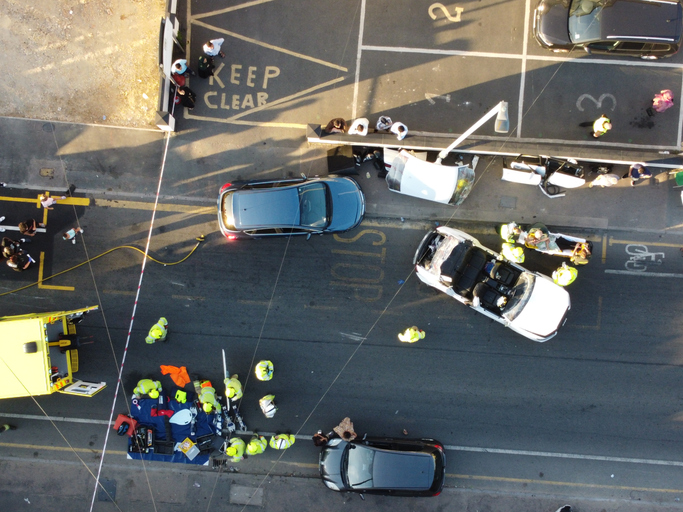
Who’s Really at Fault? The Truth About Multi-Car Collisions in Fort Myers
The driver who calls our office from a Fort Myers ER waiting room is almost always the one in the middle of the pile-up. They felt the impact from behind, they heard themselves slam into the car in front, and by the time the deputy is filling out the crash report, two other drivers are pointing at them. The police diagram and the truth are not always the same document, and the 2023 change to §768.81 made the stakes higher: a fault assignment of more than 50 percent now means zero recovery, not a reduced one. That is why the middle driver — the one with the worst whiplash and the smallest legal team — is the easiest target in a multi-car file.
Multi-car crashes on Daniels Parkway, Six Mile Cypress Parkway, and the stretch of I-75 near Alico Road run on a pattern. One driver fails to stop in time. The car they hit gets shoved forward into a third car, sometimes a fourth. By the time the dust settles, three or four insurance carriers are looking for someone other than their own insured to blame. This piece walks through how Florida actually handles these cases, what the 2023 reforms changed, and what we tell clients to do in the first 48 hours.
What Florida Law Actually Says About Multi-Car Fault
Florida runs on a modified comparative negligence rule under §768.81, FL Stat., and the 2023 amendment to that statute is the single most important change in personal injury law from my career. Plain English version: if a jury decides you are more than 50 percent responsible for the crash, you recover nothing. Not a reduced number. Zero. Before 2023, Florida was a pure comparative state, meaning a driver who was 80 percent at fault could still recover 20 percent of their damages. That is gone.
In a multi-car pile-up, this matters in a way that two-car crashes never made obvious. When fault is sliced across three or four drivers, a one or two percent swing in the allocation can move a client from a paying claim to a denial. I have watched adjusters quietly add five percentage points to a middle driver’s fault number simply because that driver has not pushed back. The rule rewards drivers who get representation early and document hard.
Two other statutes ride alongside §768.81 in nearly every case we handle. §95.11(4)(a), FL Stat. sets the deadline for filing a negligence lawsuit at two years from the date of the crash, also a 2023 change. That used to be four years. The change cut the time window in half, and the practical effect is that witness contact information and dashcam footage now disappear well before some clients even realize they need a lawyer. The third is §627.736, FL Stat., the PIP statute. Plain English: your own auto policy pays the first $10,000 of medical bills and lost wages no matter who caused the crash, but only if you see a doctor within 14 days. Miss the 14-day window and PIP is gone, which in a multi-car case can leave a client with thousands in bills before the liability fight is even resolved.
One more worth knowing about. §627.727, FL Stat. is the uninsured and underinsured motorist statute. In a four-car pile-up where the at-fault driver carries the Florida minimum of $10,000 in bodily injury, four injured people split that ten thousand. UM coverage on your own policy is what keeps a serious injury claim from collapsing into pennies on the dollar.
The Four Scenarios We Actually See in Lee County
After running thousands of crashes through this office, multi-car wrecks here mostly fall into one of four shapes:
- The classic rear-pushed sandwich. Three cars stopped at the light at Colonial Boulevard and Cleveland Avenue. The driver at the back is on their phone and never lifts off the gas. Car 3 hits car 2, car 2 hits car 1. Car 3 is almost always primarily at fault. The trap is that car 1 sometimes sues car 2 as well, on the theory that car 2 hit them, and a careless adjuster will treat that second impact as a separate event.
- The phantom-vehicle chain. Heavy traffic on Daniels Parkway, somebody up ahead brake-checks for a deer or a merging truck and is gone before the deputies arrive. The drivers who do stop end up on the report, and the actual cause of the crash is a ghost. UM coverage matters here.
- The merge-and-stack on I-75. A driver coming off the Alico Road on-ramp does not yield, a second driver swerves, and what should have been a one-car incident pulls in two or three cars in the right lane. Allocation in these is genuinely complicated, and the police report often misses the swerve entirely.
- The Summerlin or McGregor signal-light pile-up. Sun-glare on McGregor Boulevard at evening rush, or a tourist unfamiliar with the timing of the lights along Summerlin Road. Three or four cars stack up, and fault often comes down to whether the lead driver stopped legitimately or stopped without cause.
Pine Island Road has its own version of the phantom-vehicle chain because of the traffic mix coming out of Cape Coral. Each of these patterns has its own evidentiary signature, and the difference between a $20,000 settlement and a $200,000 settlement is often whether the lawyer recognized the pattern early enough to chase the right evidence.
Multi-Car Claims — Why the Fault Fight Gets Expensive
Most drivers assume that if you got rear-ended, you win. That is the headline, and it is mostly true, but the multi-car version is meaner than that for three reasons.
First, every driver who shows up on the report has their own insurance company, and every one of those carriers has an incentive to push fault onto someone else. Four adjusters working four files do not coordinate. They each take statements, build a story, and then negotiate against each other. The middle driver, the one without representation, is the cheapest place to put fault, and we watch this happen on cases that walk in the door six months late.
Second, the injuries in a chain-reaction crash are different from the injuries in a single-impact crash. The body gets hit forward, then snapped back, then sometimes hit forward again. Cervical injuries, particularly herniated discs at C5-C6 and C6-C7, show up at higher rates than in two-car wrecks. Concussions are common and underdiagnosed because the ER is focused on the obvious orthopedic injuries. We send clients to a physician we know who actually documents the neurological piece, because the records made in the first three weeks drive the value of the case.
Third, the 2023 amendments to §768.81 mean fault allocation is now adversarial in a way it was not before. Where a 20 percent fault assignment used to mean a 20 percent reduction in recovery, now a 51 percent assignment means a zero. That has changed how aggressively the defense investigates and how aggressively we have to push back. The adjuster’s first offer is no longer the floor of a negotiation. It is the opening move of a fault fight.
I have used the same approach for thirty years in these cases and have noticed that clients who get an attorney involved in the first two weeks recover meaningfully more than clients who wait two months. Not because the law is different but because the evidence is still there.
A Fort Myers claim from our files
One of the cases I think about often did not start as a car crash. A family in our area sent their child over to a neighbor’s house to play, the kind of afternoon trip that happens on every street in Lee County. The neighbor’s dog, unrestrained in the yard, attacked the child without warning. The injuries were severe. Deep facial and neck lacerations, a Level 4/5 bite on the documentation scale, and the kind of wounds a parent never forgets seeing.
The medical course was long. Emergency plastic surgery to try to minimize permanent scarring. A full course of rabies shots because the dog’s vaccination history was incomplete. Months of follow-up with a pediatric reconstructive surgeon, and a parallel course of psychological therapy for PTSD because the child would not go outside alone for the better part of a year.
Florida’s dog-bite statute is strict liability, which in plain English means the owner is responsible whether or not the dog had ever bitten anyone before. We do not have to prove the owner knew the dog was dangerous. We just have to prove the bite happened, the victim was lawfully on the property, and the damages flowed from the attack. We pursued the homeowner and the homeowner’s insurance carrier and recovered a high-value settlement that paid for the completed surgical work, the surgical work the child will still need in adolescence as facial structures finish growing, and a structured component for the therapy and the long-tail psychological care. The scarring will be with that child forever. The settlement does not undo that, but it pays for the care that does the most to soften it.
I include this story in a piece on multi-car crashes for one reason. The framework, strict liability versus negligence versus comparative fault, is the same framework that decides who pays after a four-car wreck on Daniels Parkway. The statute is different. The evidence is different. The thinking is the same.
What to Do If You Get Pushed Into the Car in Front of You
The first 48 hours decide more of the case than most people realize. Here is what we tell every client who calls our office in that window, in the order we tell them:
- Call 911 even if everyone looks fine. Under §316.066, FL Stat., the crash report from the responding deputy is the document every insurance carrier will start with. No report makes every claim harder.
- Photograph every car at the scene. Not just the one you hit. Position, license plate, damage on every quarter panel of every vehicle. I have used these photos to prove to an adjuster that car 2’s rear bumper sustained damage consistent with being hit, not with hitting, and that fact alone has moved fault assignments in our client’s favor.
- Get the names of every driver and every passenger. Passengers in other cars become witnesses, and they are the witnesses most likely to tell the truth because they have no liability of their own.
- See a doctor within 14 days. PIP requires it. Even if you feel fine. The cervical and concussive injuries from a chain-reaction crash often do not surface for three to ten days, and a medical record made on day 3 is worth more than one made on day 30.
- Do not give a recorded statement to the other driver’s carrier. Your own carrier, yes. Theirs, no, not without your attorney on the line. I have watched a 30-second recorded answer cost a client tens of thousands of dollars at settlement.
- Save everything from the scene. Dashcam footage from your car. The deputy’s business card. The towing receipt. Photos of the road conditions and any debris field. In a chain-reaction case, the debris field tells the story of the impact sequence, and it gets swept up within hours.
- Call us before you call the adjuster a second time. The first call to your own PIP carrier is fine. The second call, where the questions get more pointed, is where representation starts to matter.
Key Takeaways
- Florida’s modified comparative negligence rule under §768.81 means more than 50 percent fault equals zero recovery. In a multi-car wreck, small shifts in fault allocation move the case from paying to denied.
- The middle driver in a rear-pushed chain is almost never the cause of the crash, but is the easiest target for the other carriers. Get representation before fault gets locked in.
- You have two years to file under §95.11(4)(a), not four. The 2023 reform cut the window in half, and evidence in chain-reaction crashes disappears fast.
- See a doctor within 14 days or PIP under §627.736 is gone. Cervical injuries and concussions from chain-reaction impacts often surface days later, and the early record drives the case.
- Your own UM coverage under §627.727 is often the largest recovery source when multiple injured people share one defendant’s minimum policy limits.
Frequently Asked Questions
Q1. If I got hit from behind and pushed into the car in front of me, am I at fault for hitting them?
Generally no. Florida looks at who initiated the chain. When the rear driver pushes you forward, that driver usually owns both impacts because their failure to maintain a safe distance caused the forward push. The catch is that the middle driver, you, sometimes gets named anyway on the front car’s claim. That is where having an attorney matters, because the paperwork can read like you hit the front car on your own.
Q2. How does Florida’s 50 percent rule affect a multi-car claim?
Under §768.81, FL Stat., as amended in 2023, if a jury or adjuster assigns you more than 50 percent of the fault, you recover nothing. In a four-car pile-up, fault gets sliced across several drivers, and small percentage shifts can move you from a paying claim to a zero. That is why fault allocation, not just who was hit, drives the value of these cases.
Q3. How long do I have to file after a Fort Myers multi-car crash?
Two years from the date of the crash for most negligence claims under §95.11(4)(a), FL Stat. That window was four years before the 2023 reform. Wrongful death runs on its own two-year clock. Do not wait. Witness memory fades, dashcam footage gets overwritten, and the longer the gap, the harder it is to pin down which impact caused which injury.
Q4. Whose insurance pays first when three or four cars are involved?
Your own PIP, under §627.736, FL Stat., pays the first $10,000 of medical and lost wages no matter who caused the crash. After that, you pursue the at-fault drivers’ bodily injury liability coverage, and if their limits are too low, your uninsured/underinsured motorist coverage under §627.727, FL Stat. kicks in. In a real pile-up, two or three policies usually end up on the same claim.
Q5. Do I need a lawyer if my injuries seem minor?
Talk to one before you talk to the other side’s adjuster. Soft-tissue injuries from chain-reaction crashes often surface days later, and a recorded statement made in the first 48 hours can lock you into a story that hurts a later claim. A short call with our office costs nothing and protects the record.
Talk to Our Office
If you were in a multi-car wreck anywhere in Lee or Collier County, Fort Myers, Cape Coral, Bonita Springs, Naples, Estero, or Lehigh Acres, call our office at 239-992-8259 for a free consultation. I will sit with you, walk you through where you actually stand under Florida’s 2023 rules, and tell you straight whether you need a lawyer or whether you can handle the claim on your own. There is no fee unless we recover for you.
About the Author

Since founding Pittman Law Firm, P.L., David B. Pittman, Esq. has spent more than thirty years representing injured clients in Fort Myers and across Lee County, with a particular focus on commercial-vehicle, complex-liability, and serious-injury cases. The firm’s Fort Myers presence handles a steady stream of serious-injury work along the Daniels Parkway, Six Mile Cypress, McGregor Boulevard, Cleveland Avenue, and Summerlin Road corridors, and along I-75 between Estero and Bell Tower.
David graduated from The Citadel, The Military College of South Carolina, and earned his JD at the University of South Carolina School of Law. He holds an AV-Preeminent rating from Martindale-Hubbell and is a member of the Multi-Million Dollar Advocates Forum.
David has held a Florida real estate broker license for twenty-five years, a credential that shapes how the firm reads the property side of premises cases. The firm handles personal injury cases across Lee and Collier Counties, serving Fort Myers, Bonita Springs, Naples, Cape Coral, Estero, and Lehigh Acres, with offices at Windsor Place in Bonita Springs (main) and Fort Myers (satellite). Call 239-992-8259 for a free consultation.
The information on this website is for general information purposes only. Nothing on this site should be taken as legal advice for any individual case or situation. This information is not intended to create, and receipt or viewing does not constitute, an attorney-client relationship. This is attorney advertising.