

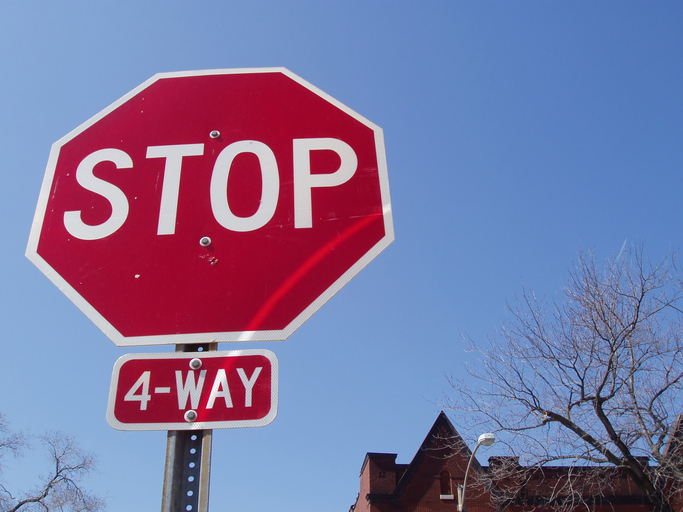
How Fault Is Determined in Fort Myers Four-Way Stop Car Accidents
Florida Statute section 316.123 sets the right-of-way rule at a four-way stop in three sentences: first to stop goes first, simultaneous arrivals yield to the driver on the right, left-turners yield to oncoming traffic. Clear enough in the driver’s handbook. In thirty years of personal injury practice in Lee and Collier Counties, I have watched that rule decide almost none of the actual cases. What decides them is whether the driver who claims to have stopped first actually came to a full stop, how fast both drivers were moving, and what evidence — a doorbell camera, a dashcam, a witness who stayed — survived the week after the crash.
What follows is how I actually look at these cases when a client first walks in the door, what Florida law genuinely says about right-of-way and shared fault, and what to do in the first forty-eight hours after the crash so you do not give the other side easy ammunition.
What Florida law actually says about four-way stops and fault
The right-of-way rule at a four-way stop lives in Florida Statute section 316.123. In plain English, the first car to come to a complete stop has the right of way. If two cars stop at roughly the same instant, the driver on the right goes first, and the driver on the left has to wait. Left-turning drivers always yield to oncoming drivers going straight. That is the textbook version.
The textbook version almost never decides the case. What decides the case is whether the driver who claims to have stopped first actually came to a full stop, and whether the driver they hit was traveling at a reasonable speed for the conditions. Both of those questions are decided under Florida’s general duty-of-care rules, not under the four-way stop statute itself.
Then comes the math. Florida runs on modified comparative negligence under Florida Statute section 768.81. In plain English, a jury can split fault between the two drivers. If you are assigned thirty percent of the blame, your damages get reduced by thirty percent. But the 2023 reform put a hard ceiling on that — if a jury decides you were more than fifty percent at fault, you recover nothing. Zero. That fifty-percent line is why insurers fight so hard to push even a sliver of blame onto our clients in stop-sign cases.
Two more statutes drive the practical side of these cases. Florida Statute section 627.736 is the Personal Injury Protection rule — your own auto policy pays the first ten thousand dollars of medical and lost-wage costs no matter who caused the wreck, as long as you see a doctor within fourteen days. And Florida Statute section 95.11(4)(a) now gives you only two years from the date of the crash to file suit on a negligence claim. That clock used to be four. Plenty of clients lose recoverable cases because they wait too long.
Four stop-sign collision patterns we handle regularly
If I sit down and pull our last several years of stop-sign files, almost every wreck falls into one of four buckets. Knowing which bucket you are in shapes how the case gets built.
- The rolling stop. One driver coasted through at five or ten miles per hour without ever putting the brake pedal flat on the floor. This is by far the most common pattern at residential intersections off McGregor Boulevard and on the side streets that feed into Cleveland Avenue. The rolling driver swears they stopped; the other driver swears they did not. The case usually turns on a doorbell camera, a dashcam, or a witness behind them.
- The simultaneous-arrival dispute. Both drivers stopped, both genuinely believed they were first, and both pulled out together. These are the hardest fault fights, and they are the ones most likely to end with shared blame under section 768.81.
- The left-turn-across-traffic miscount. A driver turning left assumes the oncoming driver is also stopping, pulls into the intersection mid-turn, and gets T-boned in the passenger door. Florida law puts the burden on the left-turning driver in almost every one of these.
- The four-way at a busy crossing with a runner. Daniels Parkway side streets, Summerlin Road feeders, and the residential cuts off Six Mile Cypress Parkway have stop signs that drivers from out of town simply blow through. When the runner hits a yielded car, fault is usually clean, but identifying the runner can be the harder problem if they leave the scene.
What makes stop-sign cases harder to close than they should be
People underestimate how much evidence disappears in the first week after a stop-sign wreck. Traffic-camera footage at most Lee County intersections is overwritten on a rolling cycle, sometimes as short as seventy-two hours. The convenience store on the corner that filmed the whole thing erases its DVR every five to ten days unless someone formally requests a copy. The witness who stopped, gave you a phone number on a napkin, and drove off — half the time that napkin number is wrong by one digit because they were rattled.
Florida’s crash-report requirement under section 316.066 means the responding officer’s report will exist, but the report’s fault narrative is the officer’s best guess from a scene they arrived at twenty minutes after the crash. I have watched plenty of officer narratives get rewritten once dashcam footage shows up. The narrative is a starting point, not a verdict.
The other complication is medical. Stop-sign crashes happen at low speeds, between fifteen and thirty-five miles per hour in most cases, and the insurance adjusters know that low speed reads to a jury as low injury. It does not work that way medically — cervical strain, disc injuries, and concussions from a thirty-mile-per-hour T-bone are real and lasting — but the defense will always try to argue the speed makes the injury implausible. That is why early, consistent medical documentation matters so much.
What we did on a Fort Myers rear-end claim
One we handled recently was a rear-end on US-41 in Fort Myers at a four-way crossing where our client had come to a full stop behind the line. The driver behind him never slowed down, hit him at speed, and then drove off before anyone could get a tag. No witnesses caught the plate. The crash report listed the at-fault driver as unknown.
Our client went to the emergency room the same night with what eventually became a chronic cervical strain. He spent several months in physical therapy and another stretch on a pain-management program. Without a known defendant, the traditional liability route was closed. We worked the case through his own carrier’s uninsured motorist coverage under section 627.727, built the medical record carefully, documented every gap and every flare-up, and pushed the carrier hard on the consistency of the injury picture.
The case closed at a full policy payout. The lesson for anyone reading this is that a hit-and-run at a stop-sign intersection is not a dead case. The standing is there in your own policy if you know to look for it.
What to do if you have just been hit at a four-way stop
This is the list I give clients when they call from the side of the road. It is the list I built over years of watching what worked and what cost people money:
- Photograph the stop signs in all four directions, not just your own. Half the disputes I see come down to whether a sign was actually visible from the other driver’s angle, especially when palmettos or oleander have grown out over the sign in older Fort Myers neighborhoods.
- Walk the intersection corners and look for cameras. Doorbell cams on the houses, ATM cameras at gas stations, drive-thru cameras at quick-service restaurants. Note the addresses. We can send a preservation letter the next morning, but only if we know where to send it.
- Get witnesses to text you a photo of their driver’s license. A phone number on a napkin gets lost or written down wrong. A driver’s license photo on your phone never gets lost.
- See a doctor within fourteen days. Not seven, not ten, but fourteen at the outside, because that is the PIP cutoff under section 627.736. Even if you feel mostly fine, get checked. Cervical strain often shows up forty-eight to seventy-two hours after the crash, and a clean medical record from day one is worth more than any argument later.
- Do not give a recorded statement to the other driver’s insurer. Your own carrier, yes, you have a contractual duty to cooperate. The other side’s adjuster will call within two or three days, sound friendly, and ask questions that are written to lock in admissions. Politely decline and tell them to call your lawyer.
- Write down what you remember the same night. Time, weather, what you saw, what you heard, what the other driver said when they got out of the car. Memory degrades fast. The note you wrote the night of the crash is far more persuasive at deposition than the one you wrote six months later.
Key Takeaways
- Florida Statute section 316.123 sets the right-of-way rule at four-way stops, but real cases are almost always decided by evidence of who actually stopped and at what speed, not by the textbook rule.
- Modified comparative negligence under section 768.81 splits fault between drivers, but if a jury puts you over fifty percent at fault, you recover nothing.
- You have two years from the date of the crash to file suit under section 95.11(4)(a). The old four-year clock is gone.
- PIP under section 627.736 pays the first ten thousand dollars of medical and lost-wage costs no matter who was at fault, but only if you see a doctor within fourteen days.
- Hit-and-run cases at stop signs are not dead. Uninsured motorist coverage under section 627.727 often becomes the source of recovery, and a full policy payout is achievable.
Frequently Asked Questions
If two cars arrive at a four-way stop at the same instant, who legally has the right of way?
Under Florida Statute section 316.123, when two drivers reach the intersection at roughly the same time, the driver on the left must yield to the driver on the right. That said, a real four-way stop almost never produces a clean simultaneous arrival, which is why fault disputes at these intersections so often turn on a few seconds of video or a single witness.
Can I still recover money if a Fort Myers police report blames me for the four-way stop crash?
Yes, often you can. A crash report is the officer’s opinion based on what was visible at the scene, but it is not the final word on civil liability. We have had cases where dashcam video, traffic camera footage, or vehicle-damage analysis flipped the fault picture entirely. Under Florida’s modified comparative negligence rule in section 768.81, you can still recover as long as you are not more than fifty percent at fault.
How long do I have to file a lawsuit after a four-way stop accident in Fort Myers?
For most negligence claims from a crash that happened on or after March 24, 2023, Florida Statute section 95.11(4)(a) gives you two years from the date of the wreck to file suit. The old four-year window is gone. That two-year clock is shorter than people expect, and it runs even while you are still in physical therapy or fighting with the insurer.
Does my own PIP coverage pay for medical bills even if the other driver ran the stop sign?
Yes. Under Florida Statute section 627.736, Personal Injury Protection pays up to ten thousand dollars of your medical and lost-wage costs no matter who caused the crash, but you must see a medical provider within fourteen days. Miss that window and the PIP benefit can be cut to two thousand five hundred dollars or denied outright.
What if the other driver fled the four-way stop after the crash?
Hit-and-run cases at intersections are more common in Lee County than people realize. If the other driver is never identified, your own uninsured motorist coverage under Florida Statute section 627.727 becomes the source of recovery. We have closed hit-and-run files at full policy payout by working the UM angle the same way we would a traditional liability case.
Talk to Our Office
If you have been hit at a four-way stop anywhere in Fort Myers, Cape Coral, or the rest of Lee County, the first forty-eight hours matter. Evidence disappears, insurers start building their version of the story, and the two-year statute starts running the day of the wreck. Call our office at 239-992-8259 for a free consultation. There is no fee unless we recover for you.
About the Author

Pittman Law Firm, P.L., founded by David B. Pittman, Esq., has built thirty-plus years of personal injury practice in Fort Myers and across Lee County, with a sustained focus on serious-injury auto and complex-liability cases. The firm’s Fort Myers presence handles a steady stream of serious-injury work along the Daniels Parkway, Six Mile Cypress, McGregor Boulevard, Cleveland Avenue, and Summerlin Road corridors, and along I-75 between Estero and Bell Tower.
Two South Carolina institutions shaped David’s path: The Citadel, The Military College of South Carolina for undergraduate, and the University of South Carolina School of Law for his JD. He is AV-Preeminent at Martindale-Hubbell and a Multi-Million Dollar Advocates Forum member.
David has held a Florida real estate broker license for twenty-five years, a credential that shapes how the firm reads the property side of premises cases. The firm handles personal injury cases across Lee and Collier Counties, serving Fort Myers, Bonita Springs, Naples, Cape Coral, Estero, and Lehigh Acres, with offices at Windsor Place in Bonita Springs (main) and Fort Myers (satellite). Call 239-992-8259 for a free consultation.
Disclaimer: This article is general information about Florida law and is not legal advice for any particular situation. Reading it does not create an attorney-client relationship with Pittman Law Firm, P.L. Every case turns on its own facts; if you have been injured, please contact our office directly. Attorney advertising.