

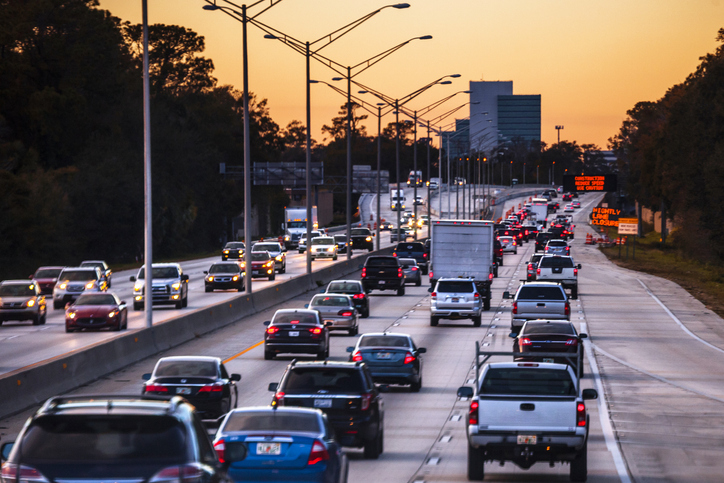
2025 Traffic Congestion Crisis: Why Fort Myers Short Trips Now Take Hours
The I-75 stretch between Alico Road and Colonial Boulevard moved about 170,000 vehicles a day in 2024. Daniels Parkway near the airport regularly stacks for a mile at rush hour. Cleveland Avenue has been under construction or resurfacing in one segment or another almost continuously since 2022. Fort Myers has become one of the most congested mid-sized metros in Florida, and the crash rate tracks right alongside it.
The legal questions that come out of that congestion — who pays, who is at fault, what happens when nobody can tell the officer exactly how the chain reaction started — land on my desk every week. Here is what the law says and what I have learned about handling those cases in the last few years.
What Florida law actually says about traffic-crash injury claims
There are five statutes I find myself walking clients through almost every week. None of them is dramatic on its own. Together they decide whether someone recovers fairly for a Fort Myers wreck or walks away holding the bag.
The first is the modified comparative negligence rule at §768.81. In 2023 the Legislature changed Florida from a pure comparative-fault state to a modified one. In plain English, if a jury decides you were 50 percent or less responsible for the crash, your recovery is reduced by your fault percentage. If a jury puts you at 51 percent or more, you recover nothing. That single change has shifted how we evaluate every congested-corridor case. When five cars pile up at the Daniels Parkway and Six Mile Cypress Parkway light and everyone is pointing at everyone else, the difference between a 49 percent finding and a 51 percent finding is the entire case.
The second is the two-year statute of limitations at §95.11(4)(a). The same 2023 reform cut the negligence filing window in half, from four years to two. Two years sounds like a long time. It is not, especially in a serious-injury case where surgery and recovery can eat the first eighteen months before anyone has thought about a lawsuit. We have already started seeing cases come in too late, and there is nothing a lawyer can do at that point.
The third is Florida PIP at §627.736. Personal Injury Protection pays the first ten thousand dollars of your medical bills no matter who caused the crash, as long as you see a treating provider within fourteen days. I cannot count how many otherwise solid cases have been damaged because the injured driver toughed it out for three weeks and then went to the doctor on day twenty-two. See a provider in the first two weeks, even if you think you are fine. That ten-thousand-dollar pot is yours regardless of fault, and skipping it is leaving money on the table.
The fourth is Uninsured Motorist coverage at §627.727. Florida is one of the most under-insured states in the country, and on a corridor like Pine Island Road or Cleveland Avenue the odds that the driver who hits you carries only the state minimum, or no bodily injury coverage at all, are real. UM steps into that driver’s shoes and pays out of your own policy. It is optional in Florida, which is the single most frustrating sentence I write in any of these pieces. Carry it. We tell every client that, every time.
The fifth is the crash-report requirement at §316.066. Florida law requires a written report any time a crash involves injury, death, or property damage that looks like a tow. In a fender-bender that turns out to have caused a herniated disc three weeks later, the existence of an officer’s report is often the difference between a case and an argument. Wait for the officer, even on a hot afternoon on Summerlin Road. The self-reported online form is not the same animal.
Six crash patterns we see regularly on Fort Myers’ busiest corridors
Congestion does not create new kinds of wrecks. It multiplies the old ones. Here are the patterns that come through our doors most often:
- Stop-and-go rear-enders on I-75 near Alico Road. Traffic crests a slow patch, the lead driver brakes, and the third or fourth car back is on a phone or following too close. These look like simple cases until you find out the at-fault driver carried only $10,000 in bodily injury coverage and the client needs a cervical fusion.
- Left-turn collisions on Cleveland Avenue and McGregor Boulevard. Older intersections with permissive left turns, heavy snowbird traffic, and sight-line problems from landscaping. The fault fight is almost always about who had the protected phase and whether the turning driver crept into the intersection.
- Multi-vehicle pileups on Colonial Boulevard. The diverging-diamond construction and the volume of traffic make this corridor one we see almost weekly. Pileups create the comparative-fault problem above: five drivers, five stories, one report from an officer who arrived after the dust settled.
- Side-swipes during merging on the Daniels Parkway and Six Mile Cypress Parkway exits. Drivers from out of town do not know the lane structure and dart across two lanes at the last moment. The local driver who was holding their lane gets clipped and then gets blamed.
- Bridge-related rear-enders on the Midpoint and Cape Coral approaches. Backups stack into single-lane queues, brake lights fire in waves, and one inattentive driver in a four-thousand-pound truck is enough.
- Construction-zone wrecks along Summerlin Road and Pine Island Road. Cones move, lanes shift overnight, and a driver who has done a route for ten years suddenly finds the merge in a different place at 7:30 a.m.
Three things that make congested-corridor claims harder to settle than they look
When a corridor is congested, three practical things happen that complicate the legal side.
First, witnesses scatter. On a quiet Bonita Springs side street, two neighbors stay until the officer arrives. On Cleveland Avenue at 5:15 p.m., everyone has somewhere to be. By the time anyone is looking for the white sedan that swerved and triggered the chain reaction, that car is in Cape Coral. Our office now starts witness work within the first week, because waiting any longer means the witnesses are gone.
Second, the property damage looks deceptively small. Modern bumpers absorb low-speed impacts and look almost untouched, while the human spine inside the car takes the full deceleration. Insurance carriers love a clean bumper photograph. They use it to argue the impact could not have caused a serious injury. We counter that with medical imaging and biomechanical testimony from a qualified engineer, but the fight is real, and the cleaner the bumper the harder the case.
Third, comparative-fault arguments multiply with every car involved. In a five-car pileup, every defense lawyer is trying to push fault away from their driver and onto someone else. With the 51-percent bar from §768.81, that is not a small fight. It is the case. Documenting the sequence of impacts, the brake patterns, the position of debris, the timing of brake lights from the data recorders, all of it matters.
What to do if you are involved in a Fort Myers traffic crash
I have walked clients through the first twenty-four hours of a wreck more times than I can count. The steps below are not generic advice from a brochure. They are the things I have watched make and break cases.
- Call 911 and wait for the officer. A crash report under §316.066 is worth the wait, even if you are blocking a lane on Daniels Parkway and the drivers behind you are honking. The officer’s narrative will outlive everyone’s memory.
- Take photographs before the cars move. Final resting positions, debris fields, brake-mark patterns. Phone cameras are good enough. We have won fault fights on photographs a client took in the first ten minutes.
- Get names and direct contact information for any witness. A name on a police report is not enough on a busy corridor. A phone number and an email is. Witnesses who saw the lead-in to the wreck are gold; ask them what they saw before the impact, not just after.
- See a doctor inside fourteen days. PIP under §627.736 requires it, and beyond the legal requirement, soft-tissue injuries reveal themselves on day three or four. Document them when they are showing up, not three weeks later when the insurance adjuster has already framed the story.
- Do not give a recorded statement to the other driver’s carrier. Your own carrier is one thing. The adjuster for the driver who hit you is taking a statement they will use against you. Politely decline, and call a lawyer before you say anything more.
- Save the car if you can. The event data recorder, the seat belt assembly, and the airbag module hold information that disappears the moment the vehicle is salvaged. If the case is serious, we will preserve the car. Tell the body shop to wait.
- Write down what you remember the same day. Time, weather, who was in the car, what songs were playing, whether the light had just turned. Your memory of the wreck is sharpest in the first forty-eight hours and gets fuzzier from there.
What a $150,000 Fort Myers rear-end case looked like
A Fort Myers client was rear-ended in a traffic collision and came to us with a neck injury. That case settled for $150,000. The police report, the documented gap between the vehicles, and the consistent medical record from the day of the crash forward were the pillars of the negotiation.
Key Takeaways
- Florida’s two-year deadline at §95.11(4)(a) is the single most-missed cutoff we see. Two years from the crash date, and the case is gone.
- Under §768.81, a jury finding of 51 percent or more fault wipes out the entire recovery. On a multi-car corridor wreck, that fault fight is the case.
- See a treating provider inside fourteen days of any crash, or the $10,000 PIP benefit at §627.736 is at risk.
- Uninsured Motorist coverage under §627.727 is optional in Florida and the most-skipped coverage we wish every Lee County driver carried.
- Photographs, witness contact information, and a written crash report at the scene are worth more than anything anyone says three weeks later.
Frequently Asked Questions
Q1. If I get rear-ended in Fort Myers stop-and-go traffic, whose insurance pays my medical bills first?
Your own PIP coverage under §627.736 pays the first $10,000 of medical bills regardless of fault, as long as you see a treating provider within 14 days of the crash. After PIP runs, claims against the at-fault driver’s bodily injury coverage and your own UM coverage come into play.
Q2. How long do I have to file a lawsuit after a Fort Myers traffic crash?
Under the 2023 reform to §95.11(4)(a), the deadline for filing a negligence lawsuit in Florida is two years from the date of the crash. That cutoff replaced the older four-year window, and missing it generally ends the case before it begins.
Q3. Can I still recover money if the crash was partly my fault?
Yes, but only if a jury assigns you 50 percent or less of the fault. Under §768.81, a Florida plaintiff found 51 percent or more at fault recovers nothing. If you are 30 percent at fault, your recovery is reduced by 30 percent.
Q4. Do I have to file a police report after a fender-bender on Daniels Parkway or Six Mile Cypress?
Under §316.066, Florida law requires a written crash report any time there is injury, death, or apparent property damage that looks like it will need a tow. On busy Lee County corridors, call the officer and wait. A self-reported insurance write-up later is rarely enough.
Q5. What if the driver who hit me has no insurance or took off?
Your own Uninsured Motorist coverage under §627.727 steps into the at-fault driver’s shoes and pays for your injuries up to your UM limit. UM is optional in Florida, which is exactly why we tell every Lee County driver to carry it.
Talk to our firm before the two-year clock runs out
If you were hurt in a Fort Myers traffic wreck, the most important call you make in the first few weeks is the one that gets you in front of a lawyer who handles these cases for a living. Our office takes the call, reviews the facts, and tells you straight whether we think there is a case worth pursuing. Call 239-992-8259 for a free consultation. There is no fee unless we recover for you.
About the Author

Pittman Law Firm, P.L., founded by David B. Pittman, Esq., has built thirty-plus years of personal injury practice in Fort Myers and across Lee County, representing injured clients across Lee and Collier Counties with a particular focus on commercial-vehicle, complex-liability, and serious-injury cases. The firm’s Fort Myers presence handles a steady stream of serious-injury work along the Daniels Parkway, Six Mile Cypress, McGregor Boulevard, Cleveland Avenue, and Summerlin Road corridors, and along I-75 between Estero and Bell Tower.
David’s undergraduate years were at The Citadel, The Military College of South Carolina; his law degree is from the University of South Carolina School of Law. He carries an AV-Preeminent rating at Martindale-Hubbell and Multi-Million Dollar Advocates Forum membership.
David has held a Florida real estate broker license for twenty-five years, a credential that shapes how the firm reads the property side of premises cases. The firm handles personal injury cases across Lee and Collier Counties, serving Fort Myers, Bonita Springs, Naples, Cape Coral, Estero, and Lehigh Acres, with offices at Windsor Place in Bonita Springs (main) and Fort Myers (satellite). Call 239-992-8259 for a free consultation.
The information on this website is for general information purposes only. Nothing on this site should be taken as legal advice for any individual case or situation. This information is not intended to create, and receipt or viewing does not constitute, an attorney-client relationship.