

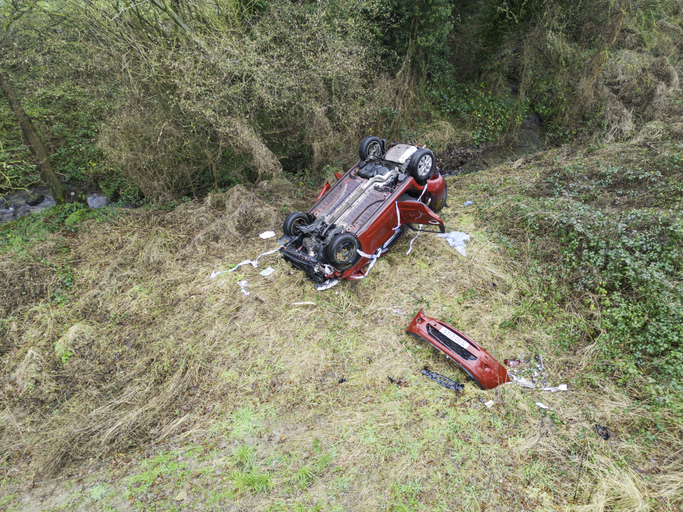
Why Vehicle Rollover Car Accidents Happen in Fort Myers
On I-75 near Alico Road, August surface temperatures run past 140 degrees on the asphalt. An aged tire at high pressure takes a load and gives up. The driver steers in response, the SUV’s center of gravity shifts, and what started as a routine southbound run ends on the shoulder with the vehicle on its side. That is the most common rollover we see in Lee County. It does not look the way rollover accidents look in movies. It looks like a tire problem and a steering input, and then it is over.
The legal questions that follow are the ones I want to walk through here: what Florida law says about fault and recovery on a rollover claim, the seven patterns we see in our office, why the case that looks simple in the police report often isn’t, and the steps that have made the most difference for the people we have represented.
What Florida law actually says about a Fort Myers rollover claim
Most of what determines whether a rollover claim is worth pursuing in Fort Myers comes down to four sections of the Florida Statutes. None of them are written for normal humans to read, so let me put each one into plain English.
Section 768.81, Florida Statutes — modified comparative negligence. Before March 24, 2023, Florida ran on pure comparative fault. You could be 80% at fault and still collect 20% of your damages. The 2023 reform flipped that. Now, if a jury puts you at 51% or more, you recover nothing. At 50% or below, your damages get reduced by your share. In a rollover, the defense almost always argues the driver overcorrected, was on the phone, or hit the curb. The fight over those few percentage points is now the whole ballgame.
Section 95.11(4)(a), Florida Statutes — the two-year statute of limitations. The same 2023 bill cut the negligence filing window from four years to two. Two years from the date of the crash, with very narrow tolling. Half the calls I get from people who waited “until they finished treatment” are calls I have to turn away because the clock ran out while they were still in physical therapy. If you were rolled out of a vehicle on Daniels Parkway, your deadline is fixed before the bruising has faded.
Section 627.736, Florida Statutes — PIP / No-Fault. Florida is a no-fault state for the first layer of medical care. Your own PIP pays the first $10,000 of medical and lost wages, regardless of who caused the rollover, on one condition: you have to receive initial care within fourteen days. Miss that window and PIP is gone. In rollover cases where the driver “feels fine” and skips the ER, that fourteen-day rule has cost people real money.
Section 627.727, Florida Statutes — Uninsured and Underinsured Motorist coverage. Florida does not require drivers to carry bodily-injury liability. Roughly one in five drivers on McGregor Boulevard is uninsured. If a phantom car runs you off Summerlin Road and disappears, the only coverage that responds is your own UM, and only if you bought it. Of all the lines on a Florida auto policy, UM is the one I push hardest on every potential client. It is the difference between a settlement and a thank-you letter.
One more, because every rollover involves it: section 316.066, Florida Statutes requires a long-form crash report whenever a wrecker is called or anyone is hurt. That report is the document the carrier reads first, and the document a jury sees later. Errors in it are not minor. We chase corrections in the first week, while officers still remember the scene.
Seven rollover patterns from Fort Myers and Lee County roads
Strip out the national averages and look at what walks in the door of our office on Bonita Beach Road. The same patterns repeat:
- The tripped SUV on a shoulder drift. Driver on Daniels Parkway, lane drifts an inch to the right, tires catch soft pavement transition or grass, vehicle trips and rolls. Nine times out of ten the driver was reaching for a phone, a coffee, or a child in the back seat.
- The August tire blowout. I-75 near Alico Road, mid-afternoon, summer surface temperatures over 140°F on the asphalt. An aged tire with high pressure and a load gives up. Top-heavy vehicles roll on the steering input that follows.
- The avoidance maneuver after a sudden brake. Two-lane stretches of Pine Island Road get this constantly. A driver ahead brake-checks for a turn, the SUV behind swerves, the swerve becomes an overcorrection, the overcorrection becomes a roll.
- The rural-road sleep. Out past Lehigh, on long straight Lee County roads with 55 mph speed limits, a fatigued driver crosses onto the shoulder, wakes up, jerks the wheel, and rolls into the ditch. Roughly three out of four fatal Florida rollovers happen on this kind of road.
- The hit-and-run that becomes a “single-vehicle” rollover. A second car clips the rear quarter on Cleveland Avenue and keeps driving. The remaining vehicle rolls. The crash report calls it single-vehicle because nobody saw the other car stop. Without UM, the case dies on paper.
- The Summerlin Road weather rollover. First fifteen minutes of a summer downpour. Oil and grime float to the surface. A heavy vehicle changes lanes into a slick spot, breaks traction, and rolls on the rebound.
- The cargo-shift rollover in pickups. Landscaping trucks, contractor vans, and personal pickups along Six Mile Cypress Parkway moving uneven loads. A sharp left at a light shifts the load right, raises the center of gravity, and the right tires leave the pavement.
None of these sound like the dramatic crashes that get filmed and posted. All of them are what our case files look like.
Four legal traps specific to rollover claims
From the outside, a rollover seems easy. The car is on its roof. Somebody did something wrong. But the legal mechanics carry several quiet traps.
Single-vehicle framing. If the report reads as a single-vehicle wreck, the insurance carrier’s first instinct is to put 100% of the fault on the driver. That kills the case under the 2023 reform. Our first job is almost always to challenge that framing, whether through paint transfer on the rear quarter, witness statements from a McGregor Boulevard storefront, or roadway-design records pulled from the Lee County DOT.
The vehicle gets totaled and disappears. Carriers move quickly to declare a rollover a total loss and send the wreck to auction. Once that vehicle is gone, so is the chance to inspect the tire that blew, the tie rod that snapped, the seat belt that did not lock. We put a hold letter on the vehicle within twenty-four hours when we can.
Soft-tissue injuries that turn out not to be soft. A Fort Myers rollover routinely produces what looks like a cervical strain in the ER and turns into a herniated disc on an MRI six weeks later. PIP runs out at ten thousand dollars long before the imaging is done. Sequencing care so the medicals are documented before the demand goes out is the difference between a $25,000 case and a six-figure one.
The road-design angle. Some Lee County intersections roll vehicles because the geometry is wrong, not because the driver was. Worn-down rumble strips, missing edge-line striping, drainage that puts an inch of standing water in the right lane — these are real defendants, and the records exist if you ask for them in time.
A US-41 rear-end with a hit-and-run — and a UM policy that carried it
A case worth describing: a client of ours, driving north on US-41 in Fort Myers in evening traffic, slowed for a light and was rear-ended by a driver who never tapped the brakes. The impact was hard enough to push our client into the vehicle ahead. The at-fault driver pulled to the shoulder, waited about ninety seconds, and drove away before any officer arrived. By the time deputies were on scene, the only physical evidence of the second vehicle was paint transfer and a broken license-plate fragment in our client’s bumper.
The injuries were the kind that get dismissed in the first round of claims handling. ER imaging on the night of the crash, a few weeks of follow-up, then escalating neck pain that pushed the case into months of physical therapy and ultimately a pain-management referral for chronic cervical strain. The carrier’s first position was the position carriers always take: soft-tissue injury, no objective findings, lowball offer.
Two things turned this case. Second, we built the medical record patiently. By the time we sent the demand, the file had imaging, treating-physician narratives, and a documented arc of consistent symptoms. The result was a full policy payout under our client’s own UM coverage, with no need to file suit. It is one of the cleanest examples I can point to of why I push every client we meet to carry meaningful UM limits in Florida.
What to do if you are in a Fort Myers rollover
The advice below comes from watching what has worked in our office, not from a generic checklist. The order matters.
- Stay belted in until you stop moving. The single worst injuries we have seen come from people who unbuckled mid-roll. Wait until the vehicle is fully at rest before you release the belt.
- Call 911 even if you feel fine. Section 316.066 will require a report anyway, and the absence of a same-day report becomes the carrier’s favorite argument three months later. The deputies who respond to rollovers along Colonial Boulevard and Cleveland Avenue know to look for the second-vehicle paint transfer; ask them to look.
- Photograph the underside. If the vehicle is on its side or roof, the underside is the only time in the vehicle’s life you will be able to photograph the suspension, the tires, the brake lines. Take those photos before the wrecker rights the vehicle.
- Get seen within fourteen days. Even if you walk away. Section 627.736 will not pay PIP after day fourteen if you have not been evaluated. An urgent-care visit is enough.
- Do not give a recorded statement to the at-fault carrier. They will call within forty-eight hours and they will ask whether you were “OK after the crash.” The right answer is that you are still being evaluated, and that you will follow up after you have spoken with an attorney.
- Save the wrecked vehicle. If the carrier wants to total it and move it to auction, ask in writing that it be held. If you have a lawyer at that point, the hold letter goes out on our letterhead.
- Find your declarations page. Specifically the UM coverage line. That number, more than anything else in the file, will determine what the case is worth.
Key Takeaways
- Section 768.81 now bars any recovery if you are 51% or more at fault — rollover defenses target driver percentage first.
- The negligence statute of limitations is now two years under section 95.11(4)(a); the old four-year clock is gone.
- PIP under section 627.736 pays $10,000 of early medical and lost wages, but only if you treat within 14 days of the rollover.
- Uninsured Motorist coverage under section 627.727 is what answers the call when a phantom vehicle leaves the scene on US-41 or McGregor Boulevard.
- Preserve the wrecked vehicle, photograph the underside, and request a complete section 316.066 long-form report before any of the physical evidence is gone.
Frequently Asked Questions
Q1. Does Florida’s 2023 negligence reform change what I can recover after a rollover?
Yes. Under section 768.81, Florida Statutes, if a jury assigns you more than 50% of the fault, you recover nothing. If you are 50% or under, your recovery is reduced by your share. Rollover defenses lean hard on driver fault, which is why how the crash is framed at the start matters.
Q2. How long do I have to file a Fort Myers rollover case after the 2023 reform?
Two years from the date of the crash under section 95.11(4)(a), Florida Statutes. The old four-year window is gone for negligence claims that accrued on or after March 24, 2023. People still call us thinking they have four years, and that mistake has ended cases.
Q3. Will my PIP cover a rollover injury if I was the driver?
Florida’s no-fault PIP under section 627.736 pays the first $10,000 of medical and lost wages regardless of who caused the crash, as long as you treat within 14 days. After that, serious-injury cases move to a bodily-injury claim against the at-fault driver or to your UM carrier.
Q4. What if the other driver fled the scene or had no insurance?
Section 627.727 of the Florida Statutes governs Uninsured and Underinsured Motorist coverage. If you carry UM, it stands in for the missing driver. Phantom-vehicle rollovers, where another car runs you off the road and keeps going, are exactly what UM was written for. The catch is corroboration, and we deal with that head-on.
Q5. Do I have to file a crash report if my rollover was a single-vehicle wreck?
Under section 316.066, Florida Statutes, any crash involving injury, death, or apparent property damage that requires a wrecker must be reported. Single-vehicle rollovers almost always meet that threshold. The long-form report the officer files becomes the spine of the case file, so we want it complete and accurate.
Talk to our office about your Fort Myers rollover
If you or someone in your family has been hurt in a rollover anywhere from Daniels Parkway to Pine Island Road, we want to hear the story before the insurance carriers shape it. Call Pittman Law Firm, P.L. at 239-992-8259 for a free consultation. There is no fee unless we recover for you. I will sit with you, look at the declarations page, pull the long-form crash report, and tell you straight what we think the case is worth.
About the Author

Pittman Law Firm, P.L., founded by David B. Pittman, Esq., has built thirty-plus years of personal injury practice in Fort Myers and across Lee County, with a sustained focus on serious-injury auto and complex-liability cases. The firm’s Fort Myers presence handles a steady stream of serious-injury work along the Daniels Parkway, Six Mile Cypress, McGregor Boulevard, Cleveland Avenue, and Summerlin Road corridors, and along I-75 between Estero and Bell Tower.
Two schools made the lawyer: The Citadel, The Military College of South Carolina, and the University of South Carolina School of Law. The recognition followed: AV-Preeminent at Martindale-Hubbell, membership in the Multi-Million Dollar Advocates Forum.
David has held a Florida real estate broker license for twenty-five years, a credential that shapes how the firm reads the property side of premises cases. The firm handles personal injury cases across Lee and Collier Counties, serving Fort Myers, Bonita Springs, Naples, Cape Coral, Estero, and Lehigh Acres, with offices at Windsor Place in Bonita Springs (main) and Fort Myers (satellite). Call 239-992-8259 for a free consultation.
Attorney advertising. The information on this page is for general information only and is not legal advice for any particular case. Reading this material does not create an attorney-client relationship with Pittman Law Firm, P.L. Past results do not guarantee a similar outcome.