

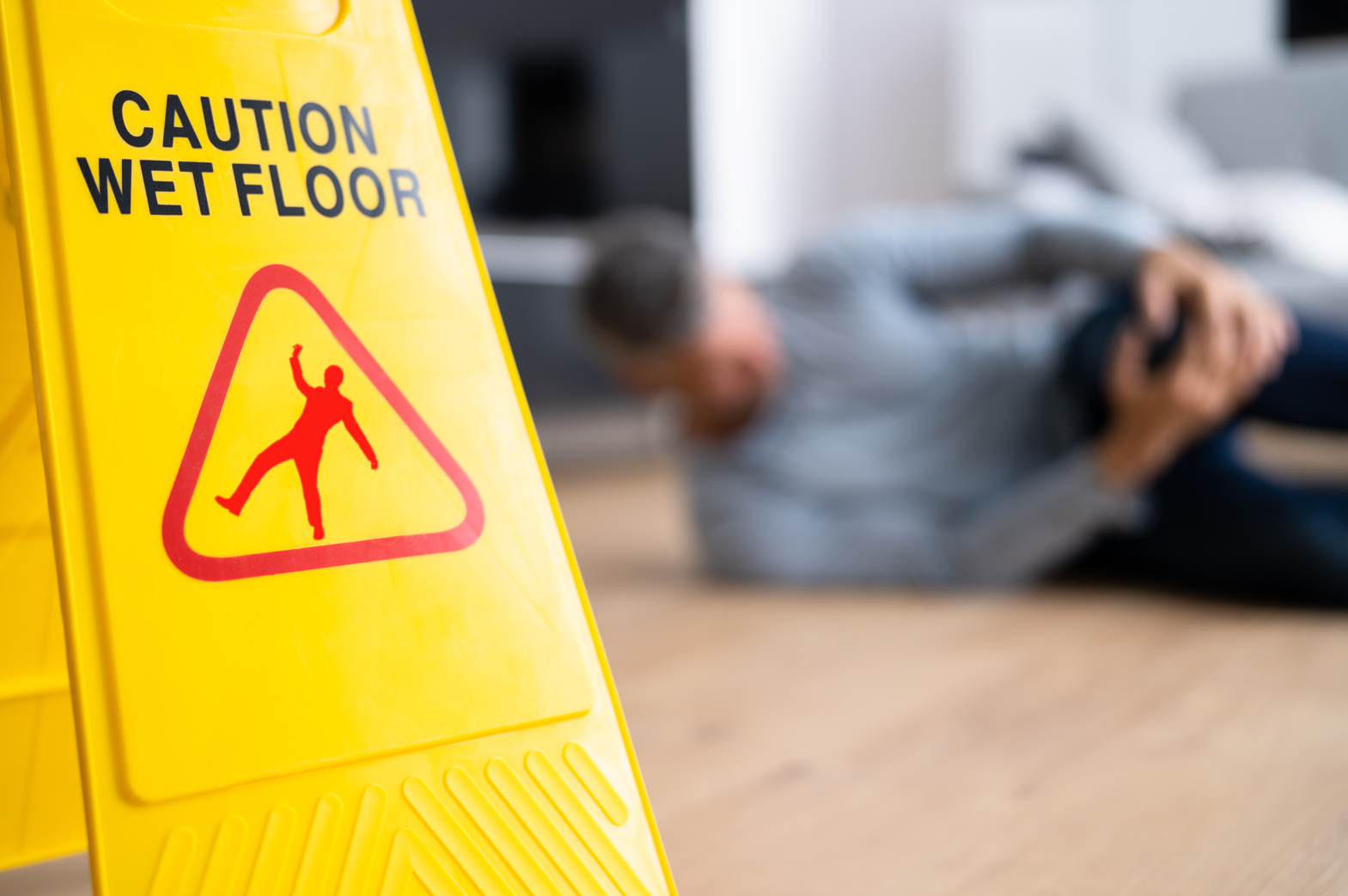
Why Naples Slip and Fall Cases Spike in the Spring Rainy Transition
Walk into any restaurant on 5th Avenue South around 4 p.m. on the first heavy rain of the spring and watch what happens at the entryway. The tourists have been out all day on dry pavers and hot asphalt. They come through the door with wet sandals, and the tile inside, which has been bone dry since November, turns immediately slick. Nobody put out a mat. Nobody mopped. The hostess is seating tables. And someone goes down. I have worked enough of those calls — the ones that start with “I fell at a restaurant in Naples last weekend” — to know that the spring rainy transition is not just weather. It is the most predictable, most preventable premises-liability season of the year.
In addition to practicing personal injury law for more than thirty years across Lee and Collier Counties, I have held a Florida real estate broker license for twenty-five years. That broker background shapes how I read a property case: I am not only thinking like a personal injury lawyer when I walk a fall site, I am also thinking like someone who has watched property managers write maintenance contracts and sit through HOA board meetings where someone decides whether to actually pressure-wash the algae off the pool deck this quarter. That second lens tends to surface the facts that move a slip and fall case from “you tripped” to “you tripped because the owner was running a property in a way no reasonable owner would run it.”
That is what I want to walk through here: what Florida law actually requires of property owners in a Naples spring, what a court looks at, where the doctrine is messier than it sounds, what we see most in Collier County, and what a person should do in the first forty-eight hours after a fall.
What Florida Law Requires of a Property Owner
Florida has three statutes that do most of the work in a slip and fall case, plus a body of case law on top of them. The right statute depends on what you fell on and where you were.
Section 768.0755, Florida Statutes — transitory foreign substances. This is the one most people have heard about even if they do not know the citation. It governs falls on a “transitory foreign substance” in a business establishment. Think water tracked in from outside, a spilled drink at a restaurant, produce on a grocery floor, mopping water, sunscreen on a resort pool deck. In plain English, the statute says you have to prove the business knew about the substance or should have known about it long enough that a reasonable manager would have cleaned it up or warned about it. Knowing it might rain is not enough. Knowing the front mat is soaked and the tile inside is wet is.
Section 768.0710, Florida Statutes — negligent maintenance and structural conditions. The other big bucket. This one covers cracked sidewalks, uneven pavement, missing handrails, broken stair treads, raised paver edges, settled walkway sections, pothole-style depressions in parking lots. These are not “someone spilled something” cases. They are “the property itself is broken” cases. Notice still matters, but the focus is on whether the condition existed long enough, and was open enough, that a reasonable owner would have repaired it or warned about it.
Section 768.075, Florida Statutes — duties owed to invitees, licensees, and trespassers. Florida still draws lines between the categories of people on the property. An invitee, like a restaurant customer or a hotel guest, is owed the highest duty: reasonable care to keep the property safe and to warn of hidden dangers. A licensee, like a social guest, is owed less. A trespasser is owed the least, with narrow exceptions for known and discovered trespassers and for child trespassers under the attractive nuisance doctrine. Most of the falls we handle involve invitees, so the duty is at its highest.
Section 768.28, Florida Statutes — claims against a government entity. A different track entirely. If you fell on a city sidewalk in Naples, in a county-owned parking facility, or inside a public building, you are dealing with sovereign immunity rules. There are pre-suit notice requirements, sharply shortened windows for that notice, and damage caps that limit recovery from the state and its subdivisions. People miss these deadlines because the statute does not look like a deadline. Do not guess at it.
Factors a Court Actually Considers
When a Naples slip and fall case lands in front of a judge or a jury in Collier County, the analysis is rarely about one fact. It is a totality picture. After thirty years of trying and settling these cases, here is what I have watched courts and adjusters actually weigh:
- Notice. Did the owner know, or should the owner have known, about the condition? How long had it been there? Were there prior complaints, prior incident reports, prior repair requests in the maintenance log?
- Inspection routine. Did the property have a written inspection schedule, and did anyone actually follow it? “Walk the floor every fifteen minutes” written on a clipboard means nothing if the time-stamped video shows no one walked it for two hours.
- Visibility of the hazard. Was the wet area marked? Was the cracked sidewalk lit? Did surrounding distractions, signage, displays, or sun glare make the defect harder to see than it would otherwise be?
- Plaintiff’s own conduct. Were you wearing appropriate footwear? Were you carrying something that blocked your view? Were you doing something the property had warned against? Florida applies modified comparative negligence, so if you are found more than 50 percent at fault, you recover nothing, and any percentage assigned to you reduces the award.
- The condition’s history. Has someone else fallen there before? Has a building inspector flagged it? Does the maintenance log show a work order that got closed without the repair being made?
- The owner’s response after the fall. Did they preserve the surveillance video, fill out an incident report, and warn the next customer, or did the wet floor get wiped down before anyone documented it? After-the-fact behavior tends to tell on people.
The Trivial Defect Doctrine, and Why It Is Not as Clean as It Sounds
Defense lawyers love to invoke the trivial defect doctrine. The shorthand version they want a judge to hear is “anything under an inch is not actionable.” That is not actually the rule, and I have seen good cases lost because plaintiffs’ lawyers accepted that framing instead of pushing back on it.
Florida courts have, over the years, declined to impose liability for very small vertical separations in sidewalks and walkways, often in the half-inch to one-inch range. But it is not a bright line. The Florida Supreme Court and the district courts of appeal have made clear that the analysis is about whether the condition was reasonably dangerous under the circumstances, and that “the circumstances” means lighting, visibility, time of day, plaintiff’s reasonable expectations, surrounding traffic patterns, distractions, prior incidents, and whether the owner knew about it. A three-quarter-inch raised paver edge in a brightly lit, well-marked walkway is one thing. The same edge in an unlit breezeway at a resort, around a corner from the bar, at eleven at night, is something else entirely. The size does not control. The total picture does.
If your case is being brushed off because the defect was “only” half an inch or three-quarters of an inch, that is the start of the argument, not the end.
What We See Most in Naples
The Naples spring-fall pattern repeats itself in a handful of locations and configurations:
Restaurant entryways along 5th Avenue South and the older commercial strips off US-41. Tile and polished concrete entries with one indoor-outdoor mat, a glass door, and a tourist coming in from a sudden afternoon shower with wet sandals. The first ten minutes after a downpour are the worst moment of the year for these floors, because water mixes with whatever has been tracked across the entry all day.
Resort and condominium pool decks off Gulf Shore Boulevard and Vanderbilt Beach Road. Pavers and stamped concrete that have been sitting in the dry season for months grow a film of algae the moment regular moisture returns. The film is invisible until you are on it. Reasonable property management addresses this with quarterly cleaning. A lot of properties do not.
Big-box and grocery store parking lots along Pine Ridge Road, Immokalee Road, and Goodlette-Frank Road. Settled pavement near cart corrals, gutter pans that puddle, and curb transitions that are not painted. The pothole or the unpainted curb is the structural condition under 768.0710. The puddle on top of it is the transitory substance under 768.0755. Both can be in play.
Older walkway pavers at condominium and resort properties up and down Tamiami Trail North. Many of these communities were built in the 1980s and 1990s, and the pavers have settled in ways that create exactly the kind of inch-or-less vertical lips defense lawyers want to call trivial. Whether they are trivial depends on lighting, history, and the property’s prior knowledge of the lip.
Grocery store and pharmacy entrances at the major intersections near Golden Gate Parkway. Produce mist, refrigerator condensation, and the same wet-mat pattern as the restaurant entries on 5th Avenue.
One Naples premises case worth noting
This anecdote is not a Naples slip and fall, but it is the closest analog from our files to what we are talking about, because it illustrates how the same pattern recognition and the same broker-trained reading of a property can change the entire trajectory of a case. I want to share it as written, because it shows what an owner’s failure to keep a property in reasonable condition can look like when the property is not a sidewalk or a pool deck but a room with a resident in it.
A family came to us about an elderly relative at a Fort Myers facility off McGregor Boulevard. They had been visiting on a Sunday afternoon, the way they always did, and noticed marks on their loved one’s upper arms that did not look like the kind of bruising a fall produces. They were finger-shaped. They were on both arms. And there was something else: a person who had been talkative and ordinary the week before was now frightened, withdrawn, and refused to be left alone in a particular hallway. The family asked the facility for an explanation and got the kind of answer that meant we needed to be involved.
We moved quickly. Our investigation produced enough to force the facility to terminate the staff member responsible. The case ended in a confidential settlement structured to fund the resident’s continuing care and the mental-health support the family knew would be a long road. Neither side wanted that family back inside that building, and that part of the resolution mattered as much as the dollars.
I share it because the same principle runs through a Naples slip and fall case at a resort or a condominium. When a property is being run in a way that ignores what a reasonable owner is supposed to do, the people who get hurt are the people the owner owes the highest duty to. The job of a personal injury lawyer is to see the pattern, document the failures, and force the property to answer for them.
What a Property Owner Is Supposed to Be Doing
This is where the broker side of our practice does real work. Florida real estate broker licensing covers property management, common-area-maintenance obligations, lease structures, HOA governance, and what falls under an owner’s reasonable duty of care from the inside. After twenty-five years of holding that license alongside the law license, here is what a reasonably run Naples property should be doing during the spring transition:
- A written inspection schedule that someone actually keeps. Entryways, restrooms, pool decks, parking-lot transitions, and any tile or polished concrete near an outside door get walked on a defined interval, and the walk gets logged with a time stamp.
- Mat management. Indoor-outdoor mats at every public entry, replaced when saturated, not left sitting in a puddle. A single soaked welcome mat is the most common piece of evidence I look for in these cases.
- Pool deck and paver maintenance on a quarterly cycle at minimum. Pressure-wash and treat for algae before the rainy season starts, not after the first fall.
- An incident report system that preserves video. Most properties have cameras. Most properties also overwrite the footage on a 30-day or 60-day loop. A property that knows what it is doing pulls and saves footage the moment a fall is reported.
- Repair orders that close with a date and an inspector’s sign-off. “Work order opened” is not a defense. “Work order opened, inspected, closed on a specific date, and signed off by a named person” is.
- Lease and common-area-maintenance clarity in commercial properties. A retail tenant and a landlord cannot point at each other forever. The lease should say who maintains the entryway tile and who handles the exterior walkway, and the maintenance records should show whoever is responsible doing the work.
When a property has these systems and they were running on the day of the fall, defending the case is genuinely harder, and rightly so. When the property does not, that absence is the case.
What to Do If You Fell
If you have fallen on a Naples property in the last few days, here is what I tell people to do, in this order:
- Get medical care that same day. Even if you think you are fine. Soft-tissue and head injuries often present late, and a contemporaneous medical record is the single most important document in your case.
- Report the fall to the property in writing, before you leave if possible. Ask for the incident report number. If they will not give you one, write down the date, time, manager’s name, and exact location yourself.
- Photograph everything. The condition, the lighting, the absence of warning signs, the saturation of the mat, the surrounding traffic, your own footwear, and your injuries. Take more pictures than you think you need.
- Find a witness if you can. Name, phone number, email. Two sentences from a stranger who saw the wet floor before you fell is worth more than ten pages of your own testimony.
- Preserve your shoes and what you were wearing. Defense lawyers will ask. Save them in a bag, do not wash them.
- Do not give a recorded statement to the property’s insurer. Not yet. Call us first.
- Write down what you remember while it is fresh. The route you walked, what you noticed before the fall, who was around, what was said after. Memory degrades quickly.
Key Takeaways
- Naples slip and fall claims rise sharply in the late-March-through-May transition because dry surfaces, fresh moisture, algae growth, and tourist foot traffic all converge.
- Florida law splits these cases across §768.0755 (transitory substances), §768.0710 (structural conditions), and §768.075 (duties to invitees, licensees, and trespassers), with §768.28 governing government-owned property.
- The trivial defect doctrine is not a bright line. Lighting, visibility, prior notice, and surrounding circumstances all matter alongside the size of the defect.
- The most useful evidence in a Naples fall case is the property’s own maintenance log, inspection schedule, prior incident reports, and surveillance video, all of which start disappearing on a clock.
- Florida shortened its negligence statute of limitations to two years for causes of action accruing on or after March 24, 2023; government claims under §768.28 run faster than that.
Frequently Asked Questions
Q1. Why do slip and fall claims rise in Naples during spring?
Late March through May is when Naples shifts from a dry winter to the early rainy season. Surfaces that have been dry for months suddenly get hit with short, intense showers, and the first rain after a long dry stretch is the most slippery moment of the year because the water rides on top of accumulated dust, sunscreen residue, palm pollen, and oil. Add the tourist surge and a lot of unfamiliar feet on tile, pavers, and pool decks, and our office sees a clear seasonal bump in claims.
Q2. Does Florida law require a property owner to put out a wet-floor sign every time it rains?
There is no statute that says “put out a sign at exactly this minute.” What §768.0755 requires is that a business invitee prove the owner had actual or constructive knowledge of the wet condition and a reasonable chance to address it. In plain English, if the front mat is soaked, the floor inside is wet, and an employee walked past it three times without acting, that is constructive knowledge, and a sign or a mop would have been a reasonable response.
Q3. What is the trivial defect doctrine and how does it affect a sidewalk case?
Florida courts have historically declined to hold property owners liable for very small surface irregularities, often around an inch or less of vertical separation in a sidewalk or walkway. It is not a bright line. Courts look at the totality, including lighting, visibility, surrounding distractions, whether the owner had prior notice, and how the defect was situated. A three-quarter-inch lip in a dim resort breezeway at night reads very differently from the same lip on a sunlit sidewalk at noon.
Q4. What if I fell on a city sidewalk or in a county-owned parking area in Naples?
Claims against a government entity in Florida follow §768.28, which has its own pre-suit notice rules and damage caps. You generally have to serve written notice on the agency and on the Department of Financial Services before you can sue, and there is a shorter clock on that notice than on a private claim. If your fall happened on a Collier County sidewalk, a municipal parking lot, or inside a government building, we move quickly to preserve that notice window.
Q5. How long do I have to file a slip and fall claim in Florida?
Florida shortened its negligence statute of limitations to two years for causes of action accruing on or after March 24, 2023. Older falls may still operate under the prior four-year window, and government claims under §768.28 have their own pre-suit notice deadlines that run faster than the lawsuit deadline itself. Call before you guess at which clock applies to your fall.
Talk to Our Office
If you or a family member fell at a Naples property this spring, do not wait to call. Surveillance video gets overwritten, maintenance logs get tidied up, and witnesses scatter back home. Call Pittman Law Firm, P.L. at 239-992-8259 for a free consultation. There is no fee unless we recover for you.
About the Author

David B. Pittman, Esq. runs a thirty-year personal injury practice in Naples and across Collier County as the founder of Pittman Law Firm, P.L., with a sustained focus on personal injury and premises-liability cases. Naples cases run heaviest along US-41, Immokalee Road, Pine Ridge Road, and Vanderbilt Beach Road, and through the older commercial and resort properties along Gulf Shore Boulevard and 5th Avenue South.
David is a Citadel grad (The Military College of South Carolina, undergraduate) and a University of South Carolina School of Law grad (JD). Martindale-Hubbell rates him AV-Preeminent; he belongs to the Multi-Million Dollar Advocates Forum.
David has held a Florida real estate broker license for twenty-five years, a credential that shapes how the firm reads the property side of premises cases. The firm handles personal injury cases across Lee and Collier Counties, serving Fort Myers, Bonita Springs, Naples, Cape Coral, Estero, and Lehigh Acres, with offices at Windsor Place in Bonita Springs (main) and Fort Myers (satellite). Call 239-992-8259 for a free consultation.
Attorney advertising. The information on this page is general information about Florida law and is not legal advice for any individual case. Reading this page does not create an attorney-client relationship with Pittman Law Firm, P.L. Prior results do not guarantee a similar outcome.