

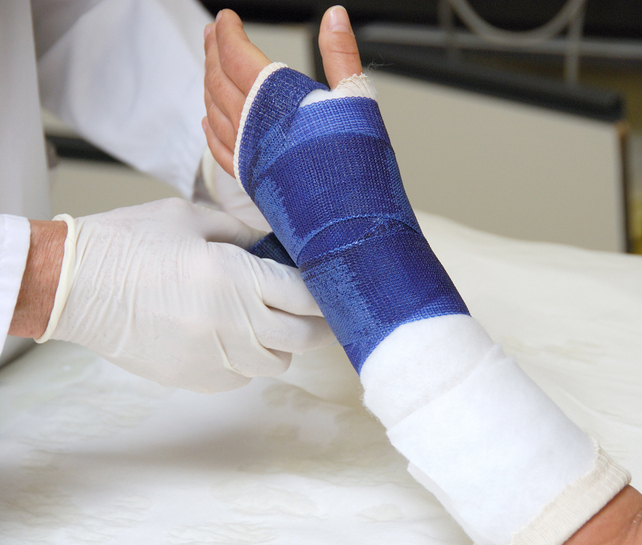
Why a Trip and Fall Accident Often Leads to a Broken Wrist
I have noticed a pattern in our trip-and-fall files that holds up across age, gender, and what people were doing when they fell. The injury that walks through our door most often is not a hip, not a shoulder, not a head injury. It is a broken wrist. Usually the distal radius, sometimes a scaphoid, occasionally a more involved fracture that travels into the elbow.
The reason is not mysterious. When a person feels their footing go, the arm shoots out before the brain has time to decide anything. The wrist takes the entire weight of a falling body on a small joint at an awkward angle. Concrete does not give. The radius does.
For the last twenty-five years, in addition to practicing law, I have held a Florida real estate broker license, and that broker work has shaped how we read these property cases. When we look at a sidewalk transition, a parking-lot wheel stop, or a worn-out commercial entrance, we are not only seeing it as lawyers. We are seeing it the way a property manager is supposed to see it during a routine walkthrough, which is the same vantage point a jury will eventually be asked to take.
What Florida law actually requires of a property owner
People searching for answers about a fall usually land on a stew of vague articles that talk about “duty of care” without telling you which statute applies. In Florida, the statute matters because it changes what you have to prove.
If you slipped on a wet floor, spilled liquid, a piece of produce, or any other temporary substance, your claim is governed by §768.0755, Florida Statutes. The legislature wrote that one to make these cases harder. You have to show the business knew, or should have known through reasonable inspection, that the substance was on the floor. Plain English: if a grape was on the supermarket floor for forty seconds, you probably lose. If it sat there for forty minutes while three employees walked past it, you probably win.
If you tripped on a structural condition — a cracked sidewalk, a raised expansion joint, an uneven curb cut, a missing handrail, a broken stair tread — your case is governed by §768.0710, which deals with negligent maintenance. That standard is broader and more workable for an injured person, because the question becomes whether the owner kept the property in reasonably safe condition, not whether some specific employee had notice of a banana peel.
Both of those statutes sit inside the broader premises-liability framework in §768.075, which sorts visitors into invitees, licensees, and trespassers and assigns a different duty to each. If you fell at a grocery store, a hotel lobby, a mall, a doctor’s office, or a restaurant, you are an invitee, and the duty owed to you is the highest. If you fell on government property — a county sidewalk, a public park, a municipal building — §768.28 kicks in, and you face damage caps and a pre-suit notice requirement that runs faster than the two-year filing deadline.
Factors a Florida court actually weighs
When I look at a new trip-and-fall file, the question I ask is not “did the person fall.” It is “what would a property manager doing the job right have done about this hazard the day before.” That maps almost perfectly onto what a Lee County or Collier County jury ends up weighing:
- How long the condition existed. Photographs, prior maintenance work orders, and employee testimony all build a timeline.
- Whether the owner had been warned. Prior complaints, prior incident reports, prior insurance claims at the same address. Carriers fight hard to keep these out.
- Lighting and visibility. A two-inch height differential in a well-lit lobby reads differently than the same defect under a burned-out parking-lot lamp at 9 p.m.
- Marking, paint, or warning. Yellow safety paint on the lip of a step is cheap and standard. Its absence is itself evidence.
- Foot traffic patterns. Where customers naturally walk versus where the defect lives. Hazards in the natural path are harder to defend than hazards off to the side.
- Industry standards. ASTM walking-surface standards and ADA tolerances are not statutes, but they get cited and they carry weight.
The trivial-defect doctrine — not as clean as it sounds
Defense lawyers love to cite the “trivial defect” doctrine. The shorthand version, which you will see repeated all over the internet, is that anything under about one inch in height is not actionable. That is not a rule. It is a tendency in some appellate opinions, and it gets misapplied constantly.
I have settled cases on height differentials measured in fractions of an inch because the lighting was bad, the area was painted the same color, and there were three prior incidents at the same spot. I have also seen defense verdicts on differentials over two inches because the hazard was in an obvious daylight location with no prior history. The totality of the conditions decides it. The ruler is one fact among many.
What we see most across Southwest Florida
Our trip-and-fall caseload across the I-75 corridor through Lee and Collier Counties and the businesses lining US-41 / Tamiami Trail breaks down into a few recurring fact patterns:
- Parking lots — wheel stops, pothole edges, deteriorated asphalt at the lip of a concrete walk. Almost every one of these is a §768.0710 maintenance case, not a transitory-substance case.
- Sidewalk transitions outside medical offices and shopping centers — settled concrete slabs with a half-inch to two-inch lip. Older clients, hard fall, wrist or hip.
- Grocery and big-box floor spills — the classic §768.0755 fact pattern. Surveillance video, when we can get it, often decides the case in the first thirty days.
- Hotel and resort common areas — wet pool decks, tile lobbies after a rain, poorly marked steps from a bar to a courtyard.
- Restaurant entrances — recessed mats that ride up, single-step thresholds that a customer does not see in fading light.
The file where a maintenance log changed everything
One file I worked recently shows how these come together. An older client of ours was walking into a medical office for a routine appointment. The concrete walkway leading from the parking area to the front door had a two-inch height differential between two slabs. There was no yellow paint, no warning cone, no sign. She caught her toe on the lip and went down hard on her right side.
She did what most people do — extended her arm to catch the fall — and the impact shattered her elbow. The orthopedic surgeon told her the joint was not reparable and that she needed a total elbow replacement. After surgery she spent months in occupational therapy just to get back to dressing herself, opening jars, and managing the small daily tasks most of us never think about.
What changed the case was the maintenance history. When we sent our records subpoena to the property manager, we learned the building’s superintendent had flagged that exact differential in writing more than a year earlier. He had asked for either a concrete grinder, a poured patch, or at minimum yellow safety paint. The owner had done none of it. Once we had that document in hand, the defense’s whole posture changed. We resolved the matter for a six-figure settlement that covered her remaining medical debt and funded the in-home assistance she was going to need going forward.
I think about that case often because the fix would have cost the property owner about forty dollars in paint and an afternoon. Instead, a woman lost the use of her dominant arm.
What a property owner is actually supposed to be doing
This is where the broker background does the most work. Twenty-five years of holding a Florida real estate broker license has put me through enough commercial property walk-throughs, lease negotiations, and common-area maintenance disputes that we know what the standard operating procedure looks like from the inside. A reasonably prudent commercial property owner in Florida is supposed to be doing the following on a routine, documented basis:
- Regular walking inspections of all common areas, with a written log. Daily for high-traffic retail; weekly at minimum for office and medical.
- Photographing and dating any flagged condition, even minor ones, before a repair order goes out.
- Yellow safety paint on every elevation change at sidewalk transitions, ramp edges, single steps, and parking-lot wheel stops, refreshed when it fades.
- A documented response protocol for spills in any food, beverage, or wet-floor environment — usually a fifteen-minute or thirty-minute inspection cycle with employee initials.
- A maintenance work-order system that retains records, which carriers and lessors require anyway. When a property owner says “we had no idea,” the work-order system is what proves whether that is true.
- Adequate exterior lighting on walkways and parking lots, with a process for replacing bulbs within days, not months.
None of this is exotic. Every property manager I have worked with knows the playbook. The question in our cases is almost always whether they actually ran the playbook on the day in question.
What to do if you fell
The actions in the first forty-eight hours after a fall do more to shape a case than anything I can do months later. Specific steps, in the order they matter:
- Get a medical evaluation the same day, even if you think you can shake it off. Wrist fractures swell and stiffen overnight, and the emergency-room timestamp anchors the case.
- Photograph the hazard before you leave the property, if you can. Stand at the height a walking person would, then crouch and shoot the differential from the side with a coin or your shoe in the frame for scale.
- Ask the business to fill out an incident report and ask for a copy. They will often refuse the copy. Note the manager’s name and the time you asked.
- Save your shoes in a bag. The defense will eventually argue you were wearing flip-flops or worn-out tread. Having the actual footwear ends that argument.
- Write down what you saw, what you heard, and who was near you within twenty-four hours, before details fade. I have used this approach with clients for years and noticed that the contemporaneous note carries far more weight at deposition than a memory reconstructed eight months later.
- Do not give a recorded statement to the property owner’s insurance carrier before you have spoken with a lawyer. Their job is to lock you into a story before you know what the story should be.
Key Takeaways
- The broken wrist is the signature injury of trip-and-fall cases because the arm extends instinctively before the brain catches up.
- The applicable Florida statute changes the entire shape of the case — §768.0755 for spills, §768.0710 for structural conditions, §768.28 for government property.
- The “trivial defect” idea is a tendency, not a bright line; lighting, prior complaints, and marking can win or lose the case at the same height differential.
- Property owners are supposed to be inspecting, documenting, painting, and lighting on a routine cycle — the work-order paper trail usually decides liability.
- The first forty-eight hours matter more than the next six months: medical record, photographs, incident report, shoes, written recollection.
Frequently Asked Questions
Q1. How long do I have to file a trip-and-fall claim in Florida?
Under the 2023 statute change, you have two years from the date of the fall to file suit on a Florida premises-liability claim. That is a hard deadline. If the property is owned by a city, county, or other government entity under §768.28, you also have a pre-suit notice requirement that runs sooner than two years, so do not wait.
Q2. Does a broken wrist actually justify hiring an attorney?
Yes, more often than people assume. A distal radius fracture that needs a plate and screws can produce six figures in medical bills, weeks of lost wages, and permanent loss of grip strength. Insurance carriers tend to lowball wrist injuries because the X-ray looks tidy after surgery. They do not pay for what you have lost in function until someone makes them.
Q3. What does Florida law require me to prove?
If you fell on a wet floor or spilled liquid, §768.0755 requires you to show the property owner had actual or constructive knowledge of the substance and should have cleaned it up. If you fell on a structural condition like a cracked sidewalk or uneven concrete, §768.0710 governs, and the duty is broader. Which statute applies changes the whole shape of the case.
Q4. What about the “trivial defect” rule I keep reading about?
Florida courts have sometimes dismissed cases where the height differential was under about an inch, but that is not a bright-line rule. Lighting, foot traffic patterns, prior complaints, and whether the owner painted or marked the defect all matter. I have settled cases on quarter-inch differentials and lost on cases with bigger ones. The totality of the conditions decides it, not a ruler.
Q5. Does it matter that I did not notice the hazard before I fell?
Not nearly as much as the insurance adjuster will tell you. Florida is a modified comparative negligence state, so a jury can assign you a percentage of fault, but the question is whether the hazard was open and obvious to a reasonable person, not whether you happened to be looking down at the moment you stepped. A defect the property owner knew about for months is still the owner’s problem.
Talk to us before you talk to their insurance carrier
If you have broken a wrist, an elbow, a hip, or anything else in a trip-and-fall on someone else’s property in Southwest Florida, call our office at 239-992-8259 for a free consultation. There is no fee unless we recover for you. we will tell you straight whether you have a case worth pursuing, what the statute requires, and what the first steps look like.
About the Author

Three decades into his personal injury career across Southwest Florida, David B. Pittman, Esq. continues to lead Pittman Law Firm, P.L., the firm he founded, with a sustained focus on personal injury and premises-liability cases. The firm represents injured clients across Lee and Collier Counties — Bonita Springs, Fort Myers, Naples, Estero, Cape Coral, and Lehigh Acres — with offices in Bonita Springs and Fort Myers.
David is a Citadel grad (The Military College of South Carolina, undergraduate) and a University of South Carolina School of Law grad (JD). Martindale-Hubbell rates him AV-Preeminent; he belongs to the Multi-Million Dollar Advocates Forum.
David has held a Florida real estate broker license for twenty-five years, a credential that shapes how the firm reads the property side of premises cases. The firm handles personal injury cases across Lee and Collier Counties, serving Fort Myers, Bonita Springs, Naples, Cape Coral, Estero, and Lehigh Acres, with offices at Windsor Place in Bonita Springs (main) and Fort Myers (satellite). Call 239-992-8259 for a free consultation.
The information on this website is for general information purposes only. Nothing on this site should be taken as legal advice for any individual case or situation. This information is not intended to create, and receipt or viewing does not constitute, an attorney-client relationship.