

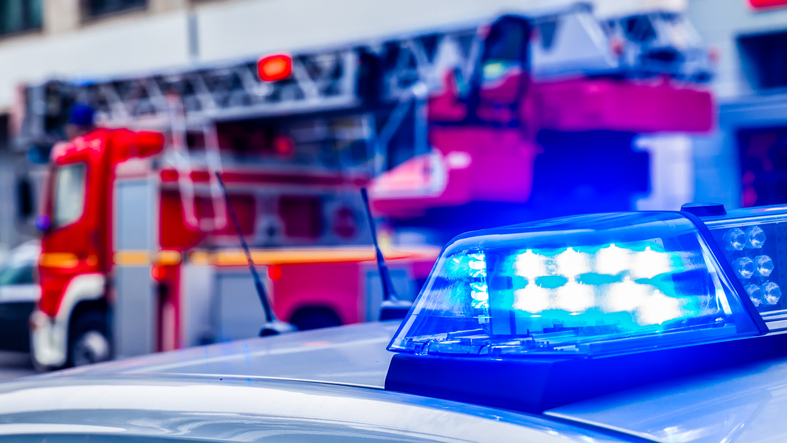
When Can Emergency Vehicles Turn Off Sirens in Southwest Florida?
Under Florida Statute 316.126, the siren is optional. Lights alone carry the same legal right-of-way as lights and siren combined — and that one word, or, is where most people get in trouble on US-41 and the I-75 corridor through Bonita Springs and Naples. Someone calls our office and says, “the lights were on but I never heard a siren — how am I supposed to know that was an emergency vehicle?” The rule is not intuitive, and the way it plays out on those roads can get expensive fast if you guess wrong.
What this post covers: the Florida statute that controls the yield duty, the contexts where ambulances and fire rescue actually run silent, what the “due regard” clause means for a driver who blows through an intersection without slowing, and what to do first if one of these crashes happens to you.
What Florida law actually says about silent-running emergency vehicles
The governing statute is Florida Statute 316.126, which sets the right-of-way rule for authorized emergency vehicles. The operative language uses the word or: a driver must yield when an emergency vehicle is “giving audible signals by siren, exhaust whistle, or other adequate device, or visible signals by the use of displayed blue or red lights.” That single word does the work. Lights alone count. Siren alone counts. Both is best, but both is not required.
There is a second layer. The same statute says the emergency driver still has a duty to drive with due regard for the safety of all persons using the highway. So while the public has to yield, the agency does not get a free pass on reckless driving. The two duties run in parallel.
If you are hurt in one of these crashes, the claim runs through the rest of Florida’s standard injury framework. Section 627.736 governs PIP — the first ten thousand dollars of medical and wage loss your own auto policy pays regardless of fault. Section 768.81, as amended in 2023, governs modified comparative negligence: if a jury finds you more than 50% at fault, you recover nothing. And section 95.11(4)(a) sets the two-year deadline for filing a negligence suit, also a 2023 change down from four years. When a public agency is involved, there is a separate pre-suit notice requirement on top of that two-year clock.
Five reasons a crew runs silent — and which one matters legally
Ambulances and fire rescue do not run silent at random. There are roughly five fact patterns that come up over and over in our office:
- Stable inter-facility transfer. The patient is already on monitors, the trip is scheduled, and the crew chooses lights-only to keep the cabin quiet. Common between hospitals along the US-41 corridor and the I-75 spine through Lee and Collier Counties.
- Late-night residential calls. Two in the morning in a Bonita Springs neighborhood, an ambulance picking up a fall patient — crews routinely kill the siren a few blocks out. The lights stay on; the noise comes down.
- Tactical police response. Burglary in progress, domestic call with a warrant subject inside. Officers want speed without announcing arrival. Lights run, siren stays off.
- Mental-health crisis calls. Sirens can escalate. Crews shift to silent approach to keep the scene from getting worse.
- End-of-run, returning to quarters. Sometimes the lights are still on as the unit clears a scene and rolls back toward the station, even though the emergency itself is over.
The first four are operational judgment calls the law generally protects. The fifth is the gray zone where most of the litigation lives, because a driver who sees flashing lights at a normal cruising speed reasonably assumes it is not a real emergency anymore.
Silent-running crashes — why the “due regard” clause does real work
The defense in these matters is almost always the same: the ambulance had the right of way, the lights were on, the plaintiff failed to yield, end of story. On paper that argument is tidy. In a real intersection on Daniels Parkway at three in the afternoon, it falls apart in several places.
First, perception time. A flashing red light without a siren reads as background visual noise — especially against Florida sun glare. The IIHS has documented for years that drivers process auditory warnings faster than purely visual ones, which is part of why the federal motor-vehicle safety standards historically built warning systems around both. (For the data side of intersection-crash research, the IIHS publishes useful background.)
Second, the “due regard” clause. Florida courts have repeatedly held that emergency drivers cannot blow through a controlled intersection at speed without slowing — even with lights and siren. With siren off, the bar effectively rises. A jury hears “the driver was running silent through a blind intersection” differently than “the driver was running silent on an open stretch of I-75.”
Third, the agency-defendant problem. When the at-fault driver is a county fire rescue unit or a municipal ambulance, sovereign-immunity caps and pre-suit notice requirements come into play. The case can still be brought, but the procedural runway is shorter and tighter than a standard car-crash file. Miss the notice, miss the case.
Fourth, evidence preservation. Most modern emergency rigs carry data recorders — speed, brake application, siren status by the second. We send the preservation letter the same week we are retained, because if the rig goes back into service and the data overwrites, the central piece of the silent-running question disappears.
What to do if an emergency vehicle was involved in your crash
The advice I give clients in the first phone call:
- Get the run number and the agency name. Not just “an ambulance hit me” — which county, which station, which unit. That information lives on the patch on the rig and on the crash report.
- Ask the responding officer to note siren status. If the crash report has a check box for “audible warning in use,” make sure it gets filled in. We have seen cases turn on that single line.
- Photograph the scene before you leave. Skid marks tell you whether either driver braked. Intersection sight lines tell you what each driver could have seen.
- Get to a doctor the same day if you can. PIP starts running on the date-of-loss. If you wait more than fourteen days for an initial evaluation, you can lose the PIP benefit entirely under 627.736.
- Save the gear and the vehicle. Do not let the salvage yard crush the car until the data has been pulled. Both your event data recorder and the agency’s matter here.
- Call before you talk to the agency’s risk-management office. The pre-suit notice and the recorded-statement issues do not forgive mistakes made in the first week. That is the period where we want to be involved.
Key Takeaways
- Florida Statute 316.126 says lights alone or siren alone is enough to require you to yield — the word in the statute is or, not and.
- The emergency driver still owes a “due regard” duty. If the rig ran silent through a blind intersection without slowing, the agency can be liable.
- The statute of limitations under section 95.11(4)(a) is two years for negligence, with a separate pre-suit notice clock when a public agency is the defendant.
- PIP under section 627.736 pays the first ten thousand dollars of medical and wages no matter who was at fault — but you have to be seen by a doctor within fourteen days.
- Preserve the rig’s event data and siren-status logs early. Once the unit goes back into service, the recording often overwrites and the case gets harder.
Frequently Asked Questions
Q1. Is an ambulance allowed to run lights without a siren in Florida?
Yes. Florida Statute 316.126 says emergency vehicles can establish right-of-way with either audible or visual warnings. The little word in there is or, not and. So an ambulance running silent with red lights flashing has the same legal standing as one running both.
Q2. If a fire truck hits me while running silent, can I still recover?
Often yes. Emergency drivers still owe a duty of due regard for the safety of other motorists. If a jury finds the driver was reckless or failed to slow at an intersection, the agency can be liable. Sovereign immunity caps apply against public entities, but the case is usually viable.
Q3. What is the deadline for filing a claim against a public agency in Florida?
Two years for the underlying negligence claim under section 95.11(4)(a), with a separate pre-suit notice requirement against the public body. Miss the notice window and the claim is gone, even if the two-year deadline has not run.
Q4. Does PIP pay if an ambulance causes a crash?
Your PIP under section 627.736 pays the first ten thousand dollars of medical and lost wages regardless of fault. Beyond that, recovery depends on the agency’s liability coverage, your UM coverage under section 627.727, and whether the injury meets the permanent-injury threshold.
Q5. What should I do if I do not see the ambulance until the last second?
Do not panic-swerve. Brake straight, signal, and ease right when you have space. Stay stopped until it clears. After it passes, take a breath before you re-enter traffic. We have seen secondary crashes happen because a driver lurched back into the lane while another car was still pulled over.
Talk to our office before you talk to anyone else
If you or someone in your family was hurt in a crash involving an ambulance, a fire rescue unit, or any other emergency vehicle in Bonita Springs, Fort Myers, Naples, Estero, Cape Coral, or Lehigh Acres, call our office at 239-992-8259 for a free consultation. There is no fee unless we recover for you. The first few days matter more than people realize — that is the window where the rig’s data, the dispatch audio, and the agency’s run logs are still available. Our firm has handled these matters across Lee and Collier Counties for more than three decades.
About the Author

Three decades into his personal injury career across Southwest Florida, David B. Pittman, Esq. continues to lead Pittman Law Firm, P.L., the firm he founded. The firm represents injured clients across Lee and Collier Counties — from the main office at Windsor Place on Bonita Beach Road through Fort Myers, Naples, Estero, Cape Coral, and Lehigh Acres — with a particular focus on commercial-vehicle, complex-liability, and serious-injury cases.
David is a Citadel grad (The Military College of South Carolina, undergraduate) and a University of South Carolina School of Law grad (JD). Martindale-Hubbell rates him AV-Preeminent; he belongs to the Multi-Million Dollar Advocates Forum.
David has held a Florida real estate broker license for twenty-five years, a credential that shapes how the firm reads the property side of premises cases. The firm handles personal injury cases across Lee and Collier Counties, serving Fort Myers, Bonita Springs, Naples, Cape Coral, Estero, and Lehigh Acres, with offices at Windsor Place in Bonita Springs (main) and Fort Myers (satellite). Call 239-992-8259 for a free consultation.
Disclaimer: This article is for general information only and is not legal advice. Reading it does not create an attorney-client relationship with Pittman Law Firm, P.L. The hiring of a lawyer is an important decision that should not be based solely on advertisements. Past results do not guarantee future outcomes.