

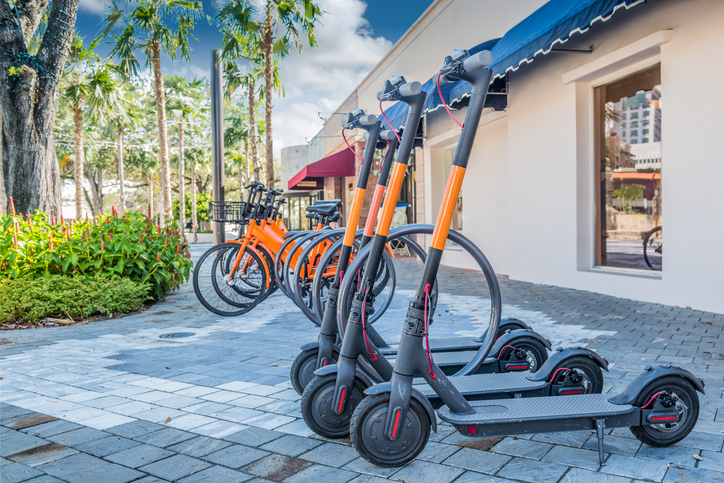
Tourist Hotspots Face Alarming Surge in Electric Scooter Accidents
The families who flew in from Ohio or New Jersey, rented two scooters from a sidewalk dock along US-41 / Tamiami Trail, and ended up in an emergency room before the week was out — those are the calls our office gets more and more often. The national data confirms what we have been hearing on the phones. According to the U.S. Consumer Product Safety Commission, e-scooter emergency department visits rose from roughly 8,500 in 2017 to about 57,000 in 2022, and head and face injuries lead the list. Southwest Florida is part of that picture.
I will tell you up front that scooter cases are some of the harder personal injury files we handle. I have run several of them through to settlement, and the recurring themes are the same: tangled coverage, a rental contract written to make the rider lose, a city that has not yet adopted clean rules, and a rider who, more often than not, did not know what their helmet or their lack of helmet would do to the claim. This is a piece about how those cases actually move through our office, not a recitation of statistics.
What Florida law actually says about e-scooters
Florida treats a standing electric scooter as a motorized scooter under Florida Statute 316.003. The relevant cross-references are sitting in the same chapter of the traffic code, and the practical effect is this: a rider is generally permitted on bike lanes and on roads with a speed limit of 25 mph or under, but cities are allowed to write their own rules on top of that. Lee County, Collier County, Fort Myers, Bonita Springs, and Naples have all written slightly different ordinances. A tourist who picks up a rental scooter on a Saturday afternoon has no realistic way to know which set of rules applies on which block.
The deadline to file a personal injury claim is set by section 95.11(4)(a) of the Florida Statutes, and after the 2023 tort reform it now runs two years from the date of the crash, not four. Wrongful death is also two years. The other piece of 2023 reform that matters on scooter files is the modified comparative fault rule. In plain English: if a jury finds the rider more than fifty percent at fault for the crash, the rider recovers nothing. Anything fifty percent or below, and the recovery is reduced by the rider’s share of fault. That is a very different legal landscape than the one most out-of-state riders are used to.
The third statute we lean on is Florida’s negligent entrustment doctrine, which comes out of case law more than a single code section. If a rental operator hands a 130-pound scooter capable of 18 mph to someone who is visibly intoxicated, or to a child who is plainly under the operator’s own posted minimum age, the operator can be liable for the rider’s injuries on a theory separate from the rental contract. That doctrine is one of the few ways past the click-wrap waiver, and it requires evidence — surveillance footage, transaction timestamps, the app’s age-verification log — that goes stale fast.
Tourist scooter crash patterns we see most often in Southwest Florida
After running these files for a few years, the pattern collapses to five recurring fact patterns. We get some version of one of these in almost every scooter call:
- Tourist-rented scooter on a sidewalk, struck by a car turning into a driveway. Almost always along US-41 / Tamiami Trail or a feeder road off it. Riders are usually going the wrong direction on the sidewalk relative to traffic, and drivers turning in are not looking for a 15-mph vehicle on the walk. Liability is mixed; the case turns on whether the driver had a clear line of sight.
- Sidewalk-to-road transition crash, solo. The rider drops off a curb, the small front wheel catches, and the rider goes over the bars. Head and wrist injuries dominate. The defendant is the rental operator if a maintenance defect contributed, or no defendant at all if it was simply the curb.
- Pothole, drainage grate, or seam fault on the road surface. These cases run against a municipality or a private property owner, and they live or die on the notice question — did the city know about the hazard and fail to fix it within a reasonable window. Sovereign immunity caps recovery against a public entity at $200,000 per person, $300,000 per incident.
- Alcohol-involved rider, late-night, downtown. The rider may still have a case against a car that struck them, but the rider’s fault percentage will be elevated, and the recovery will be reduced accordingly. These files almost always settle below their medical specials.
- Closed-community scooter or golf-cart incident. Different vehicle category in Florida law (a low-speed vehicle under 316.2122 if it is a true LSV, or simply a golf cart under 316.212), but the medical and legal picture overlaps with scooter files almost completely. The defendant is the cart driver personally, and sometimes the homeowner’s association if its operating rules contributed.
Three reasons scooter files are harder to resolve than they first appear
The first complication is the rental agreement. Every operator in Florida that I have read uses some version of a clickwrap with a liability waiver, a one-way attorney-fee clause, and an arbitration provision pointing to a forum out of state. Florida law treats most of those provisions as enforceable against an adult rider. The carve-outs are narrow: maintenance defect, gross negligence, and product liability claims against the manufacturer of the scooter itself.
The second complication is insurance. Most personal auto policies in Florida exclude motorized scooters from the definition of an insured vehicle. That means the rider’s own bodily injury liability coverage will not pay for damage the rider caused to a third party, and the rider’s own collision coverage will not pay for damage to the scooter. PIP is the surprising piece — Florida PIP follows the named insured for injuries sustained “as a pedestrian,” and most scooter-versus-car injury claims fit that definition. We have collected PIP for scooter riders in maybe two-thirds of the files where the rider had auto coverage at home.
The third complication is the helmet question. Florida law does not require an adult scooter rider to wear a helmet, and the absence of a helmet is not, by itself, a defense to liability. But a defense lawyer will try to assign a comparative-fault percentage on a head-injury claim by arguing the rider should have worn one anyway. We push back on that with the rental operator’s own conduct — most of the dockless rental fleets do not provide a helmet at the kiosk, do not warn the rider to wear one, and in some cases actively post photos of helmetless riders in their own marketing materials.
How a case like this moves through our office
A case I think about often involved a passenger in a golf cart inside the Pelican Landing community in Bonita Springs. The cart was the closest neighbor to a scooter that we see in our files in this part of Lee County. The driver took a sharp turn too quickly through a curve on one of the interior community roads. Our client, a passenger in the back-facing seat, was ejected onto concrete. The injuries were a pelvic fracture and a subdural hematoma — a brain bleed — that required an ICU stay and several months in an assisted-living facility during recovery.
The case had two defendants. The first was the driver personally, on a straightforward negligent-operation theory. The driver’s homeowner’s policy provided some coverage for the cart but not enough to reach the medical specials, which had already crossed six figures by the time the file came in. The second piece was the community itself. The community’s published rules for cart operation set a posted speed on interior roads and required certain safety practices that, in our view, had been allowed to lapse. We did not have to litigate that piece all the way to a verdict; the negotiation focused on the personal liability of the driver and on whether the community’s standards for cart operation had been enforced consistently.
The file settled on a combined-defendant basis, with the personal-liability portion of the recovery doing most of the work. The client walked, slowly, out of the assisted-living facility about ten months after the crash and is now back in her own home.
What that file taught us applies to every scooter case we have run since. The medical picture drives the legal one. A pelvic fracture plus a subdural hematoma will produce a recoverable case even when liability is mixed; a sprain plus a contusion will not, regardless of how clean the liability picture is. The first phone call we make on every new scooter file is to the treating physician, not to the carrier.
What to do if you go down on a scooter in Southwest Florida
For locals and tourists alike, the steps that actually matter in the first 48 hours after a scooter crash, in our observed order of priority:
- Photograph the scooter before the rental operator picks it up. In particular, photograph the brakes, the front wheel, any cracked components, and the ID number on the deck. The operator’s geofencing system will dispatch a charger or a maintenance team within hours, and once the scooter is back in the warehouse, the physical evidence is gone.
- Screenshot the ride history in the rental app. Start time, end time, GPS path, the click-through acknowledgments at the start of the ride. Some operators will purge a ride from the app’s visible history within 30 days. Pull it the same day.
- Get treated, then get treated again 72 hours later. Adrenaline masks pelvic, wrist, and concussion symptoms in the first six hours. We have seen clients walk away from an ER with a “soft tissue” sign-off and turn out to have a hairline pelvic fracture or a slow subdural bleed two days later. A repeat exam at 48-to-72 hours catches that.
- Do not give a recorded statement to any insurance carrier. Not the rental operator’s carrier, not your home auto carrier, not the driver-who-hit-you’s carrier. The recorded statement is taken before the rider knows what they have, and it gets used at every later step.
- Save the helmet — or the absence of one. If you were wearing a helmet, save it intact, do not wash it, and keep the receipt or rental record. If you were not wearing one, do not buy one and pretend after the fact. Either picture is easier to manage than a manufactured one.
- Pull your home-state auto declarations page. If you flew in from out of state, your home auto policy may contain medical payments, uninsured motorist, or extended pedestrian coverage that follows you out of state. Most riders do not know they have it.
- Call a Florida personal injury lawyer inside the first month. The two-year filing deadline under Florida Statute 95.11(4)(a) is shorter than it sounds, particularly when the medical recovery is still in progress and the rental operator’s registered agent has to be located for service.
Key Takeaways
- Florida treats an e-scooter as a motorized scooter under Florida Statute 316.003, and city ordinances layer additional rules on top. Tourists almost never know which rules apply on which block.
- The 2023 tort reform shortened the personal-injury filing window to two years from the date of the crash and added a modified comparative fault bar at 50 percent.
- Most personal auto policies in Florida exclude motorized scooters from collision and liability coverage, but PIP often still applies on pedestrian-style scooter-versus-car injuries.
- Helmet non-use is not a defense to liability under Florida law. A defense lawyer will still try to assign a comparative-fault percentage on head-injury claims.
- The first 48 hours of evidence preservation — photographing the scooter, screenshotting the rental app, and getting a follow-up medical exam — usually decides whether the file is worth pursuing.
Frequently Asked Questions
Q1. If I rent a scooter and crash, is the rental company on the hook? Usually less than the rider expects. The rental click-wrap agreement almost always disclaims liability for rider error, and Florida courts generally enforce those. Where a rental operator can be on the hook is a maintenance defect (bad brakes, a wheel that locked up) or a known geofencing or charging failure. Preserving the scooter, the app data, and any ride-end photos right away is what makes that case viable.
Q2. I was hit by a car while riding a scooter — does the driver’s auto policy cover me? Yes for the driver’s bodily injury liability coverage, if the driver was at fault. The harder question is whether your own auto PIP applies. Florida PIP follows the named insured and resident relatives for pedestrian-style injuries, which often includes scooter riders struck by a vehicle. We pull every policy in the household before assuming the rider is on their own.
Q3. I was a tourist visiting Florida and got hurt on a scooter. Which state’s law applies? Florida law applies to the crash because the injury happened here. Your home-state auto policy may still provide medical payments or uninsured motorist coverage depending on the language, and we routinely ask injured visitors to send the declarations page from their home-state policy so we can read the territorial clause. Filing deadlines run on Florida’s two-year personal injury statute, so do not wait.
Q4. Does it matter that I was not wearing a helmet? Less than insurance adjusters claim. Florida is a modified comparative fault state after the 2023 tort reform, and a defense lawyer will try to assign a percentage of fault to the no-helmet decision, particularly on head-injury claims. But helmet non-use does not bar recovery on its own, and on lower-body injuries (pelvis, leg, wrist fractures), it is largely irrelevant to causation.
Q5. How long do I have to file a scooter-injury claim in Florida? Two years from the date of the crash for a personal injury claim under section 95.11(4)(a) of the Florida Statutes, as amended by the 2023 tort reform package. Wrongful death is also two years. That is shorter than it sounds once you account for medical recovery, insurance back-and-forth, and locating the rental operator’s registered agent for service, so we advise scooter clients to call our office well inside the first year.
Free Consultation — Pittman Law Firm, P.L.
If you or someone you love was hurt on an electric scooter in Bonita Springs, Fort Myers, Naples, Estero, Cape Coral, Lehigh Acres, or anywhere along the I-75 corridor through Lee and Collier Counties, our office is available to talk through the file. Call 239-992-8259 for a free consultation. There is no fee unless we recover for you.
About the Author

Pittman Law Firm, P.L. — founded by David B. Pittman, Esq. — has handled personal injury cases across Southwest Florida for more than thirty years. The firm represents injured clients across Lee and Collier Counties — Bonita Springs, Fort Myers, Naples, Estero, Cape Coral, and Lehigh Acres — with offices in Bonita Springs and Fort Myers, and a particular focus on commercial-vehicle, complex-liability, and serious-injury cases.
Between undergraduate at The Citadel, The Military College of South Carolina and a JD from the University of South Carolina School of Law, David built the foundation for a personal injury practice that now carries AV-Preeminent status with Martindale-Hubbell and membership in the Multi-Million Dollar Advocates Forum.
David has held a Florida real estate broker license for twenty-five years, a credential that shapes how the firm reads the property side of premises cases. The firm handles personal injury cases across Lee and Collier Counties, serving Fort Myers, Bonita Springs, Naples, Cape Coral, Estero, and Lehigh Acres, with offices at Windsor Place in Bonita Springs (main) and Fort Myers (satellite). Call 239-992-8259 for a free consultation.
The information on this website is for general information purposes only. Nothing on this site should be taken as legal advice for any individual case or situation. This information is not intended to create, and receipt or viewing does not constitute, an attorney-client relationship. Pittman Law Firm, P.L. is an attorney advertising communication.