

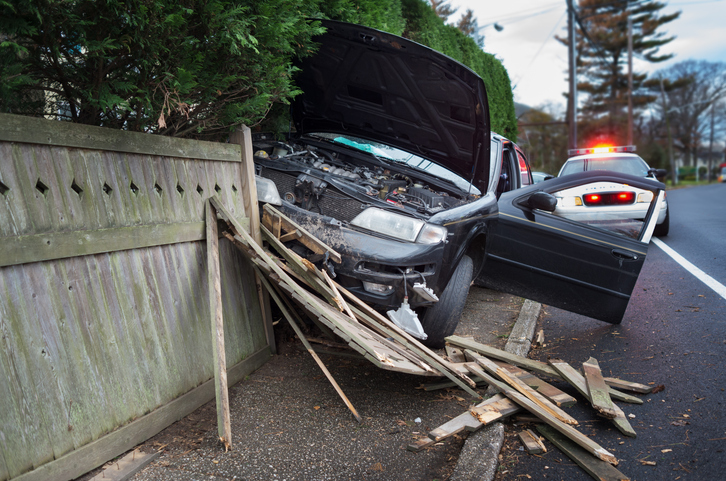
Single Vehicle Accident in Fort Myers, Florida: Who Pays When You’re Forced Off the Road?
Florida law does not decide fault by counting how many cars ended up damaged. It decides fault by looking at who caused the chain of events. A driver who swerves off Daniels Parkway to avoid a pickup that cut across two lanes and never stopped — that driver did not cause their own crash, even if only their car is in the ditch. The phantom driver caused it.
I have practiced personal injury law in Lee and Collier Counties for over thirty years, and I have walked hundreds of Fort Myers drivers through this same conversation. The caller sounds apologetic, half-resigned to paying their own deductible, and tells me a truck ran them off the road and disappeared. Most of the time, the answer is that they have a case. What does change is how hard you have to work to prove it. That is the part I want to walk you through.
What Florida law actually says about single-vehicle and phantom-vehicle crashes
Four statutes do most of the work in these cases. Let me take them in plain English.
Florida Statute 627.736 (PIP). Every Florida driver has to carry $10,000 in Personal Injury Protection. PIP pays 80 percent of reasonable medical bills and 60 percent of lost wages, no matter who caused the crash, as long as you see a doctor within fourteen days. PIP does not pay a dime toward repairing your car. If you wait two weeks and a day to get checked out, you forfeit the medical benefit entirely. I have seen people lose their PIP because they “felt fine” on day fifteen and then woke up on day twenty with a herniated disc.
Florida Statute 627.727 (Uninsured Motorist). UM is the coverage that actually pays in a phantom-vehicle claim. Under Florida law, a hit-and-run driver who never stopped is treated as uninsured, and a no-contact phantom driver can be treated the same way, but with one catch. Florida requires independent corroboration of the phantom vehicle. Your own statement is not enough. You need a witness, dashcam footage, a 911 call placed before impact, or some other proof that the phantom car existed. Without it, the carrier will deny the claim and call it a single-vehicle loss of control.
Florida Statute 768.81 (Modified Comparative Negligence). In March 2023 Florida moved from pure comparative negligence to modified comparative negligence. Plain English: a jury still assigns each party a percentage of fault, but if you are found more than 50 percent at fault for your own crash, you recover nothing. Under the old law you could be 80 percent at fault and still collect 20 percent. Not anymore. This is why insurance adjusters in 2026 push so hard to pin a swerve or an over-correction on the driver.
Florida Statute 95.11(4)(a) (Statute of Limitations). The same 2023 reform cut the deadline for negligence lawsuits from four years down to two. If your crash happened after March 24, 2023, you have two years from the date of the wreck. Period. Most drivers I talk to assume they have plenty of time. They do not.
Florida Statute 316.066 (Crash Reports). Florida requires a written crash report any time the wreck involves injury, death, or apparent property damage of at least $500. Call the police. Even if you feel fine and the car looks driveable, get the report. The report is the first piece of evidence the adjuster will read.
Six types of forced-off-the-road cases we handle in Lee County
After thirty years of practice in Lee County, the same patterns repeat. Here are the ones I see most often.
- The phantom merge. A pickup or box truck drifts across the lane line on I-75 near Alico Road or on Colonial Boulevard near the Edison Mall. The driver behind swerves onto the shoulder, clips the guardrail, and the offending vehicle keeps going.
- The forced left. A car turns left across your path from a side street onto McGregor Boulevard without yielding. You brake hard and steer right to avoid T-boning them, hop the curb, and hit a palm.
- The blowout from a road defect. A pothole or chunk of construction debris on Six Mile Cypress Parkway or Pine Island Road shreds a tire. If a contractor left the debris, that contractor can be the defendant.
- The mechanical failure. Brake-line corrosion, a defective tire, a stuck throttle. These are product liability cases, and the manufacturer or repair shop can be on the hook.
- The animal or sudden obstruction. A deer crosses Summerlin Road at dusk. The reasonable-driver standard generally protects a swerve to avoid a large animal. Hitting a squirrel and rolling the car is a different story.
- The weather event with a contributing driver. A summer downpour reduces visibility on Daniels Parkway, and the driver in front brakes hard with no taillights working. Two causes, two possible defendants.
None of these is a clean single-vehicle accident in the way an adjuster wants to describe it. Every one has another responsible party hiding behind the easy label.
Three things that make these claims harder to prove than a rear-end
The difficulty in a forced-off-the-road case is almost never the law. The difficulty is the proof. The carrier starts with one fact in its favor — only one car was damaged — and works backward from there. The driver who actually caused the wreck is either gone, unidentified, or denying it ever happened.
Three things make these claims harder than the average rear-end case. First, the corroboration rule under Florida Statute 627.727 means your UM carrier will demand a witness or physical evidence before they treat the phantom driver as uninsured. Second, modified comparative negligence under 768.81 gives the carrier an incentive to argue you over-corrected, took the curve too fast, or could have braked instead of swerved. They are trying to push your fault number above 50 percent. Third, your own collision deductible applies while the fight over UM property damage plays out, so you can find yourself paying out of pocket on a wreck you did not cause.
I have watched insurance adjusters reframe a clear phantom-vehicle claim as a “driver inattention” loss inside of two phone calls. The way to stop that is to put the evidence on the table before the adjuster’s narrative hardens.
What a $1,000,000 Fort Myers case looked like
A Fort Myers woman was involved in a serious car accident and sustained a permanent injury to a leg requiring long-term in-patient rehabilitation. The case settled for $1,000,000. What looked to the adjuster like a straightforward single-vehicle incident turned into a full recovery once we built the evidence around what actually triggered the crash. Single-vehicle cases are recoverable; they just take more work in the first thirty days than almost any other file type.
What to do if you are forced off the road
Most of what follows I have learned the hard way, watching cases get easier or harder based on what the driver did in the first hour. None of this is generic.
- Call 911 from the scene, not from home. A recorded 911 call placed before the dust settles, describing the phantom vehicle, is one of the strongest pieces of corroboration under Florida Statute 627.727. Memory of the make and color is freshest in the first ten minutes.
- Get the crash report number before you leave. Ask the responding deputy or trooper for the report number. You will need it to open the PIP claim. I have had clients try to track this down two weeks later and burn a full day on it.
- Photograph the road, not just the car. Skid marks, gouges in the asphalt, debris field, the line of sight from where the phantom driver entered your lane. Those photographs tell the reconstruction story your own car cannot tell.
- Ask the business across the street for camera footage that day. Gas stations, drive-thrus, and strip-mall storefronts on McGregor, Cleveland, and Summerlin almost all have exterior cameras now. Footage is typically overwritten within seven to fourteen days. Ask in person, the day of the crash if you can.
- See a doctor within fourteen days, even if you feel fine. The PIP statute is unforgiving on this. A primary-care visit on day three is worth more than an ER visit on day fifteen.
- Save the dashcam SD card before you drive again. Most dashcams overwrite on a loop. Pull the card, copy it twice, and label it.
- Do not give a recorded statement to the other carrier without a lawyer. Your own PIP carrier you have to cooperate with. The other side’s carrier is a different conversation, and they record it for a reason.
Key Takeaways
- Single-vehicle in Florida does not mean single-fault. A phantom driver who forced you off the road is still the cause under Florida law.
- Florida Statute 627.727 requires independent corroboration of a phantom vehicle, which is why a 911 call, dashcam footage, or a named witness matters more than the police report.
- Modified comparative negligence under Florida Statute 768.81 cuts off any recovery if you are found more than 50 percent at fault, which is what the adjuster will push for.
- The 2023 reform shortened the negligence statute of limitations to two years under Florida Statute 95.11(4)(a). Old four-year assumptions are out of date.
- The first hour of evidence-gathering decides most of these cases. After that, the carrier’s story usually hardens.
Frequently Asked Questions
Q1. If only my car crashed, am I automatically at fault?
No. Florida law looks at causation, not at how many cars ended up damaged. If another driver crossed into your lane and you swerved to avoid being hit, that driver caused the crash even if their car never touched yours. The legal name for this is a no-contact or phantom vehicle claim, and Florida courts recognize them every day.
Q2. How does PIP work when I am the only car in the crash?
Florida Statute 627.736 requires every driver to carry $10,000 in Personal Injury Protection. PIP pays 80 percent of reasonable medical bills and 60 percent of lost wages regardless of fault, as long as you see a doctor within 14 days. PIP does not pay for your vehicle damage, which is where collision coverage and uninsured motorist property damage come in.
Q3. Will uninsured motorist coverage apply to a phantom driver who never stopped?
Yes, in most cases. Under Florida Statute 627.727, a phantom vehicle is treated as an uninsured vehicle, but Florida law generally requires independent corroboration of the phantom driver beyond your own statement. A witness, dashcam footage, or a 911 call placed before the crash usually satisfies that requirement.
Q4. How long do I have to file a single-vehicle claim in Florida?
For crashes after the March 2023 reform, Florida Statute 95.11(4)(a) sets a two-year deadline for negligence claims. That is half the old four-year window. Notice deadlines to your own insurer are shorter still, often 30 days, so call our office early rather than late.
Q5. What if the insurance adjuster says I am partly at fault for swerving?
Florida uses modified comparative negligence under Statute 768.81. A jury can assign you a percentage of fault, but if you are more than 50 percent at fault you recover nothing. The reasonable-driver standard usually protects a driver who swerved to avoid an immediate collision, but the adjuster will press the point, so build the evidence record early.
If you were forced off the road in Fort Myers, call us
If another driver ran you off the road and disappeared, do not let your own carrier write the story for you. I have spent thirty years building these phantom-vehicle and forced-off-the-road cases in Lee and Collier Counties, and we know what evidence the carriers need to see to stop calling it a single-vehicle loss. Call 239-992-8259 for a free consultation. There is no fee unless we recover for you.
About the Author

The firm is led by David B. Pittman, Esq., who founded Pittman Law Firm, P.L. and has practiced personal injury law in Fort Myers and across Lee County for more than thirty years. The firm’s Fort Myers presence handles a steady stream of serious-injury work along the Daniels Parkway, Six Mile Cypress, McGregor Boulevard, Cleveland Avenue, and Summerlin Road corridors, and along I-75 between Estero and Bell Tower, representing injured clients across Lee and Collier Counties, with a particular focus on commercial-vehicle, complex-liability, and serious-injury cases.
David holds an AV-Preeminent rating from Martindale-Hubbell and belongs to the Multi-Million Dollar Advocates Forum. His undergraduate degree is from The Citadel, The Military College of South Carolina, and his JD is from the University of South Carolina School of Law.
David has held a Florida real estate broker license for twenty-five years, a credential that shapes how the firm reads the property side of premises cases. The firm handles personal injury cases across Lee and Collier Counties, serving Fort Myers, Bonita Springs, Naples, Cape Coral, Estero, and Lehigh Acres, with offices at Windsor Place in Bonita Springs (main) and Fort Myers (satellite). Call 239-992-8259 for a free consultation.
Disclaimer: This article is for general information only and is not legal advice. Reading it does not create an attorney-client relationship with Pittman Law Firm, P.L. Every case turns on its own facts, and Florida law changes. If you have been hurt in a crash, speak with a Florida attorney about your specific situation.