

Unexpected Vehicle Damage After a Crash: A Florida Lawyer’s Guide to Trees, Road Debris, and Hit-and-Runs
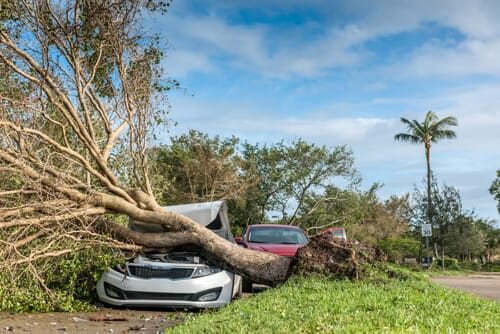
A tree drops on your car during a storm. A ladder bounces off the truck ahead of you on I-75. Someone clips your parked car in a Bonita Springs shopping center and is gone before you get back from the store. Each situation looks simple from the outside — damage happened, someone should pay. What I have learned after thirty years of practice in Lee and Collier Counties is that the coverage analysis behind each of these claims is almost never what the caller expects.
People assume the property owner’s insurance pays for the tree. They assume the trucking company pays for the ladder. They assume their own carrier will treat a hit-and-run on a parked car the same way it treats a fender-bender at a stoplight. None of those assumptions reliably hold up under Florida law. And when the damage is paired with an injury — which happens far more than people realize — the property-damage piece often becomes the only contemporaneous evidence of how the collision actually occurred. So it is worth handling correctly from the first hour.
What Florida law actually says about unexpected vehicle damage
Three statutes do most of the heavy lifting in these cases, and a fourth shows up whenever there is also a bodily injury claim.
The first is the crash-report requirement under §316.066, Florida Statutes. A written report is required any time a crash results in injury, death, or apparent property damage of at least $500. Most modern vehicle damage clears that threshold easily — a bumper alone runs more than that. In plain English: if a tree falls on your car, if road debris cracks your windshield from a passing truck, or if someone hits your parked car and leaves, you should be calling the non-emergency line and getting a report written. Your insurance company will ask for the report number before they touch the claim.
The second is §627.727, Florida Statutes, which governs uninsured and underinsured motorist coverage in Florida. Plain English: if the at-fault driver in a hit-and-run is never identified, your own uninsured motorist coverage — assuming you carry it — steps in and treats the unknown driver as if they were uninsured. Most Floridians I talk to do not realize their UM policy is the primary safety net in a hit-and-run, and a meaningful number of them have declined UM coverage on the form their agent slid across the desk at the policy bind. That decline is reversible going forward but not retroactive to the crash that already happened.
The third is §627.736, Florida Statutes, the Personal Injury Protection statute. Every Florida driver is required to carry $10,000 in PIP, and that PIP is your first $10,000 of medical bills regardless of fault — including in a tree-falls-on-your-car case where there is no other driver to chase. PIP has a fourteen-day deadline: if you do not see a doctor within fourteen days of the incident, you lose access to the PIP benefit entirely. I cannot fix that deadline. Nobody can.
And when there is an injury claim alongside the property damage, the fourth statute that matters is §768.81, Florida Statutes — Florida’s modified comparative negligence rule, rewritten in the 2023 tort reform. Plain English: if a jury thinks you were more than 50% at fault for your own injuries, you recover nothing. Below 50%, your recovery is reduced by your percentage of fault. That matters more than you would think in a road-debris case, because the defense’s first move is almost always to argue you were following too closely or driving inattentively. Pair that with the statute of limitations — §95.11(4)(a), Florida Statutes — which the same 2023 reform shortened from four years to two years, and you have a much tighter window to develop evidence than people remember from the old rules.
Four types of unexpected vehicle damage — and what each one means for coverage
Property damage from “weird stuff” tends to cluster into four scenarios. Each one has its own coverage answer.
- A tree, branch, or palm frond drops on your car. If the cause is weather alone, this is a comp-coverage claim against your own carrier — not a liability claim against whoever owns the tree. If the tree was visibly dead, leaning, or had been reported to the property owner before the storm, that changes the analysis and a negligent-maintenance claim against the owner becomes viable. The deciding evidence is almost always pre-storm photos.
- Road debris hits your vehicle on I-75 or US-41. A ladder, a piece of furniture, an unsecured tarp, a tire-tread carcass — if you can identify the vehicle the debris came from, Florida law requires loads to be secured and the responsible driver or trucking company pays. If you cannot identify the source, the claim shifts to your collision coverage or, if there was injury, to UM.
- Hit-and-run on a parked car. If you carry collision, your carrier pays for the repairs minus the deductible whether the other driver is ever caught. If you only carry the Florida statutory minimum, you may have no first-party property-damage coverage at all. Uninsured-motorist property damage coverage exists in Florida and most drivers do not carry it.
- Hit-and-run on a moving vehicle with injury. This is the worst version of all of these. Your PIP covers the first $10K of medical regardless of identification. Your UM bodily injury coverage steps in for the rest if the at-fault driver is never found. Without UM, an unidentified hit-and-run injury claim has very limited recovery options no matter how badly you were hurt.
I have seen each of these four scenarios more times than I can count along the I-75 corridor through Lee and Collier Counties and along US-41 / Tamiami Trail, and the coverage outcome usually turns on three boring things: whether the claimant had UM, whether there was a dashcam, and whether someone called police within the first hour.
Why tree, debris, and hit-and-run claims take more work than they look
The reason a tree-falls-on-your-car or a piece-of-ladder-bounces-off-a-truck case is harder than a normal rear-ender comes down to four practical complications.
Identification. In a normal crash, both drivers stop. Information gets exchanged. The at-fault party is identified within five minutes. In a road-debris case the source vehicle is usually a quarter-mile ahead by the time you process what just happened, and even if you catch a partial plate, it is rarely enough to track down the owner. We have used video pulled from gas stations, toll-gantry plate reads, and dashcam footage from following vehicles to identify drivers — but none of that is automatic, and none of it works if you wait three weeks to ask.
Coverage gaps. Florida’s minimum auto policy does not include collision, does not include comp, and does not include uninsured-motorist property damage. A driver carrying only the statutory minimum has effectively no first-party coverage when a tree falls on their car or when an unknown driver clips their parked vehicle. The first conversation we have with a new client in this situation is often a hard one: their own policy did not buy what they thought it bought.
Causation disputes when there is an injury. Insurance defense lawyers know that a road-debris case raises a fact question about whether the driver was paying attention. The defense will argue you should have seen the ladder. They will argue the tree was visible. They will argue you were following too closely. Under the post-2023 comparative-fault rule in §768.81, a finding that you were 51% at fault wipes out the recovery entirely. The cases that resolve cleanly are the ones where we develop the scene evidence early — usually within the first ten days.
The PIP fourteen-day deadline. If there is any chance of injury — even just whiplash from a tree branch landing on the hood — see a doctor inside fourteen days. Not three weeks. Not “when it starts to bother me.” Fourteen days. People skip this step because the property damage feels like the bigger problem, and then the soft-tissue injury that surfaces a month later is no longer a covered PIP claim. I have lost count of how many otherwise-good cases have been gutted by this single mistake.
The hit-and-run case behind this
Whenever someone calls about “just” property damage, our first question is always about how they are physically feeling, and our second question is whether they have seen a doctor. The reason goes back to a case from our own files.
A Fort Myers client called us about vehicle damage after a rear-end collision. As we walked through the facts, it became clear there was a real physical injury underneath — neck surgery-level damage that had not been properly connected to the crash by the treating provider. The initial carrier offer treated the case as a minor fender-bender. It was not. The client had a pre-existing neck condition, but what the crash caused was a new acute injury requiring surgery — a before-and-after that the medical records could establish clearly once we had the right physicians reviewing the chart.
The case settled at $175,000. The number is in our case files because it reflects exactly what happened: a client who came in talking about property damage and left with a resolution that covered the surgery, the recovery time, and the long-term care the injury required. Property damage and bodily injury are not always separate claims. Sometimes they are the same crash.
What to do if a tree falls on your car, debris hits you, or you get hit-and-run
From thirty years of watching these cases play out, here is the order of operations that produces the best outcomes:
- Take the photos before you move the car. In a tree case, photograph the tree itself — the trunk, the root ball, the soil it pulled out of. A dead or rotted tree looks different from a healthy one that just got beaten by a hurricane, and a jury can tell. In a road-debris case, photograph the debris from multiple angles before traffic destroys it. In a hit-and-run, photograph any paint transfer or vehicle parts left behind.
- Call the non-emergency line and get a written report. Not a “courtesy call.” A written crash report under §316.066. The report number is what unlocks your own insurance, and it is also what protects you if the other driver gets identified later.
- Look for video. Within the first 48 hours, walk the surrounding area and check for security cameras at gas stations, businesses, and residences. Most systems overwrite within seven days, some within 72 hours. The footage that solves a hit-and-run is usually gone by week two.
- See a doctor inside fourteen days, even if you “feel fine.” PIP is your first $10,000 of medical bills regardless of fault. Skip the fourteen-day window and you lose access to it entirely. The visit costs you nothing relative to what you lose by skipping it.
- Do not give a recorded statement to the other driver’s carrier. Yours, fine. Theirs, no. Recorded statements taken in the first 72 hours — when you are exhausted, in pain, and still trying to figure out what happened — get used months later to argue you were inattentive, that the damage was preexisting, or that the injuries do not match the impact.
- Pull your declarations page and read it. Find the UM line. Find the collision line. Find the comp line. If any of them say “rejected” or are blank, that is the gap you are now living with on this claim — and the gap you should close before the next claim.
- Save the repair estimates and shop notes. If you do end up bringing a personal injury claim later, the property damage photos and shop notes are often the cleanest evidence of impact severity, which directly drives the value of the bodily-injury case.
Key Takeaways
- A tree falling on your car in a storm is usually a comp-coverage claim against your own carrier — not a claim against the property owner — unless you can show the tree was visibly dead or previously reported.
- For road-debris and hit-and-run claims, the difference between recovery and no recovery almost always comes down to whether you carry uninsured motorist coverage and whether anyone identified the source vehicle.
- Florida law requires a written crash report under §316.066 for damage over $500, which most modern vehicles clear easily.
- If there is any chance of injury — even a stiff neck the next morning — see a doctor within fourteen days or you lose your PIP benefit under §627.736.
- The 2023 tort reform shortened the statute of limitations for negligence claims from four years to two years under §95.11(4)(a). Waiting to call a lawyer is no longer the low-risk move it used to be.
Frequently Asked Questions
Q1: If a tree falls on my car during a storm in Southwest Florida, who pays for the damage?
If the tree fell because of weather alone and nobody was negligent, your own comp coverage typically pays — not the property owner’s policy. If the tree was visibly dead, leaning, or had been reported as a hazard before the storm, that changes things and the property owner may be on the hook for negligent maintenance. Photographs of the tree’s pre-storm condition are what usually decide the question.
Q2: Can I sue the driver in front of me if a piece of cargo flies off their truck and hits my car on I-75?
Yes, if you can identify the vehicle. Florida law requires loads to be secured, and a driver or company that loses cargo is generally liable for resulting damage. The hard part is identification. Without a plate number or a witness, the claim usually shifts to your own collision or uninsured motorist coverage. Dashcam footage solves this in about ten seconds, which is one reason I tell every client to put a $60 dashcam in their car.
Q3: My parked car was hit and the other driver took off. What does my insurance cover?
If you carry collision coverage, that pays for the repairs minus your deductible regardless of whether the other driver is ever found. If you only carry liability — which is what Florida’s minimum requires — you may have no first-party coverage at all for an unidentified hit-and-run on a parked car. Uninsured motorist property damage coverage helps if you carry it, but most Florida drivers do not.
Q4: Do I have to file a police report for a hit-and-run if nobody was hurt?
Under §316.066, Florida Statutes, a written crash report is required when damage exceeds $500, which most modern vehicle damage does. Beyond the legal requirement, your insurer will usually demand a police report number before they process a hit-and-run claim. Filing the report also preserves the chance that the other driver gets identified later through a body shop or a witness call-in.
Q5: How long do I have to bring a claim if the falling debris or hit-and-run also caused injuries?
Under §95.11(4)(a), Florida Statutes, the statute of limitations for personal injury negligence claims is two years from the date of the incident for crashes after March 24, 2023. Property damage claims have their own timelines under the policy. Two years sounds long until you spend the first six months in physical therapy and the next six months waiting on medical records, so the sooner an attorney can start preserving evidence, the better.
Talk to our office before you talk to the other driver’s insurer
If a tree dropped on your car, if something flew off a truck on I-75 or US-41 and damaged your vehicle, or if someone hit you and left, the first call should be to a lawyer who handles these claims every week. I review every new matter personally. There is no charge for the call, and there is no fee unless we recover for you.
Call 239-992-8259 for a free consultation, or reach out through our contact page. We represent injured clients across Lee and Collier Counties, with offices in Bonita Springs and Fort Myers.
About the Author

David B. Pittman, Esq. is the founding attorney of Pittman Law Firm, P.L., handling personal injury cases across Southwest Florida since the firm’s founding more than thirty years ago. The firm represents injured clients across Lee and Collier Counties — Bonita Springs, Fort Myers, Naples, Estero, Cape Coral, and Lehigh Acres — with offices in Bonita Springs and Fort Myers. David’s practice has a particular focus on commercial-vehicle, complex-liability, and serious-injury cases.
David studied undergraduate at The Citadel, The Military College of South Carolina, then law at the University of South Carolina School of Law. Martindale-Hubbell rates him AV-Preeminent; the Multi-Million Dollar Advocates Forum lists him as a member.
David has held a Florida real estate broker license for twenty-five years, a credential that shapes how the firm reads the property side of premises cases. The firm handles personal injury cases across Lee and Collier Counties, serving Fort Myers, Bonita Springs, Naples, Cape Coral, Estero, and Lehigh Acres, with offices at Windsor Place in Bonita Springs (main) and Fort Myers (satellite). Call 239-992-8259 for a free consultation.
Attorney advertising. The information on this page is for general information purposes only and is not legal advice for any individual case or situation. Reading this page does not create an attorney-client relationship with Pittman Law Firm, P.L. Prior results do not guarantee a similar outcome.