

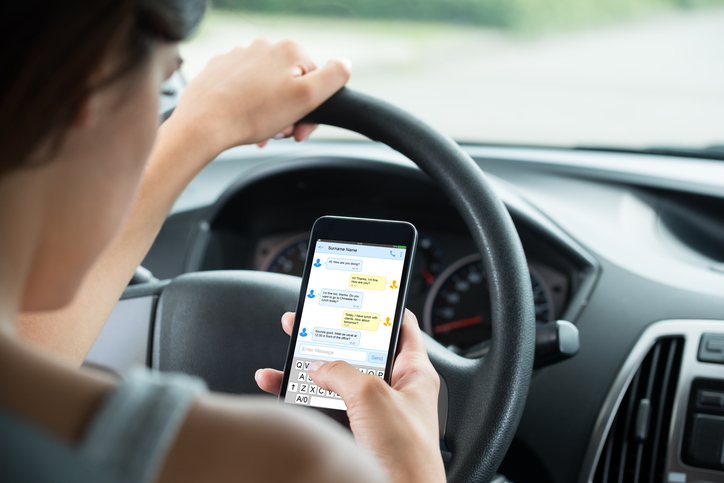
Major Studies Reveal Alarming Truths About Distracted Driving
NHTSA reported 804,928 crashes attributed to distraction in 2021. That is not a trend line or a projection — that is one year’s count from the federal agency that tracks these numbers. AAA added a detail that I find just as troubling: after a driver puts the phone down, the mind stays distracted for roughly twenty-seven seconds. Half a minute of inattention on the I-75 corridor through Lee and Collier Counties — where a car at highway speed covers more than half a mile in that window — is a rear-end collision waiting for its moment.
For over thirty years, I have watched this category of case go from a rarity to one of the most common reasons clients walk through our door. The version of the question has shifted too. It used to be “was he on the phone?” Now it is “was he on the phone, or the maps, or the texts, or the dashboard touchscreen, or the watch on his wrist?” The answer is usually that we cannot know for sure until we pull the records — and the carriers know that, which is why they fight so hard to keep us from pulling them.
What Florida law actually says about distracted driving
Florida’s hands-free texting statute is the headline piece of law in this area, but it is rarely what decides a civil case. What decides the civil case is the negligence framework that surrounds it. A few statutes matter more than the others.
Section 768.81, Florida Statutes, governs comparative fault. After the 2023 reform, Florida runs on modified comparative negligence — if a jury finds you more than fifty percent at fault, you recover nothing. Below fifty percent, your recovery is reduced by your share of fault. In a distracted-driving case where both drivers were arguably looking at something other than the road, that fifty-percent line becomes the entire fight.
Section 95.11(4)(a), Florida Statutes, sets the deadline. For crashes after March 24, 2023, you have two years from the date of the wreck to file a negligence lawsuit. The pre-reform window was four years, and I still have to explain to people that the old number does not apply to them. Two years passes quickly when you are also healing.
Section 627.736, Florida Statutes, is the PIP statute — Personal Injury Protection. Your own auto policy pays the first $10,000 of medical and lost wages regardless of fault, as long as you see a qualifying provider within fourteen days of the crash. Distracted-driving cases tend to involve injuries that blow past $10,000 in a single MRI, which is where the at-fault driver’s bodily injury coverage or your own Section 627.727 Uninsured Motorist coverage comes in.
Section 316.066, Florida Statutes, requires a written crash report for any wreck involving injury, death, or property damage over $500. The time-stamped narrative in that report is a quiet workhorse — it lets us line up the officer’s clock against the phone carrier’s clock and show the jury whether the at-fault driver’s screen was active at impact.
Five distracted-driving crash types we see across Lee and Collier Counties
The headlines say “texting” but the cases break down into a wider set of patterns. The five we see most:
- The rear-end on a red-light release. Light turns green, lead car eases off the brake, second car is still mid-text from the red. AAA’s twenty-seven-second hangover is the entire mechanism of injury. We see this on US-41 / Tamiami Trail at the heavier signalized intersections more often than anywhere else in the service area.
- The drift-into-the-next-lane on a long highway run. A driver on I-75 between Estero and Naples checks a notification, looks back up two seconds later, and is already over the line. Sideswipes that turn into rollovers when the driver overcorrects.
- The dashboard-touchscreen wreck. Newer cars buried the climate, music, and even the wipers in a touch menu. Drivers take their eyes off the road longer to use a touchscreen than they used to take to fiddle with a knob. IIHS testing has documented this — see iihs.org on driver-vehicle interface research.
- The hands-free-but-cognitively-gone driver. Bluetooth call, eyes forward, mind a thousand miles away. Inattention blindness — the driver looks straight at a pedestrian and does not register them. These cases are tough to prove because nothing looks wrong on video.
- The work-task driver. Sales rep, delivery driver, gig worker checking the next stop in the app. When the distracted driver was working at the moment of impact, the employer often becomes a defendant under vicarious-liability rules, which can change the recovery picture entirely.
Why a clear distracted-driving case is harder to win than it looks
People assume a distracted-driving case is a layup. Phone in hand, crash, payday. It rarely plays out that way, and the reasons matter.
First, proof. Most drivers will not admit they were on the phone. They will say they were “checking the mirror” or “reaching for a water bottle.” Without the carrier records, you have a credibility contest. We move on phone records early because carriers only hold the detailed data for a finite retention window, and once it ages out it is gone for good.
Second, the comparative-fault game. Defense carriers in 2026 are sophisticated and they read the 2023 reform the same way we do. If they can push your percentage of fault to fifty-one, your case is worth zero. So even a clear rear-end can turn into a fight over whether you stopped too quickly, whether your brake lights worked, whether you were also on your phone. We prepare for that fight from day one.
Third, the cognitive distraction problem. The law treats “eyes off road” distraction more harshly than “mind off road” distraction, but the crash physics do not care which one it was. AAA’s research is good ammunition here because it is a peer-reviewed scientific source we can cite at mediation and at trial — not a marketing piece. CDC injury data from cdc.gov also helps frame the public-health picture in damages presentations.
Fourth, technology evidence is a moving target. Modern cars log a remarkable amount of data — steering input, brake application, accelerator position, sometimes even infotainment interaction — to the event data recorder. We have to download the EDR before the car is auctioned by the insurer, which can happen within weeks. Miss that window and you lose the cleanest evidence in the case.
A South Fort Myers case that shows what distracted driving costs
A South Fort Myers man was driving on a routine afternoon when he was hit head-on by a distracted driver. He fractured his wrist and sustained facial injuries that needed medical attention and follow-up care. The carrier for the at-fault driver — who by every indication had not been watching the road — tried to minimize the injury by pointing to the fact that the client had pre-existing wear in his wrist joint visible on prior imaging.
We built the case on the difference between what the imaging showed before the crash and what the fracture required afterward — a clear before-and-after that made the cause of the new injury undeniable. The case settled at $575,000. If you or a family member were hurt by someone who was not paying attention, that is exactly the kind of claim we bring.
What to do if you think the other driver was distracted
If you walk away from the wreck and you suspect the other driver had a phone in their hand, here is the sequence I have watched work, more or less in this order:
- Tell the officer at the scene. Say the words. “I believe the other driver was on their phone.” The officer will not always note it, but if they do, it shows up in the §316.066 crash report and we have a baseline we can build from.
- Photograph the inside of the other car if you can safely do it. Phone on the seat, phone on the console, mount on the dash — any of it is useful. I have had clients get this from the passenger side window before the tow truck arrived.
- Look for witnesses, not just license plates. The driver behind the at-fault driver often has the best view. A passenger in a third car may have been watching the at-fault driver look down right before impact. Get a name and a phone number, not just “white sedan.”
- See a doctor within fourteen days, even if you feel fine. PIP coverage under §627.736 disappears if you wait past day fourteen. Soft-tissue injuries also tend to surface around day three to day five, after the adrenaline drops.
- Do not give the other driver’s insurance company a recorded statement. They are not your insurer. They have one job and it is to find your percentage of fault. Talk to a lawyer first.
- Call before two weeks have passed. Phone carrier records, EDR data, and physical evidence on the car all age out fast. The earlier we are retained, the more we can preserve.
Key Takeaways
- NHTSA attributed 804,928 crashes to distraction in 2021, and AAA found cognitive distraction lasts about twenty-seven seconds after the phone goes down — long enough to cover half a mile of I-75 at highway speed.
- Florida’s modified comparative negligence rule under §768.81 means you recover nothing if you are more than fifty percent at fault, which is why defense carriers fight so hard on apportionment.
- The statute of limitations for negligence claims after March 24, 2023 is two years under §95.11(4)(a) — half of what it used to be.
- PIP covers the first $10,000 of medical and lost wages under §627.736, but only if you see a qualifying provider within fourteen days.
- Phone records, EDR downloads, and witness statements have short shelf lives. Distracted-driving cases live or die on early preservation.
Frequently Asked Questions
Q1. Is texting at a red light legal in Florida?
Florida’s hands-free texting law applies while operating a motor vehicle, and the practical reading by most enforcement officers is that a car stopped at a red light with the engine running and the driver in the seat is still being operated. More important than the legal question is the safety one. AAA’s research found the cognitive distraction lingers for roughly twenty-seven seconds after you put the phone down, which means the car behind you is moving before your brain is.
Q2. How do you prove the other driver was on a phone?
Phone records, subpoenaed early. We send a preservation letter to the carrier within days of being retained and follow with a subpoena once suit is filed. Modern records show texts, app activity, and data sessions down to the second. We pair the timestamps with the crash report time under §316.066, FL Stat. and the 911 call log. When the timestamps line up with impact, the case stops being a swearing match.
Q3. What if I was partly distracted too?
Florida runs on modified comparative negligence under §768.81, FL Stat. As of the 2023 reform, if a jury finds you more than fifty percent at fault you recover nothing. At fifty percent or less, your recovery is reduced by your share. Carriers know this rule and try to push your percentage up. That is one of the main reasons people hire us — we push back with the evidence.
Q4. How long do I have to file a distracted driving claim in Florida?
Two years from the date of the crash for negligence claims that arose after March 24, 2023, under §95.11(4)(a), FL Stat. The pre-reform window was four years. We have seen people lose otherwise strong cases because they assumed they still had the old four years. If your crash is recent, the clock is shorter than you think.
Q5. Does PIP cover me if a distracted driver hits me?
Yes. Florida PIP under §627.736, FL Stat. pays the first $10,000 of medical and lost wages regardless of fault, as long as you see a qualifying provider within fourteen days. PIP is not the whole picture though. For real injuries you usually need to reach the at-fault driver’s bodily injury liability coverage or your own Uninsured Motorist coverage under §627.727, FL Stat.
Talk to our office
If you were hit by a driver you believe was distracted, the sooner we are involved the more evidence we can save. Call 239-992-8259 for a free consultation. There is no fee unless we recover for you. I handle these cases personally, from the first phone call through resolution, and our office covers Bonita Springs, Fort Myers, Naples, Estero, Cape Coral, and Lehigh Acres.
About the Author

Personal injury is the focus of David B. Pittman, Esq.’s practice across Southwest Florida, and has been since he founded Pittman Law Firm, P.L. more than three decades ago. The firm represents injured clients across Lee and Collier Counties — Bonita Springs, Fort Myers, Naples, Estero, Cape Coral, and Lehigh Acres — with offices in Bonita Springs and Fort Myers, and a particular focus on commercial-vehicle, complex-liability, and serious-injury cases.
Educationally, David is a graduate of both The Citadel, The Military College of South Carolina, and the University of South Carolina School of Law. Professionally, he holds AV-Preeminent status with Martindale-Hubbell and Multi-Million Dollar Advocates Forum membership.
David has held a Florida real estate broker license for twenty-five years, a credential that shapes how the firm reads the property side of premises cases. The firm handles personal injury cases across Lee and Collier Counties, serving Fort Myers, Bonita Springs, Naples, Cape Coral, Estero, and Lehigh Acres, with offices at Windsor Place in Bonita Springs (main) and Fort Myers (satellite). Call 239-992-8259 for a free consultation.
The information on this page is for general information only and is not legal advice. Reading it does not create an attorney-client relationship with Pittman Law Firm, P.L. Every case turns on its own facts. This page is attorney advertising under the Rules Regulating The Florida Bar.