

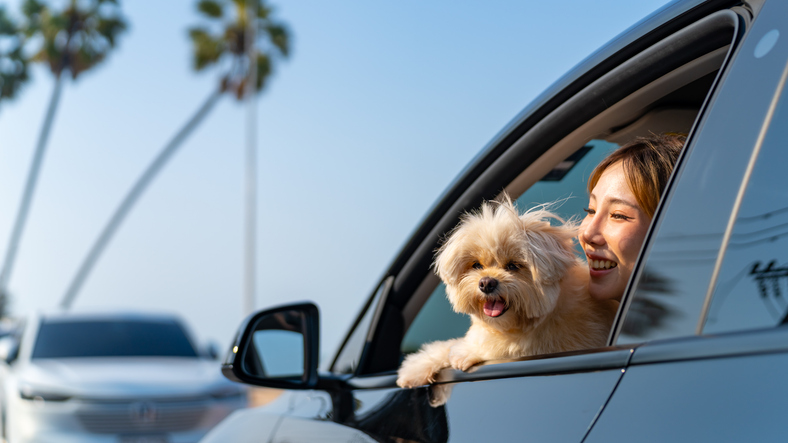
Is Driving with a Dog on Your Lap Illegal in Fort Myers?
Florida has no statute that names a dog on the driver’s lap as illegal. None. That surprises people, but it is true — the Legislature has considered the issue repeatedly and the bills keep dying in committee. What Florida does have are careless-driving, obstructed-view, and reckless-driving statutes, and a Lee County jury does not need a dog-specific law to find that a driver who was distracted by a pet caused the crash.
If you were the one hurt by that driver, here is how these cases actually work and what the first call to an attorney should cover.
What Florida law actually says about driving with a dog on your lap
There is no Florida statute that prohibits a dog from sitting on the driver’s lap. None. People always look for one, and reporters write about proposed bills every couple of years, but the bills keep dying in committee. So when an officer at the corner of Cleveland Avenue and Colonial Boulevard writes a ticket for it, the officer is reaching for one of three other tools.
§316.1925 — careless driving. This is the most common citation in dog-on-the-lap cases. The statute says a driver must operate a vehicle in a careful and prudent manner, regard for the width, traffic, surface of the road, and any other condition then existing. In plain English, if your dog is in your way, you are not driving carefully. The fine alone usually runs a few hundred dollars, but the bigger consequence is what it does to a later civil case.
§316.2004 — obstructed view or control. A driver cannot operate a vehicle when anything blocks the view through the windshield or interferes with the controls. A 30-pound dog standing between you and the wheel is the textbook example. Read the statute at leg.state.fl.us if you want the exact language.
§316.192 — reckless driving. This one is harder for the State to prove because it requires “willful or wanton disregard” for safety. A lap dog by itself is rarely enough. But add a swerve, a phone in the other hand, and a near-miss on Summerlin Road, and the charge changes character fast. First offense is up to 90 days and a $500 fine. Second is up to six months and $1,000.
None of these statutes mentions a dog by name. That is exactly the point. Florida law does not care what distracted the driver. It cares whether the driving fell below a reasonable standard.
Four pet-distraction crash types that come through our Lee County files
After three decades of handling Lee County crash claims, the dog-related cases sort themselves into four patterns. I see roughly this distribution:
- The lap-dog rear-end. Driver looks down to settle the dog, looks up at brake lights, hits the car in front. Usually low-speed, usually a soft-tissue claim against the dog driver’s bodily-injury coverage. Settles inside policy limits if the carrier is reasonable.
- The window-leaner. Dog with its head out the window jumps or lunges. Driver corrects, crosses the centerline. These get serious quickly, particularly on two-lane stretches of Pine Island Road where there is no shoulder to absorb a wide correction.
- The front-seat-airbag injury to the pet. Not a personal injury case in the traditional sense, but a frequent question. An airbag deploys at roughly 200 mph and was engineered for a 165-pound adult. A small dog in the front seat almost never survives deployment. Owners want to know if homeowner’s coverage applies. It usually does not.
- The unrestrained dog as a projectile. A 50-pound dog in a 40-mph collision generates around 2,000 pounds of force on whatever it hits. Usually that is the back of a child’s car seat, the windshield, or the rear passenger. These are the cases where the injury to the human passenger is severe and the carrier still tries to argue the dog “contributed” to the damages.
Three complications we see on every dog-distraction claim
From the injured-party side, a dog-distracted-driver case has three complications that a typical rear-end claim does not.
First, the at-fault driver is sympathetic. Juries like dogs. The defense will lean on this. The driver will be presented as a loving pet owner who made a single small mistake. So the case has to be tried on the physics and the conduct, not on the emotion. Photographs of the cabin afterward, the dog’s location in the vehicle when EMS arrived, and the citation paperwork all matter more than usual.
Second, the comparative negligence picture gets messy. Under §768.81, Florida’s modified comparative negligence rule (reformed in 2023), an injured party who is 51% or more at fault recovers nothing. The defense in a dog case will look for any cracks in the injured driver’s story — were they speeding, were they tailgating, did they have time to react. Even a 20% comparative share knocks 20% off the recovery. Read the full statute at leg.state.fl.us.
Third, the timeline is shorter than people remember. §95.11(4)(a) was reformed in 2023 to cut the negligence statute of limitations from four years to two. So if you were rear-ended by a lap-dog driver on Daniels Parkway in June of 2024, your suit has to be filed by June of 2026. I have had three potential clients walk into our office in the last year with strong cases that were already time-barred because they waited. Full text at leg.state.fl.us.
The other layer is insurance. Florida is a no-fault state. Your own PIP under §627.736 pays the first $10,000 of medical bills regardless of who caused the crash. After that you are working against the at-fault driver’s bodily-injury limits, and in many Fort Myers cases that is the state minimum of $10,000, which evaporates against any real injury. The fallback is your own Uninsured/Underinsured Motorist coverage under §627.727. Most drivers either do not have UM or have stacked it without understanding what stacked means.
What to do if a dog-distracted driver hit you in Lee County
The first hour after the crash is where most of the evidentiary damage is done, and I tell every caller the same thing.
- Call the police even on a low-speed bump. Florida’s crash-report requirement under §316.066 kicks in for any crash with injury, death, or apparent damage over $500. The report is the spine of the later claim. Without it, the at-fault driver’s story is the only story.
- Photograph the inside of the other car. I have used this in three claims now. If the dog is still in the cabin, photograph it. If there is a chewed leash on the passenger seat, photograph that. The carrier will scrub anything inconsistent within hours.
- Ask the responding officer, on the record, whether a careless-driving citation is going in. The officer’s narrative carries weight in negotiation. I have noticed that drivers who ask politely at the scene get clearer reports than drivers who say nothing.
- Get the at-fault driver’s full declarations page, not just the insurance card. The card tells you who the carrier is. The declarations page tells you what the policy limits actually are. Two different documents.
- Do not give a recorded statement to the other carrier before you have talked to a lawyer. One sentence in a recorded statement has cost clients five-figure reductions in settlement. We do not charge for the call.
- See a doctor inside 14 days. Florida PIP has a fourteen-day initial-treatment rule under §627.736. Miss it and you forfeit the $10,000 of no-fault medical.
None of those steps is generic, and none of them is something a 1-800 billboard firm is going to walk you through in the first hour. I do, because we have seen what happens when those steps are skipped.
How a Fort Myers head-on claim reached $575,000
A South Fort Myers man came to us after a head-on collision with a distracted driver. He sustained a fractured wrist and facial injuries. That case settled for $575,000. The distracted-driving documentation — the police report narrative, the witness statements, and the citation the officer wrote — was what made that number achievable.
Key Takeaways
- Florida has no statute that names dogs and laps, but officers routinely cite under §316.1925 (careless driving), §316.2004 (obstructed view), or §316.192 (reckless driving) when a pet is in the way.
- Under §768.81, a Lee County jury can divide fault between drivers, and an injured party who is 51% or more at fault recovers nothing.
- The statute of limitations on a negligence claim is now two years under §95.11(4)(a), not four. The 2023 reform shortened it, and we are watching cases get time-barred because of it.
- PIP under §627.736 pays the first $10,000 of your medical bills regardless of fault, but only if you treat within 14 days of the crash. UM coverage under §627.727 is the practical backstop for anything serious.
- Photographs of the other vehicle’s cabin and a contemporaneous police report do more for a dog-distracted-driver case than almost anything else. Do both at the scene.
Frequently Asked Questions
Q1. Can a Fort Myers officer ticket me just for having my dog on my lap?
Florida has no statute that names dogs and laps. But if the dog blocks the wheel, blocks your view, or pulls your eyes off the road, an officer can write you up for careless driving under §316.1925 or for an obstructed-view violation under §316.2004. The dog does not need to cause a crash for the citation to stick.
Q2. If my dog caused me to swerve and rear-end somebody on Daniels Parkway, am I automatically at fault?
Usually yes, and the carrier will press hard on that. Under Florida’s modified comparative negligence rule in §768.81, a jury can still divide fault between drivers, but if your share lands at 51% or higher, you collect nothing for your own injuries. Anything you did with the dog will be the first thing the defense puts on the screen.
Q3. What about the other driver, the one I hit because of my dog?
The injured driver has two years to file under §95.11(4)(a) (lowered from four years in the 2023 reform). Their own PIP under §627.736 pays the first $10,000 of medical bills regardless of fault. After that, they can pursue the at-fault driver’s bodily-injury coverage and, if that is short, their own Uninsured/Underinsured Motorist coverage under §627.727.
Q4. Does my auto policy still cover me if the crash was caused by my dog?
In most cases, yes. Florida bodily-injury liability coverage is for negligence behind the wheel, and a distracted-driver crash from an unrestrained pet is still negligence. The carrier may raise rates at renewal, and if the citation is reckless driving rather than careless, the policy implications get worse. Read your declarations page or call us before you give a recorded statement.
Q5. What is the safer setup for a dog in the car in Florida?
Back seat, crash-tested harness clipped into the seat belt receiver, or a secured carrier on the back floorboard. Keep the dog out of the front passenger seat because front airbags deploy at roughly 200 mph and were engineered for an adult, not a 12-pound terrier. After thirty years of handling Lee and Collier County crashes, the back-seat-harness setup is the one I have seen survive a collision intact.
Talk to a Fort Myers Personal Injury Attorney
If you were hit by a distracted driver in Fort Myers, Cape Coral, Bonita Springs, Estero, Naples, or Lehigh Acres — whether the distraction was a dog, a phone, or anything else — call our office at 239-992-8259 for a free consultation. There is no fee unless we recover for you. I will pick up, look at the police report, pull the at-fault driver’s policy limits, and give you a straight read on what the case is worth.
About the Author

The firm is led by David B. Pittman, Esq., who founded Pittman Law Firm, P.L. and has practiced personal injury law in Fort Myers and across Lee County for more than thirty years, representing injured clients across Lee and Collier Counties, with a particular focus on commercial-vehicle, complex-liability, and serious-injury cases. The firm’s Fort Myers presence handles a steady stream of serious-injury work along the Daniels Parkway, Six Mile Cypress, McGregor Boulevard, Cleveland Avenue, and Summerlin Road corridors, and along I-75 between Estero and Bell Tower.
Between undergraduate at The Citadel, The Military College of South Carolina and a JD from the University of South Carolina School of Law, David built the foundation for a personal injury practice that now carries AV-Preeminent status with Martindale-Hubbell and membership in the Multi-Million Dollar Advocates Forum.
David has held a Florida real estate broker license for twenty-five years, a credential that shapes how the firm reads the property side of premises cases. The firm handles personal injury cases across Lee and Collier Counties, serving Fort Myers, Bonita Springs, Naples, Cape Coral, Estero, and Lehigh Acres, with offices at Windsor Place in Bonita Springs (main) and Fort Myers (satellite). Call 239-992-8259 for a free consultation.
The information on this page is for general information only and is not legal advice for any individual case or situation. Reading this page does not create an attorney-client relationship with Pittman Law Firm, P.L. This is attorney advertising.