

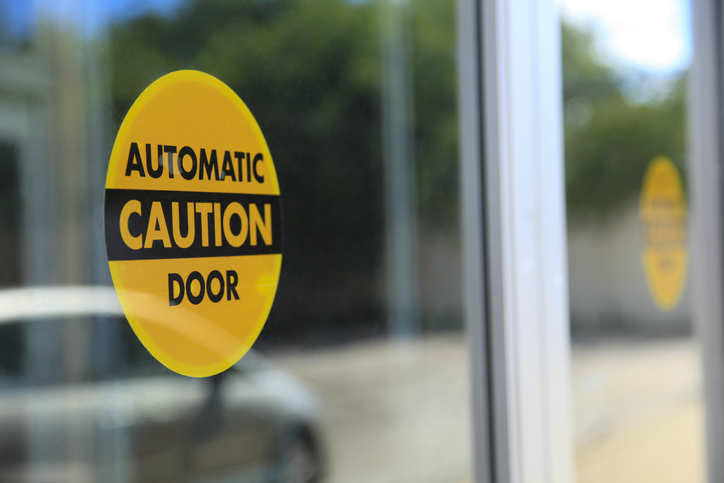
How to Protect Yourself from Automatic Door Malfunction Injuries in Southwest Florida
A grocery sliding door clips a shoulder in Bonita Springs. A hospital entrance reverses on a wheelchair in Fort Myers. A revolving door at a Naples hotel pinches an ankle. These injuries can range from a bad bruise to a torn rotator cuff to a head strike that puts someone in the ER. What I have seen across thirty years of personal injury practice — and twenty-five years as a Florida real estate broker — is that the building owner was often quietly aware of the problem for months before a customer finally got hurt. That awareness, or the failure to act on it, is where these cases begin.
This post lays out what Florida law says about these claims, the patterns we keep seeing in our office, the practical reasons these cases are harder than they look, a case from our practice, and a short list of things to do if a door hits you or somebody you love.
What Florida law actually says about automatic-door injury claims
An automatic-door injury is a premises liability case. The property owner has a duty to keep the premises in a reasonably safe condition for invitees — that is the legal label for paying customers and members of the public the business intends to attract. A door that pinches, drops, or fails to detect a person standing in the threshold is a dangerous condition. The question is whether the owner knew about it, or whether the condition existed long enough that a reasonable owner should have known about it.
A handful of Florida statutes drive almost every conversation I have with a client after an incident like this:
- §95.11(4)(a), Fla. Stat. — the statute of limitations. After the 2023 tort reform, you have two years from the date of the injury to file suit on a negligence claim. That used to be four. In plain English, half of the runway you would have had a few years ago is gone, and every week the door’s service company spends adjusting the sensors is a week where the as-found evidence is changing.
- §768.81, Fla. Stat. — modified comparative negligence. Florida juries assign percentages of fault. If the jury decides you were 20% at fault for not noticing the door wobble, your recovery is reduced by 20%. If the jury decides you were 51% or more at fault, you recover nothing. The 2023 reform moved the bar from pure comparative to this modified version, which the defense bar uses aggressively.
- §627.736, Fla. Stat. — PIP. Personal Injury Protection only covers motor-vehicle crashes. A common mistake clients make is assuming their auto PIP covers the first $10,000 of medical bills for a slip or a door strike at a business. It does not. The medical bills run through the client’s health insurance, then we pursue the property owner’s general liability policy.
One more piece of context the statutes do not capture. Automatic doors are governed by an industry standard called ANSI/BHMA A156.10 for sliders and A156.27 for swingers. Compliance with that standard is not the law in Florida, but it is the benchmark every door installer and service technician is supposed to work to. When a building’s annual safety audit shows the sensors out of spec and the owner does nothing for six months, that audit becomes the spine of the negligence argument.
Incident types we handle in our office
If I sort the automatic-door incidents we have handled in the last several years, almost every one of them lands in one of these buckets:
- Sliding doors that close on a person mid-stride. Usually a grocery store, big-box retailer, or strip-mall entrance along US-41 / Tamiami Trail. The motion sensor either failed to detect a slower-moving customer or was set with too aggressive a close-delay.
- Sliding doors that reverse on a person standing in the threshold. A clerk holding the door open with a hand cart, an elderly customer pausing to fish for keys. The safety beam should have held the door open. It did not.
- Swing doors that swing into someone walking by. The activation mat or wall sensor fires a fraction of a second before someone enters the swing arc. Common at medical office entrances.
- Revolving doors at hotels and high-rises. Speed too high, no slow-down sensor functioning, no emergency stop reachable. Pinched ankles, ankles caught between the wing and the drum, a kid swept off balance.
- Doors with broken or removed safety beams. The bottom safety beam is missing — knocked off by a cart months earlier — and nobody at the store noticed because the door still opened on the top sensor.
- Doors operating outside posted hours. Owner switched the door to manual to save on service calls, customers were not warned, somebody pushed against a door that was supposed to swing automatically.
The bucket matters because it tells us which standard the door was supposed to meet, which company installed and serviced it, and what kind of preservation letter goes out in the first week.
What makes automatic-door cases difficult to win
The straightforward version of the story is that a door hit a customer and the store should pay. The actual case has more moving pieces.
First, the defense almost always argues the door was working properly at the time and the customer was not paying attention. The way to take that argument apart is with the service log — the maintenance records the door company keeps for that specific building. If the log shows a service call three weeks before our client got hit, and the technician’s notes say “sensor reset, recommended replacement, owner declined,” the case looks very different. If the log is clean, our case gets a lot harder.
Second, video is finite. Retail security systems overwrite video on a 14-to-30-day loop. If we do not get a preservation letter to the building owner inside two weeks, the footage of the malfunction is gone and we are left with witness recollection.
Third, the door service company is its own defendant. Stores typically contract out the install and the maintenance to a national service company, and that company carries its own commercial general liability policy. We routinely put both the store and the service company on notice and sort out the relative percentages of fault after discovery. Under §768.81, the jury will allocate those percentages, and the client recovers from each according to their share.
Fourth, and this is where the real-estate broker side of my background tends to come up — most retail tenants do not own the building. The landlord-tenant lease will say one of them is responsible for “common areas” and entrances. Sometimes that is the landlord, sometimes the tenant, sometimes both with a maintenance schedule appended. Figuring out who actually had the duty to inspect and repair the door is a contract-reading exercise as much as a personal-injury one.
What to do if an automatic door hurts you or a family member
None of this is legal advice for any specific situation. It is the action list I give my own family if a door drops on them at a Bonita Springs strip mall or along the I-75 corridor between Lee and Collier Counties.
- Get medical attention the same day, even if you feel fine. Door strikes to the head, shoulder, and lower back can present with delayed symptoms. Concussion and rotator cuff injuries in particular show up worse on day three than on day one. Going to urgent care or the ER creates the contemporaneous medical record that everything else gets built on.
- Tell the manager on duty, in writing if you can. Ask for an incident report and ask for a copy. If the manager refuses to provide a copy, write down the manager’s name and the time you reported it. Send a follow-up email to the store the same day so there is an electronic timestamp.
- Photograph the door and the area around it. Sensors, safety beams, the threshold, any posted notices, any visible damage. If the door is still cycling, take a short video of it cycling. If the safety beam is broken, photograph that specifically — that detail can disappear in a service visit the next morning.
- Get the names and phone numbers of any witnesses. Not their statements — just contact information. A two-line note from a stranger who saw the door close on you is worth more than your own recollection three months later.
- Save the clothes and shoes you were wearing. Sounds odd. Defense witnesses will sometimes argue a customer was wearing footwear that affected their gait or sightline. Preserving the actual items lets us shut that argument down.
- Call a lawyer inside the first two weeks. Not because we are in a hurry to sign a client, but because a preservation letter to the property owner and the service company has to go out before the video loop overwrites and before the door is recalibrated. We send these letters at no cost.
One thing I usually add when I am giving this advice in person — do not sign anything the store hands you. Property owners and their carriers sometimes ask for a recorded statement or a release within the first week. That is not the moment to be making decisions about what your case is worth.
Key Takeaways
- Automatic-door injuries are premises liability claims. Liability turns on whether the owner knew or should have known about the dangerous condition under §768.81 and standard premises law.
- The Florida statute of limitations for negligence is now two years under §95.11(4)(a). Half of the old runway is gone.
- Your auto PIP does not pay for a door strike at a business. The medical bills run through health insurance, and the property owner’s general liability policy is the real source of recovery.
- Security video overwrites in 14 to 30 days and door technicians can recalibrate sensors within 48 hours. A preservation letter in the first two weeks is the single most useful early step.
- Both the store and the door service company can be liable, and the jury will assign percentages between them. Putting both on notice early matters.
Frequently Asked Questions
Is the property owner automatically liable when an automatic door hurts someone?
No. Florida premises liability turns on whether the owner knew or should have known about the dangerous condition and failed to fix it. We have to show the malfunction existed long enough, or recurred often enough, that a reasonable property owner should have caught it. Maintenance records and prior incident reports do most of the heavy lifting on that question.
How long do I have to file a claim after an automatic door injury in Florida?
Under §95.11(4)(a), Florida Statutes, the deadline is two years from the date of the injury for negligence claims that accrued after the 2023 tort reform. That is half of what it used to be, and it runs while the building owner is quietly repairing the door and overwriting the evidence. Call a lawyer early.
Can I still recover if I was on my phone or distracted when the door hit me?
Probably yes, but your recovery gets reduced. Florida uses modified comparative negligence under §768.81. If the jury assigns you 30% of the fault, your recovery drops by 30%. If they put you at 51% or higher, you recover nothing. Distraction is a real argument, but a door that closes on a paying customer is the owner’s problem, not yours.
Who actually pays in an automatic door case — the store or the door company?
Often both, in different proportions. The store carries premises liability coverage for the condition of its property. The service company that installed or maintained the door carries its own commercial general liability policy. We typically put both on notice early and sort out the percentages after discovery.
What evidence disappears fastest after an automatic door incident?
Security camera footage and the door’s service log. Most retail systems overwrite video on a 14-to-30-day loop. The service company can be back out within 48 hours to recalibrate sensors, which wipes the as-found settings. A preservation letter sent within the first week is one of the more useful things a lawyer can do on a case like this.
Talk to our office
If a malfunctioning automatic door has hurt you or somebody in your family at a store, hospital, hotel, or office in Bonita Springs, Fort Myers, Naples, Estero, Cape Coral, or Lehigh Acres, call our office at 239-992-8259 for a free consultation. There is no fee unless we recover for you. We can usually have a preservation letter out to the property owner the same day.
About the Author

Three decades into his personal injury career across Southwest Florida, David B. Pittman, Esq. continues to lead Pittman Law Firm, P.L., the firm he founded. The firm represents injured clients across Lee and Collier Counties — from the firm’s main office at Windsor Place on Bonita Beach Road through Fort Myers, Naples, Estero, Cape Coral, and Lehigh Acres — with a particular focus on commercial-vehicle, complex-liability, and serious-injury cases.
After undergraduate work at The Citadel, The Military College of South Carolina, David earned his JD at the University of South Carolina School of Law. He is AV-Preeminent at Martindale-Hubbell and a member of the Multi-Million Dollar Advocates Forum.
David has held a Florida real estate broker license for twenty-five years, a credential that shapes how the firm reads the property side of premises cases. The firm handles personal injury cases across Lee and Collier Counties, serving Fort Myers, Bonita Springs, Naples, Cape Coral, Estero, and Lehigh Acres, with offices at Windsor Place in Bonita Springs (main) and Fort Myers (satellite). Call 239-992-8259 for a free consultation.