

Can You Still Sue After a Fort Myers Slip and Fall If There Is a Caution Sign?
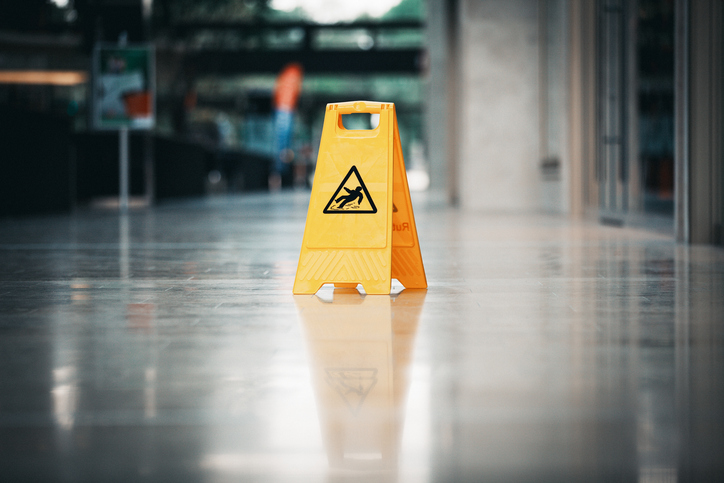
A yellow caution cone is not a release form. That is the short answer to the question clients ask me before they have even sat down in our conference room. They walked in certain that the cone erased their case. It does not. Under §768.0755, Florida Statutes, a business’s duty to keep its floors safe does not transfer to the customer the moment someone drags a plastic triangle out of a utility closet. The cone is one piece of evidence a jury considers. Whether the owner did enough — whether the hazard was cleaned up promptly, whether the sign was visible from the approach, whether this same spill had been reported before — is a separate question, and it is almost always where a case like this turns.
The truth is that the property owner is the one carrying the duty here, not you. A wet-floor sign does not transfer that duty back onto the customer who walked through the door. It just tells a jury that the owner knew something was wrong. Whether the owner did enough about it is a separate question, and it is usually where the case gets won or lost.
For the last twenty-five years, in addition to practicing law, I have held a Florida real estate broker license, and that broker work has shaped how we read property cases. When I walk a fall scene, I am not only thinking like a personal-injury lawyer. I am also thinking like the licensee who has spent two and a half decades inside lease agreements, common-area maintenance clauses, and the operational responsibilities that follow a “for invitees” sign on a commercial door. That dual lens — lawyer and broker — is the reason our office spots premises arguments that other firms miss.
What Florida law actually requires of a property owner
Most of these cases live inside three statutes. Read in order, they tell the story.
Florida Statute 768.075 sets the baseline duties a property owner owes to people who come onto the land. The duty is highest to invitees — customers in a store, patients at a medical plaza, guests at a hotel — and it is a duty of reasonable care. In plain English, that means the owner has to inspect, fix what is broken, and warn about what cannot be fixed right away.
Florida Statute 768.0755 is the one defense lawyers reach for first. It governs falls on transitory foreign substances — things like spilled water, dropped grapes, leaked hydraulic fluid, a melted snow-cone on a tile floor. To win that kind of case, the injured customer has to show the business had actual or constructive knowledge of the substance. Actual knowledge means somebody at the store saw it. Constructive knowledge is the more common fight — it means the spill was there long enough that a careful manager should have caught it on a routine sweep. Time on the floor, repeat occurrences in the same spot, and surveillance video are how that record gets built.
Florida Statute 768.0710 covers the other family of premises cases — the ones where the danger was not a puddle but a feature of the property itself. Cracked sidewalks. A jagged broken section of concrete. Uneven pavement between two sections of a parking lot. A missing handrail. A loose stair tread. These are structural, not transitory, and the analysis is different. The owner does not get the same “we did not know about the spill” defense, because the defect is part of the property the owner is responsible for maintaining.
If the fall happened on government land — a sidewalk in a municipal park, the floor of a county building, a Lee County Port Authority property — Florida Statute 768.28 kicks in. Sovereign immunity is partly waived, but there are damages caps, pre-suit notice requirements, and procedural steps that have to happen on time. Miss the notice window and the case is gone, no matter how serious the injury.
Factors a Florida court actually considers
Here is the practical list a judge or jury weighs when a caution sign is in the picture. None of these is dispositive on its own. The point is the totality.
- Where the sign was positioned relative to the hazard, and whether a person walking the natural traffic line would see it before stepping into the danger.
- How visible the sign was given lighting, height, color contrast against the floor, and any objects blocking it — pallets, displays, decorative plants, a stocking cart.
- How long the hazard had been present, and what the store’s own inspection or sweep logs say about the last walk-through.
- Whether the size and number of signs matched the size of the area — one cone for a 6,000-square-foot grocery aisle is not the same as one cone for a small entryway.
- Whether prior complaints or prior incidents at the same location put the owner on notice that the spot was a known problem.
- Whether the warning described the actual danger — a generic “wet floor” cone next to a torn floor mat with a tripping edge is not really a warning at all.
I tell clients to picture two scenes. In the first, an employee sees a coffee spill, immediately drops a wet-floor cone right on top of the spill, radios for a mop, and the customer slips during the thirty seconds in between. That property owner has done about what a reasonable manager would have done. In the second, the same coffee spill sat for forty-five minutes, three employees walked past it, the cone got placed ten feet away behind an endcap, and a customer rounded the corner and went down. Those are different cases, even though both have a cone in the photo.
The trivial-defect doctrine — and why it is messier than it sounds
Defense lawyers in trip cases love to argue trivial defect. The shorthand version is that a vertical change in pavement of roughly an inch or less is sometimes treated as not actionable, on the theory that ordinary walkways are not glass-smooth and pedestrians are supposed to watch where they step.
It is not a bright-line rule, and any client who has been told otherwise has been told wrong. Florida courts look at the totality. A three-quarter-inch lip in bright sun, on flat clean concrete, with no foot traffic distractions, may not get past summary judgment. The same three-quarter-inch lip in a dim parking garage stairwell, painted the same gray as the surrounding concrete, with a glare from a poorly-placed light fixture, can absolutely go to a jury. Lighting, visibility, the foreseeable distraction of the location, prior complaints, and the owner’s actual conduct all come into play.
That is why I take pictures at the same time of day the fall happened. The defense will sometimes show a photo taken at 11 a.m. on a clear morning to make a 7 p.m. defect look obvious. It is not obvious if you cannot see it.
What we see most in Fort Myers
The slip-and-fall calls coming into our office out of Fort Myers tend to cluster in a few places, and the pattern has been steady for years.
Big-box and grocery falls along the Cleveland Avenue corridor and out toward Six Mile Cypress Parkway — almost always transitory substance cases under §768.0755. Produce spills, leaks from refrigerated cases, tracked-in rain by the front doors during summer afternoon storms. The cases turn on what the store’s own sweep logs show and whether the surveillance video has been preserved before it cycles out, which on most retail systems is somewhere between fourteen and thirty days.
Medical plazas and office parks off Summerlin Road and along Daniels Parkway — these tend to be structural cases under §768.0710. Cracked or heaved sidewalk slabs, broken concrete in covered walkways, parking-lot wheel stops in the wrong place. The clientele skews older. The injuries skew worse: hip fractures, wrist fractures, shoulder labrum tears, head strikes.
Hotels and resorts along the McGregor Boulevard run down toward the river — pool decks, lobby tile transitions, valet drop-offs. And mixed-use developments off Colonial Boulevard, where a fall on what looks like store property can actually be the responsibility of the common-area landlord or the property management company. That distinction matters enormously, and it is one of the places the broker background pays off — I can read the lease.
A Summerlin Road medical plaza: when the cone was nowhere near the break
A few months back our office settled a case out of a medical plaza off Summerlin Road in Fort Myers. Our client was in her seventies, a careful walker, on her way back to her car after a routine appointment. The walkway between the building and the parking lot had a jagged broken section of concrete that had been sitting that way for months. Tenants had told management. Nothing got done.
She caught a toe on the lip, came down hard on her hip, and suffered a femoral neck fracture. That is the type of break that almost always means surgery in someone her age, and it did — a partial hip replacement, followed by inpatient rehabilitation and a long stretch of home physical therapy. She is walking again. She is not the same as she was before the fall, and at her age she does not get those years back.
The property owner pointed at the tenant. The tenant pointed at the management company. We read the lease, pulled the maintenance correspondence, and walked the scene with photographs taken at the same time of day. The case settled in the six figures against the commercial property management company. The repair, when it finally happened, took about three hours.
I tell that story because clients ask whether a “small” trip is worth pursuing. A two-inch chunk of concrete becomes a hip replacement. That is the math of premises cases. The defect is small. The injury is not.
What a property owner is supposed to be doing
This is where twenty-five years of holding a Florida real estate broker license changes how I see these cases. I have sat on the other side of the table — managing properties, negotiating leases, allocating common-area maintenance obligations between landlord and tenant. I know what a reasonably run commercial property looks like operationally, because I have been responsible for running them.
A property owner exercising reasonable care is, at minimum, doing the following:
- Running a documented inspection schedule that matches the property’s risk profile — a grocery store needs sweep logs every fifteen to thirty minutes in foul-weather hours, not every two hours.
- Training staff to address spills and structural defects when they spot them, and to mark and warn while the fix is being done — not as a substitute for the fix.
- Maintaining the common areas in line with the lease and in line with any property-management agreement, including walkways, parking lots, stair treads, handrails, lighting, and drainage.
- Keeping records of complaints and prior incidents, and acting on them. A complaint log that sits in a drawer with no work orders behind it is almost a written confession.
- Preserving surveillance video when an incident happens, instead of letting it cycle out on the default fourteen-day overwrite.
When I review a premises case, I am comparing what the owner actually did against that list. The further the conduct sits from that list, the stronger the case. Having spent twenty-five years as a Florida real estate broker in addition to representing injured Floridians, I have seen first-hand what a property owner’s reasonable safety obligations look like from the inside, and I can usually tell within an afternoon whether a defendant met them or did not come close.
What to do if you fell
If you are reading this in the first few days after a fall, here is what I tell clients on the phone before they come in.
- Get medical care today, not next week. Hip and head injuries hide. A delay in treatment becomes the first thing the carrier argues — they will say you must not have been hurt because you did not see a doctor.
- Write down what happened while it is fresh. Where you were walking, the direction you came from, what was on the floor, where the cone was relative to your path, who you spoke to, what they said. One page is enough.
- Photograph the scene before it changes. Get the hazard, get the sign placement, get the lighting, get the angles a person walking your path would actually see. If you cannot do it because you are at the hospital, ask a family member to go back.
- Ask for an incident report and keep your copy. If the store refuses to give you one, write down the name of the person who refused.
- Save the shoes you were wearing and the clothes that hit the ground. Do not wash them. Defense lawyers love to argue about footwear.
- Do not give a recorded statement to the property’s insurance carrier. Tell them you will be represented and your lawyer will be in touch.
- Call us before you settle anything. Initial offers in slip-and-fall cases are almost always low, sometimes by a factor of ten.
Key Takeaways
- A wet-floor cone is one piece of evidence. It is not a release, and it does not erase a Florida property owner’s duty of reasonable care under §768.075.
- Transitory substance cases under §768.0755 turn on actual or constructive knowledge — usually proved through sweep logs, prior complaints, and surveillance video.
- Structural-defect cases under §768.0710 — cracked concrete, missing handrails, uneven pavement — follow a different analysis because the defect is part of the property, not something that just appeared on it.
- Trivial defect is not a bright line. A small lip in bad lighting, with prior complaints in the file, can absolutely go to a jury.
- Time is the enemy of premises cases. Surveillance video cycles in two to four weeks, witnesses scatter, and Florida’s two-year statute on negligence does not wait. Move quickly.
Frequently Asked Questions
Q1. If a yellow caution sign was out when I fell, is my case dead?
No. A wet-floor cone is one fact a jury considers, not a release the store gets to sign on your behalf. Florida courts look at the whole picture: where the sign sat, whether you could actually see it from your line of approach, how long the hazard had been there, what management knew, and what a reasonably careful property owner would have done. I have settled plenty of cases where a cone was technically present and the store was still on the hook.
Q2. What does Florida Statute 768.0755 actually require me to prove?
For a slip on a transitory foreign substance, the law says you have to show the business had actual or constructive knowledge of the spill and should have cleaned it up. Actual knowledge means an employee saw it. Constructive knowledge usually comes from time on the floor, repeat occurrences, or surveillance video showing the puddle sat there long enough that a careful manager would have caught it. We build that record through inspection logs, video, and witnesses.
Q3. How long do I have to file a slip and fall claim in Lee County?
For falls happening in 2023 or later, the statute of limitations for general negligence in Florida is two years. That window runs from the date of the fall. If a government property is involved, you have an earlier notice deadline under Florida Statute 768.28, which can be as short as three years for the notice but with hard procedural steps. Do not assume you have time. Call us and we will tell you what clock is running.
Q4. The store had a “not responsible for injuries” sign at the door. Does that block my claim?
No. A property owner cannot post a sign and waive away a duty that Florida law imposes on them. Those signs are aimed at deterring claims, not defeating them. Premises-liability duties under Florida Statute 768.075 are statutory and apply regardless of what is printed on the front door.
Q5. What should I do in the first 24 hours after a Fort Myers slip and fall?
Get checked by a doctor that same day, even if you think you can walk it off. Hip fractures and head injuries do not always show up immediately. Then write down what happened while it is fresh: where you were walking, what was on the floor, where the cone was relative to your path, who you spoke to at the store. Take photos before the place gets cleaned up. Ask for an incident report and keep a copy. Then call us before you call the insurance adjuster.
Talk to Our Fort Myers Slip and Fall Attorneys
If you fell in a Fort Myers store, hotel, medical plaza, or parking lot — and you were told the caution sign settled the question — please get a second opinion before you walk away from your case. Our office handles these claims across Lee and Collier Counties, and we offer a free consultation. There is no fee unless we recover for you.
Call Pittman Law Firm, P.L. at 239-992-8259, or reach us through our contact page. I will get back to you the same day in most cases.
About the Author

Pittman Law Firm, P.L. — a personal injury practice that has operated in Fort Myers and across Lee County for more than thirty years, with a sustained focus on personal injury and premises-liability cases — is led by founder David B. Pittman, Esq. The firm’s Fort Myers presence handles a steady stream of serious-injury work along the Daniels Parkway, Six Mile Cypress, McGregor Boulevard, Cleveland Avenue, and Summerlin Road corridors, and along I-75 between Estero and Bell Tower.
David completed his undergraduate degree at The Citadel, The Military College of South Carolina, and his JD at the University of South Carolina School of Law. Martindale-Hubbell rates him AV-Preeminent; the Multi-Million Dollar Advocates Forum counts him as a member.
David has held a Florida real estate broker license for twenty-five years, a credential that shapes how the firm reads the property side of premises cases. The firm handles personal injury cases across Lee and Collier Counties, serving Fort Myers, Bonita Springs, Naples, Cape Coral, Estero, and Lehigh Acres, with offices at Windsor Place in Bonita Springs (main) and Fort Myers (satellite). Call 239-992-8259 for a free consultation.
Disclaimer: The information on this page is for general information only and is not legal advice for any particular case. Reading this page does not create an attorney-client relationship with Pittman Law Firm, P.L. Past results do not guarantee a similar outcome in your case. This page may be considered attorney advertising under the Rules Regulating The Florida Bar.