

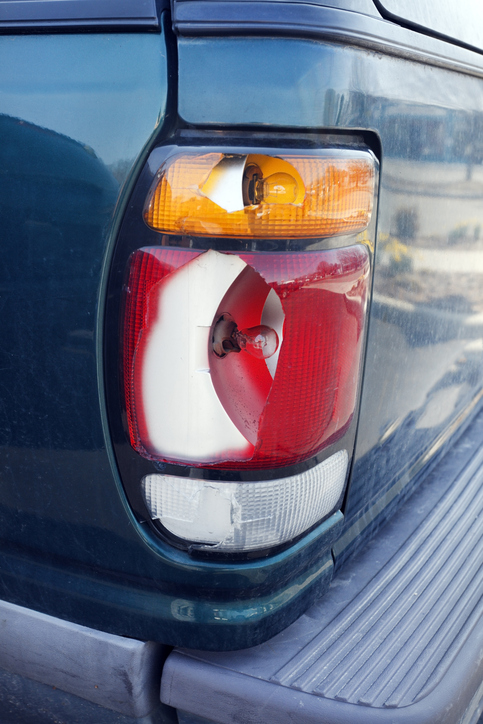
Broken Brake Lights & Florida Law: Who’s Really at Fault in Fort Myers Car Accidents?
Florida Statute 316.222 requires two working red stop lamps, visible from 300 feet in normal daylight. That is not a long statute. It is six sentences. And yet the argument over whether one burned-out bulb shifts any fault onto the front driver — and how much — shows up in a meaningful number of serious-injury cases we work on Cleveland Avenue, McGregor Boulevard, and US-41. A six-dollar bulb can drive a six-figure legal fight once the 2023 comparative-fault reform enters the picture.
I want to walk through what the law actually says, the five patterns we see in our office, why the analysis is never as clean as the statute, and a real case we closed for a Fort Myers client after a hit-and-run on US-41.
What Florida Law Actually Says About Brake Lights and Rear-End Fault
There are three pieces of Florida law that do the heavy lifting on any brake-light case. They are not complicated, but they have to be read together.
Florida Statute 316.222 — the brake-light requirement. Most passenger cars in Florida have to be equipped with two working red stop lamps on the rear, visible from 300 feet in normal daylight. Older vehicles manufactured before January 1, 1972 can get by with one. Trailers over 3,000 pounds need their own stop lamp. The light has to come on when the foot brake is applied. Plain English: if you can buy the bulb at AutoZone, the statute expects you to keep it working.
Florida Statute 768.81 — modified comparative negligence. Since the March 2023 tort reform, Florida is no longer a pure comparative state. If a jury assigns you 51% or more of the fault, you recover nothing. At 50% or less, your damages get reduced by your percentage of fault. Plain English: in a brake-light case, the question is not just “was the lead driver partly at fault?” It is “was the lead driver more than half at fault?” Crossing that 50-line is now an all-or-nothing event. You can read the statute here.
Florida Statute 95.11(4)(a) — the two-year deadline. The 2023 reform also cut the negligence statute of limitations from four years to two for crashes occurring after March 24, 2023. So a Fort Myers driver rear-ended in 2025 has until 2027 to file suit, not 2029. The statute is here.
The presumption itself is judge-made law, not statutory. Florida courts have held for decades that the rear driver in a rear-end collision is presumed negligent. It is a rebuttable presumption, which means the rear driver can knock it down with evidence — and a non-working brake light is one of the classic ways to do it. The other classic ways are a sudden unexpected stop without legitimate reason, a vehicle reversing into the following car, and a lane change that left no time to react.
Five brake-light fact patterns from Fort Myers cases
After thirty-plus years of personal injury work in Lee and Collier Counties, I can tell you the cases sort themselves into a handful of recognizable patterns. Brake-light claims are no different. Here are the five we see over and over in our office:
- Both brake lights out on the lead car. This is the cleanest version. If the lead vehicle had no functional rear brake signal at all, the presumption against the rear driver weakens fast. We have run cases like this where fault ended up split 60/40 or even 70/30 against the front driver.
- One bulb out, one working. This is the most common version, and it is much harder to win. Florida law requires two functioning lamps, but one working brake light still gave the rear driver a warning. Insurers know it. Defense lawyers know it. The fault split here usually moves only ten or fifteen percentage points.
- Brake lights working, but the third center-mounted lamp (CHMSL) is out. The high-mounted brake light. It is required on virtually every passenger car built after 1986. Losing it alone almost never shifts fault, but it can support a broader pattern of poor maintenance.
- Trailer brake lights not synced with the tow vehicle. Florida Statute 316.2225 requires trailer brake lights to operate together with the tow vehicle. This one comes up on Daniels Parkway and out toward I-75 near Alico Road with contractor trailers and boat trailers. A trailer that hides the tow vehicle’s lights and has none of its own is a strong shared-fault argument.
- Brake lights worked at impact but had been out the week before. Sometimes we get records from the lead driver’s mechanic or a recent inspection showing a problem that was repaired. The other side will try to use this as a smear. Photographs and the post-crash police report are what defeat that argument.
Why the bulb question is never as simple as it sounds
On paper, the analysis is simple: if the lead car’s brake lights did not work, the rear driver gets some relief from the presumption of fault. In real cases, almost none of it is simple.
First, proving the bulb was out at the moment of impact is harder than people think. The crash itself often destroys the rear of the lead vehicle. The brake-light housing is one of the first things to shatter. Once the bulbs are out of their sockets, you cannot tell whether they were lit at impact. The same physical damage that shows the crash happened also erases the very evidence everyone is fighting over. We have learned to ask, at the first meeting, whether anyone took a photograph of the cars in the moments after the wreck, before tow trucks moved anything. Phone photos with timestamps are gold here.
Second, the police report is not always conclusive. A Fort Myers officer arriving thirty minutes after the crash may not test the brake lights at all, especially if a tow truck has already loaded the lead vehicle. The crash report under Section 316.066, Florida Statutes records what the officer observed, not necessarily what the bulbs were doing at the moment of impact.
Third, the modified comparative negligence rule has made the 50% line a battlefield. Before March 2023, a brake-light defense that pushed your client to 40% fault still let the client recover 60% of the damages. Now, an aggressive defense lawyer who can sell a jury on 51% leaves your client with nothing. That has changed how we work these cases. We are more aggressive about reconstruction work, more selective about which brake-light cases we file, and more careful with what we say in early adjuster calls.
Fourth, the PIP system runs parallel to all of this. Under Section 627.736, Florida Statutes, your own carrier pays the first $10,000 of medical bills regardless of fault, but only if you get treatment within fourteen days. That fourteen-day rule traps a lot of Fort Myers drivers who tell themselves they will tough it out and see how the neck feels in a couple of weeks.
A Fort Myers hit-and-run rear-end we closed on UM
One we worked recently involved a client rear-ended on US-41 in Fort Myers by a driver who never stopped. Our client was sitting at a light when she was hit from behind hard enough to push her car a full length into the intersection. By the time she could get her bearings, the other car was gone. No plate, no description beyond a dark SUV.
The clinical picture turned into a chronic cervical strain that did not resolve with the first round of physical therapy. ER care the night of the crash, then weeks of PT, then a pain-management referral when the headaches and neck pain would not settle down. She was a working mother, and she was losing days on the calendar she could not afford to lose.
Because the at-fault driver was never identified, the bodily-injury side of the case turned on her own uninsured motorist coverage under Section 627.727, Florida Statutes. We pulled traffic-camera stills, neighborhood doorbell video, and the FHP supplement report. The case closed for the full policy limits.
I tell this story because it captures something we see often: clients assume a hit-and-run leaves them with no one to sue and therefore nothing to recover. That is wrong, and it is exactly the assumption insurance carriers count on. The UM policy you already pay for is the lever that opens these cases.
What to Do If You Are Rear-Ended in Fort Myers and Brake Lights Are an Issue
Some of this is the same advice you would get for any rear-end crash. Some of it is specific to the brake-light fight. After thirty years of doing this work along the Cleveland Avenue, McGregor Boulevard, and Summerlin Road corridors, here is what I tell my own family members to do:
- Photograph the rear of the lead vehicle before it is moved. Multiple angles. Get the tail-light housings even if they are shattered. If you can stand far enough back to get the whole rear of the car in one shot, do that too.
- If you are the rear driver and you suspect a brake-light failure, say so to the officer. Use the actual words. “I never saw brake lights.” It belongs in the narrative section of the crash report, and it is much harder to add later.
- Get the dash-cam file off your phone or your car within 24 hours. Some systems overwrite footage in a loop. We have lost evidence on cases because the file got rolled over by Tuesday.
- Get medical attention inside the fourteen-day PIP window. Not because you are dramatizing anything. Because Florida law treats a fifteen-day delay as a near-fatal problem for your no-fault medical coverage.
- Do not give a recorded statement to the other driver’s carrier before you have talked to a lawyer. Adjusters are professional and friendly. They are also trained to ask questions in a sequence designed to lock you into a fault percentage you do not yet have the information to defend.
- Save the citation, if one was issued. A $75 brake-light ticket against the lead driver is a small piece of paper that carries real weight in a fault-percentage fight.
- Call us before the two-year clock gets short. Even six months in, a case that needs reconstruction work is easier to build than one we get at the eighteen-month mark.
Key Takeaways
- Florida starts every rear-end case with a presumption that the rear driver is at fault, but the presumption can be defeated, and a non-working brake light is one of the standard ways to do it.
- Section 316.222 requires two working red stop lamps visible from 300 feet. One bulb out is a citation. Both bulbs out is a much stronger fault-shifting argument.
- The 2023 reform to Section 768.81 means a driver found more than 50% at fault recovers nothing, so the 50-line is now a cliff, not a slope.
- Two-year statute of limitations under Section 95.11(4)(a) applies to negligence claims arising after March 24, 2023. The old four-year window is gone for new crashes.
- Hit-and-run rear-end cases are not hopeless. PIP under Section 627.736 and uninsured-motorist coverage under Section 627.727 often carry the recovery, even when the fleeing driver is never found.
Frequently Asked Questions
Q1. Does a broken brake light alone make the front driver at fault for a rear-end crash in Fort Myers?
Not by itself. Florida starts with a rebuttable presumption that the rear driver is at fault. A non-working brake light on the lead car gives the rear driver a real argument to push some percentage of fault onto the front driver under Florida’s modified comparative negligence rule, but it has to be paired with proof the bulb was out at the moment of impact and that the rear driver had no fair warning the lead car was slowing.
Q2. What Florida statute requires working brake lights, and what is the fine?
Florida Statute 316.222 requires two working red stop lamps on the rear of most passenger vehicles, visible from 300 feet in normal daylight. A citation for a non-working brake light is a non-criminal traffic infraction with a base fine that typically runs about $75 plus court costs. The bigger consequence is not the ticket. It is how that citation gets used by an insurance adjuster or a defense lawyer to argue shared fault.
Q3. How does Florida’s 2023 modified comparative negligence reform change a brake-light case?
Under Section 768.81, Florida Statutes, a plaintiff who is found more than 50% at fault recovers nothing. So if a jury decides the broken brake light makes the front driver 51% responsible, that driver walks away with zero. Before the 2023 reform, the same person would still recover, just reduced by their percentage. That single change is the reason brake-light evidence has gotten much more contested since March 2023.
Q4. How long do I have to file a lawsuit after a Fort Myers rear-end crash?
Two years from the date of the crash under Section 95.11(4)(a), Florida Statutes, for negligence claims that arose after March 24, 2023. The old four-year window is gone for new cases. If a driver fled the scene, the same two-year clock generally applies for negligence, although uninsured-motorist contract claims can run on a longer schedule. Do not guess on this. Call us before the calendar gets close.
Q5. If the driver who hit me fled, can I still recover money?
Often yes. Florida PIP under Section 627.736 pays the first $10,000 of medical bills and lost wages regardless of who was at fault. If you carry uninsured motorist coverage under Section 627.727, that coverage steps in for the bodily-injury side of a hit-and-run as if the missing driver had no insurance. We have closed hit-and-run files in our office for the full UM policy limits where the at-fault driver was never identified.
If You Were Rear-Ended in Fort Myers, Call Us
If a brake-light fight is brewing in your case, the cost of waiting is real. Evidence moves. Vehicles get repaired or scrapped. Witnesses forget. At Pittman Law Firm, P.L., we have been handling serious-injury auto cases in Fort Myers and across Lee and Collier Counties for more than thirty years. Call us at 239-992-8259 for a free consultation. There is no fee unless we recover for you.
About the Author

A more-than-thirty-year personal injury practice in Fort Myers and across Lee County has been the daily work of David B. Pittman, Esq., founder of Pittman Law Firm, P.L., with a sustained focus on serious-injury auto and complex-liability cases. The firm’s Fort Myers presence handles a steady stream of serious-injury work along the Daniels Parkway, Six Mile Cypress, McGregor Boulevard, Cleveland Avenue, and Summerlin Road corridors, and along I-75 between Estero and Bell Tower.
Academically: The Citadel, The Military College of South Carolina for undergraduate; the University of South Carolina School of Law for the JD. Professionally: AV-Preeminent at Martindale-Hubbell and a member of the Multi-Million Dollar Advocates Forum.
David has held a Florida real estate broker license for twenty-five years, a credential that shapes how the firm reads the property side of premises cases. The firm handles personal injury cases across Lee and Collier Counties, serving Fort Myers, Bonita Springs, Naples, Cape Coral, Estero, and Lehigh Acres, with offices at Windsor Place in Bonita Springs (main) and Fort Myers (satellite). Call 239-992-8259 for a free consultation.
Disclaimer: This article is general information about Florida personal injury law and is not legal advice. Reading it does not create an attorney-client relationship with Pittman Law Firm, P.L. Every case turns on its own facts. If you have been injured in a crash, please call our office for a free consultation about your situation. Attorney advertising.