

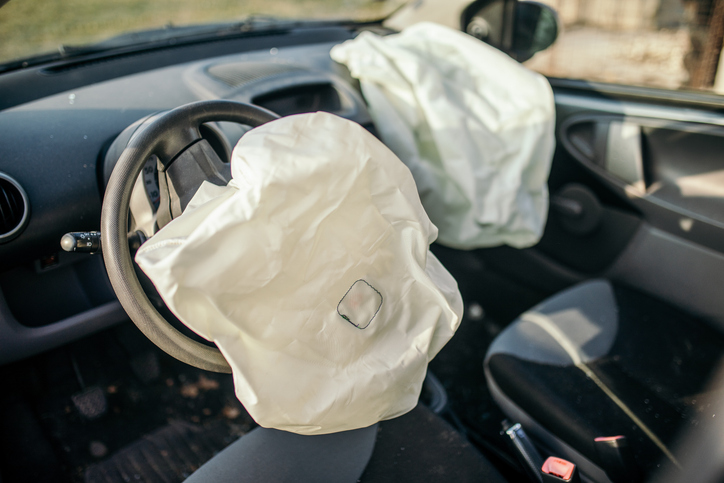
At What Speed Do Airbags Deploy in a Fort Myers Car Accident?
Clients sit down in our office, point at the dent in their bumper or the buckled hood, and ask the same thing: “Why didn’t the airbag go off?” Or the inverse: “The airbag went off — does that mean the case is automatic?” After more than thirty years on these cases in Lee and Collier Counties, I can tell you the answer is almost never as clean as people expect, and the airbag light is a much weaker piece of evidence in a real case than insurance adjusters would like you to believe.
Here is what actually drives an airbag in a modern car, what Florida law says about the claim that follows, and what we look for in our own files when we work these cases out of the Fort Myers satellite and the main office in Bonita Springs.
What the engineering says — and why “speed” is the wrong question
Most drivers think of airbag deployment as a speed switch: hit X mph, the bag fires. The sensors do not work that way. They measure rapid deceleration — how fast your vehicle changes speed in milliseconds — along with pressure changes inside the doors and accelerometer data from sensors placed around the frame. The National Highway Traffic Safety Administration describes frontal airbags as designed to deploy in a moderate-to-severe frontal crash, generally equivalent to hitting a rigid wall at 8 to 14 mph unbelted, with the belted threshold pushed up because the seatbelt is already doing meaningful work.
Side airbags use a different calibration. The Insurance Institute for Highway Safety publishes the geometry behind side curtain deployment, which can fire at lower closing speeds because there is less crush space between an occupant’s head and a pillar than there is between a chest and a steering column. From sensor activation to full inflation takes roughly 1/20th of a second, and deflation begins almost immediately so the bag is partly down by the time the occupant’s chest meets it. If any link in that chain is mistimed by 70 milliseconds, the bag stops protecting and starts injuring.
The plain-English version I give clients: airbags are tuned to crash energy, not speedometer numbers, and a 15 mph rear-end at a Cleveland Avenue stoplight can produce a real cervical injury without ever tripping the system.
What Florida law actually says about a car-accident claim
Before we get into airbag scenarios, the legal frame matters because it shapes every decision you make in the first 30 days after a wreck.
- Two-year statute of limitations. Under Florida Statute §95.11(4)(a), as amended by the March 2023 tort reform, you have two years from the date of the crash to file a negligence lawsuit. The old four-year window applies only to wrecks that happened before the reform took effect. Plain English: do not assume you have time. You don’t.
- Modified comparative negligence. Florida Statute §768.81 now bars recovery entirely if the jury finds you more than 50 percent at fault. Below that, your award is reduced by your percentage of fault. Plain English: if a defense team can pin 51 percent on you for sitting too close to the wheel or driving unbelted, your case is gone.
- PIP — the first $10,000 of medical. Florida Statute §627.736 requires every registered vehicle owner to carry Personal Injury Protection. Your own PIP pays the first $10,000 of medical and lost wages no matter who caused the wreck, but only if you are seen by a qualified medical provider within 14 days of the crash. Miss the 14-day window and you forfeit PIP entirely.
- Uninsured Motorist. Under Florida Statute §627.727, UM coverage on your own policy is the single most useful piece of paper you can own as a Florida driver. In hit-and-run cases — including airbag-deployment cases where the other driver runs — UM is often the only real source of recovery.
- Crash report duty. Florida Statute §316.066 requires a written law-enforcement report for any crash involving injury, death, or apparent property damage of at least $500. Get one. The report number is what the body shop, the doctor, and the insurer will all ask for first.
Five airbag scenarios we see in Fort Myers practice
Here is the practice-level reality. After three decades of these files, almost every Fort Myers airbag question lands in one of five buckets:
- Airbag deployed, injuries are real. Frontal crash on I-75 near Alico Road, sensors fired, driver took the bag full in the chest. Burns to the forearms from the propellant, sometimes a broken nose or wrist, often a cervical strain underneath. These are the cleanest liability cases but the medical workup has to be careful — airbag injuries hide under deployment trauma.
- Airbag did not deploy, low closing speed, occupant still hurt. The classic Cleveland Avenue rear-end at a red light. Closing speed around 15 mph, no deployment, driver presents three days later with a stiff neck that turns into a six-month physical-therapy file. Adjusters will lean hard on the no-deployment fact. The medicine is the answer, not the dashboard.
- Airbag did not deploy, high closing speed, occupant badly hurt. This is where product liability lives. Frontal crash on Daniels Parkway, deformation pattern says 35 mph, no deployment. Preserve the vehicle, pull the event data recorder, get an engineering witness on the file early. The insurer will salvage that car within thirty days if you let them.
- Airbag deployed in a crash that did not warrant it. Pothole hits, curb strikes, low-speed parking-lot taps that throw a curtain bag into a passenger’s face. Rare, but we have seen one or two — and the injury from the deployment itself can be substantial.
- Airbag deployed, hit-and-run driver gone. The wreck that drove the case anecdote below. The bag does its job, the other driver flees, and the entire recovery has to come from the client’s own UM policy.
What makes airbag cases harder to resolve than they look
Three practical complications come up over and over.
The insurer’s first move is to total the car. Once a vehicle is totaled, salvage takes it, and the airbag control module — which stores the crash data we need — goes with it. We send a preservation letter the day we open the file. If the car is already at a salvage yard, we go get the module before it is sold.
The 14-day medical clock. I cannot count the number of clients who walked away from a Summerlin Road wreck saying “I feel okay” and then woke up two weeks later with a frozen neck. By then, PIP is gone. The 14-day rule under §627.736 has no exceptions, and the carrier loves the deadline because it lets them deny coverage on a paperwork ground rather than a medical one.
The comparative-fault attack on the driver. Defense teams in airbag cases love three arguments: the driver was too close to the wheel, the driver was unbelted, and the driver took some action — looking at a phone, eating, reaching back — that contributed to the wreck. Under the 50-percent bar, any of those can swallow the entire claim. We build against those arguments from the very first client interview.
A hit-and-run case out of Fort Myers
One we worked recently came in on a Monday morning after a Friday-night wreck on US-41 in Fort Myers. Our client was stopped at a light, hit hard from behind, pushed into the car in front. The driver who caused the chain reaction took off northbound before anyone could get a tag — a true hit-and-run. The front and side airbags in our client’s vehicle deployed.
The visible damage looked moderate. The emergency room cleared her that night with a soft collar and a prescription for an anti-inflammatory. By the following Thursday she could not turn her head to back out of her driveway. Her primary-care doctor ordered an MRI, which showed a cervical strain that ended up requiring four months of physical therapy and a pain-management protocol on top of the initial ER workup.
Because the at-fault driver was never identified, the only real source of recovery was her own uninsured-motorist policy. The carrier resisted for several months. We pulled the airbag module data, walked them through the closing-speed analysis the deployment record supported, and stayed in front of the medical providers so the treatment narrative held together. The matter resolved with a full policy payout to our client.
Two takeaways from that file. First, an airbag deployment is evidence — sometimes the best evidence — of crash severity, and it survives a low-visible-damage defense. Second, in hit-and-run cases the case is your own UM policy. Florida drivers who carry it have a real claim. Drivers who decline it usually have nothing.
What to do if you’ve been in a Fort Myers wreck with airbag deployment
This is the action list I give clients in our first conversation. It is not a generic checklist — every item ties to something I have seen go wrong on a real file.
- Take pictures of the deployed airbag before anyone touches the car. The bag pattern, the residue on the steering wheel cover, the position of the curtain bag — all of that disappears once the vehicle is towed and the bag is cut out. Twenty minutes of phone photos has saved more cases than any single piece of paper.
- Get seen by a doctor within 14 days. Not within two weeks — within 14 days. The PIP clock is calendar days, not business days, and missing it by 24 hours forfeits $10,000 in medical that you have already paid premiums for.
- Do not give a recorded statement to the at-fault driver’s insurer. They will call within 48 hours. They are not gathering facts; they are gathering admissions about your seating position and your seatbelt use. Refer them to our office.
- Do not let the salvage yard release the vehicle. If your car is totaled, the airbag control module needs to come out before the vehicle is auctioned. Tell the body shop or tow yard in writing to hold it.
- Write down what you remember in the first 48 hours. Direction of travel, light timing, where the other vehicle came from, what you heard before impact. Memory degrades fast and adjusters will exploit the gaps.
- Pull your declarations page and confirm your UM limits. If you do not know what your UM coverage is, find out today, not after the next wreck. In a hit-and-run, UM is the case.
Key Takeaways
- Airbag deployment is a crash-energy decision, not a speed switch — a low-speed rear-end can produce a real injury without firing the bag.
- Front bags generally deploy at the equivalent of a 10 to 12 mph rigid-wall hit unbelted, around 16 mph belted; side curtain bags fire at lower closing speeds because there is less crush space.
- Florida’s two-year statute of limitations under §95.11(4)(a) is the new normal — waiting is the most common mistake we see.
- The 14-day PIP rule under §627.736 has no exceptions; missing it forfeits the first $10,000 of medical.
- In hit-and-run cases, the recovery comes from your own uninsured-motorist policy — if you don’t have UM, you usually don’t have a case.
Frequently Asked Questions
At what speed do front airbags actually deploy in a Florida car accident?
Front airbags are generally calibrated to deploy in a crash equivalent to hitting a rigid barrier at roughly 10 to 12 mph if the driver is unbelted, and at roughly 16 mph or higher if the driver is wearing a seatbelt. The exact threshold varies by make, model, and crash geometry, and the sensors look at deceleration force, not just speedometer numbers.
If my airbag did not deploy, does that mean I do not have a case?
No. Airbags do not deploy in every serious wreck — low-speed rear-end hits, angled side-swipes, and underrides can produce real injuries without triggering deployment. We have recovered policy-limit settlements on Fort Myers wrecks where no airbag went off. The deciding question is medical injury and liability, not the dashboard light.
Can a defective airbag make the manufacturer liable?
Yes, in the right facts. If an airbag fails to deploy in a crash that clearly should have triggered it, or deploys with the wrong force and injures the occupant, that opens a product-liability claim against the manufacturer or supplier on top of the bodily-injury claim against the at-fault driver. Preserve the vehicle and the airbag module before the insurer totals it out and sends it to salvage.
Does Florida’s modified comparative negligence rule affect an airbag case?
It can. Under Florida Statute §768.81 as reformed in 2023, a plaintiff found more than 50 percent at fault recovers nothing. Defense lawyers in airbag cases sometimes argue the injured driver was seated too close to the wheel, was unbelted, or contributed to the crash. We anticipate that argument from the first client interview and build the file accordingly.
How long do I have to file a Fort Myers car accident claim after an airbag injury?
Two years from the date of the crash, under Florida Statute §95.11(4)(a) as amended in March 2023. The old four-year window is gone for any wreck that occurred after the reform. Waiting is the single most common mistake we see — by the time a claimant calls, witnesses have moved, event data recorder information may have been overwritten, and the vehicle has been crushed.
Talk to our office before you talk to their adjuster
If you have been hurt in a Fort Myers car accident and the airbag deployed — or didn’t — call our office at 239-992-8259 for a free consultation. We work these cases out of the Bonita Springs main office and our Fort Myers satellite. There is no fee unless we recover for you, and the first conversation costs nothing. The sooner we open the file, the sooner we can lock down the vehicle, the module data, and the medical timeline before the insurer makes any of it go away.
About the Author

The firm is led by David B. Pittman, Esq., who founded Pittman Law Firm, P.L. and has practiced personal injury law in Fort Myers and across Lee County for more than thirty years, with a sustained focus on serious-injury auto and complex-liability cases. The firm’s Fort Myers presence handles a steady stream of serious-injury work along the Daniels Parkway, Six Mile Cypress, McGregor Boulevard, Cleveland Avenue, and Summerlin Road corridors, and along I-75 between Estero and Bell Tower.
After The Citadel, The Military College of South Carolina, David took his JD from the University of South Carolina School of Law and built a personal injury practice that now carries AV-Preeminent recognition with Martindale-Hubbell and a membership in the Multi-Million Dollar Advocates Forum.
David has held a Florida real estate broker license for twenty-five years, a credential that shapes how the firm reads the property side of premises cases. The firm handles personal injury cases across Lee and Collier Counties, serving Fort Myers, Bonita Springs, Naples, Cape Coral, Estero, and Lehigh Acres, with offices at Windsor Place in Bonita Springs (main) and Fort Myers (satellite). Call 239-992-8259 for a free consultation.
The information on this page is for general informational purposes only and is not legal advice. Reading this article does not create an attorney-client relationship with Pittman Law Firm, P.L. Past results do not guarantee a similar outcome. This is attorney advertising.