

Are Diverging Diamonds Making Fort Myers Roads More Dangerous? The Truth About Auto Accidents
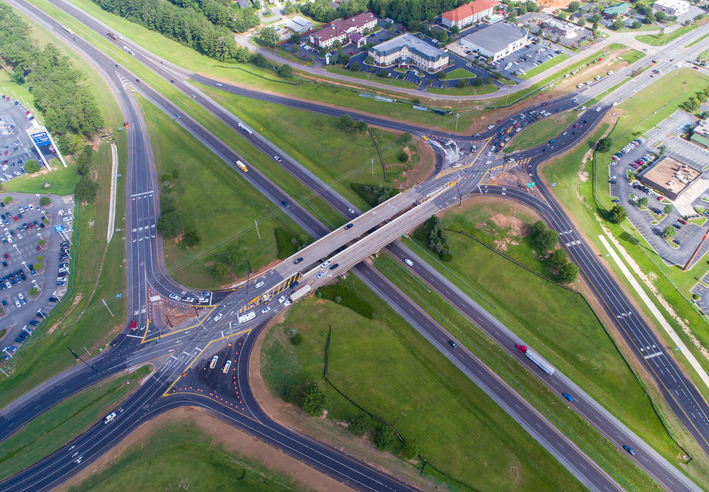
Let me correct the misconception up front: the Colonial Boulevard and I-75 diverging diamond interchange is not making Fort Myers roads more dangerous. The design cuts overall crash rates by roughly a third and severe crashes by more than half — those are federally documented outcomes, not marketing. What it does do is put an unfamiliar road geometry in front of drivers who are used to a conventional cloverleaf, and during season traffic that combination still produces crashes. The crashes that happen at the new interchange tend to be specific to the crossover design. And people who get hurt in those crashes still face the same Florida law, the same insurance fights, and the same two-year clock everyone else does.
I want to walk through what Florida law actually does with these cases, because the road design is not the legal question. The legal question is who was careless, by what percentage, and what that means for the person sitting across from me with a stack of medical bills.
What Florida law actually says about crashes at a diverging diamond
Florida did not write a special statute for diverging diamonds. The same rules that apply to a fender-bender on McGregor Boulevard apply to a crash at the new Colonial interchange. There are four that matter most in our office.
The first is §768.81, Florida Statutes — modified comparative negligence. After the March 2023 tort reform, if a jury decides you were more than 50% at fault for your own crash, you recover nothing. At 50% or below, your recovery is reduced by your percentage of fault. In plain English: if a jury says you were 20% responsible and the other driver was 80% responsible, and your damages are $100,000, you take home $80,000. If they flip those percentages, you take home zero.
The second is §95.11(4)(a) — the statute of limitations. Florida cut the deadline for negligence claims from four years to two years in 2023. If your crash on the Colonial interchange happened after March 24, 2023, you have two years from the date of the wreck to file suit. I still meet people who think they have four years, and that misunderstanding has cost more than one person their case.
The third is §627.736 — Personal Injury Protection, what most people call PIP. Every Florida driver’s policy carries at least $10,000 of no-fault medical and wage coverage that pays regardless of who caused the crash. The catch most people miss is the 14-day rule: if you do not seek medical treatment within fourteen days of the crash, you forfeit the PIP benefit. I have lost count of how many people have walked into our office two weeks and a day after a crash, surprised to learn that the clock ran out.
The fourth is §627.727 — Uninsured and Underinsured Motorist coverage. UM is the single most useful coverage a Florida driver can buy, and it is the coverage we wish more of our Fort Myers clients had stacked when they walk in the door. If the at-fault driver has a $10,000 bodily injury policy and your medical bills are $180,000, your own UM coverage is what fills the gap.
The four crash patterns we see at the Colonial interchange
I have read the studies that say diverging diamonds cut overall crashes by roughly a third and severe crashes by more than half. I believe those numbers. What I also believe, in three decades of representing crash victims in Lee and Collier Counties, is that the crashes that do happen at these interchanges tend to fall into a few repeating patterns.
- Lane-change-during-crossover. A driver realizes mid-bridge that they are in the wrong lane for their exit, jerks across two lanes inside the crossover, and clips the car next to them. The driver almost always tells the trooper that the design confused them. The dashcam footage usually shows they were on the phone.
- Failure-to-yield at the signal. At the crossover points, the traffic signal is the only thing keeping eastbound and westbound traffic from meeting. When someone runs that signal, the result is the kind of head-on or near-head-on collision the design was supposed to eliminate.
- Rear-end at the back of the queue. Traffic on Colonial Boulevard backs up into the interchange during season, and a distracted driver doing 45 toward a stopped line of cars produces the same rear-end crash we have always seen on Daniels Parkway and Six Mile Cypress Parkway.
- Tourist-following-tourist. Two unfamiliar drivers, neither willing to commit to a lane, both braking at the crossover. This one usually produces low-speed crashes with high-speed injuries, because nobody saw it coming.
Why diverging diamond cases are harder than they look
People assume a clean rear-end or a signal-runner is an open-and-shut case. Three things make these cases tougher than they appear.
The first is the comparative-fault argument the defense reaches for almost reflexively. If the design is unfamiliar and the lanes shift, the defense lawyer is going to argue that the injured driver was at least partially responsible for not anticipating the crossover. That is where §768.81 bites. We have to be ready to push that percentage down with signal-timing data, dashcam footage, and the FDOT design standards that say a properly marked diverging diamond is supposed to be intuitive.
The second is insurance limits. The at-fault driver in a Florida crash often carries a $10,000 bodily injury policy and nothing else. A serious diverging diamond crash — multiple cars, multiple injuries — burns through that limit before the first MRI is read. UM coverage on the injured party’s own policy is usually the only path to a meaningful recovery, and a lot of people in Lee County either never bought UM or stacked it incorrectly.
The third is the FDOT angle. Every client asks me whether they can sue the state for designing a “confusing” road. The answer is almost always no, for two reasons. Sovereign immunity under §768.28 caps state liability at $200,000 per person, and design-immunity defenses are strong when the design follows accepted engineering standards. I have looked at this question carefully on more than one diverging diamond case, and I have not yet seen one where FDOT was the realistic defendant. The driver who ignored the signage is.
How we handled a Fort Myers DUI case
One we worked recently involved a Fort Myers family driving home on a weekend evening when they were hit head-on by an impaired driver. The father took the worst of it — multiple fractures and internal bruising that did not fully show up on imaging until two days later. His wife and one of their children were also injured, though less seriously.
She got the father in front of orthopedic surgeons we have worked with for years, coordinated the follow-up imaging that caught the internal bruising, and stayed on the family’s primary care to keep the PIP paperwork moving inside the 14-day window. By the time the carrier called us with their first offer, the family’s treatment plan was documented end-to-end.
The at-fault driver had a standard bodily injury policy. We pursued the carrier hard on the impairment angle — Florida juries do not look kindly on drunk drivers, and the insurer knew it. We recovered the maximum policy limits, the family resolved their injuries, and the father was back at work months earlier than the first orthopedic note had predicted. The case was not complicated. It was patient, and I trust the steady, document-everything approach over the dramatic one almost every time.
What to do if you are in a crash on the Colonial interchange or any Fort Myers road
This is the practical list, drawn from cases I have actually worked, not from a generic checklist.
- Take photos before the cars move. The lane markings and signage at a diverging diamond do not show up in a police report sketch. Your own photos of where each car ended up, and which lane it was in, are worth more six months later than you would think.
- Ask for the crash report number on scene. Under §316.066, the long-form report has to be filed within 10 days. Knowing the report number lets us pull it the moment it is available.
- See a doctor in the first week, not the second. The PIP 14-day clock is real and it is unforgiving. I would rather a client see a doctor and be told they are fine than wait and lose the no-fault benefit.
- Do not give the other carrier a recorded statement. Their adjuster will be polite and will sound concerned. The recording is being used to lock you into a version of the facts before you have seen all of your imaging.
- Pull your own declarations page and check your UM. Most clients I sit down with do not know what their UM coverage is. Find the number before you talk to a lawyer — it changes what kind of case we are actually working with.
Key Takeaways
- Diverging diamonds are statistically safer than the interchanges they replaced, but the crashes that do happen tend to repeat in four patterns we see in our office.
- Florida’s modified comparative negligence rule under §768.81 means a defense lawyer will try to pin part of the fault on the injured driver, especially when the road design is unfamiliar.
- The statute of limitations for a Lee County car crash is two years from the date of the wreck, not four — the 2023 reform cut the window in half.
- PIP under §627.736 pays the first $10,000 of medical and wage loss regardless of fault, but only if you treat within 14 days.
- Suing FDOT over a road design is almost never the realistic path. The at-fault driver’s carrier — and your own UM coverage — is where serious recoveries come from.
Frequently Asked Questions
Q1. If I crash at the Colonial Boulevard and I-75 diverging diamond, does the unusual road design help or hurt my case?
It usually does not change the legal analysis much. Florida still applies the same negligence rules, and §768.81 still allocates fault by percentage among everyone involved. What the design does sometimes do is help your story — a jury can be shown the same signage and lane markings the other driver ignored, which makes “I was confused” a weaker excuse than it would be at a more familiar intersection.
Q2. How long do I have to file an auto accident lawsuit in Lee County under the 2023 reforms?
Two years from the date of the crash for most negligence claims, under §95.11(4)(a). Florida cut the window from four years to two in March 2023, and we still see people who think they have the old four-year clock. If your crash happened on the Colonial interchange after March 24, 2023, the two-year deadline applies.
Q3. Can the Florida Department of Transportation be sued if the diverging diamond design contributed to my crash?
It is possible, but harder than people think. Sovereign immunity caps damages against state agencies at $200,000 per person and $300,000 per incident under §768.28, and design-decision claims face additional defenses. In nearly every diverging diamond crash we have looked at, the at-fault driver and that driver’s insurance carrier are the realistic source of recovery, not FDOT.
Q4. What if the other driver claims they were confused by the crossover and that is why they hit me?
That is a fault argument, not a defense to liability. Under Florida’s modified comparative negligence rule, a jury can split fault between drivers, but “I did not understand the road” is not a free pass. We have handled cases where the at-fault driver said exactly that, and once the dashcam and signal-timing data came in, the percentage assigned to confusion shrank quickly.
Q5. Does my PIP cover me if I am hurt in a crash on the new Colonial interchange?
Yes. Florida’s no-fault statute, §627.736, gives you up to $10,000 in Personal Injury Protection medical and wage benefits regardless of who caused the crash, as long as you seek treatment within 14 days. PIP is the floor, not the ceiling — for serious injuries you can step outside PIP and pursue the at-fault driver’s bodily injury coverage and your own UM policy under §627.727.
Talk to our office before you talk to the other driver’s insurer
If you have been hurt in a crash at the Colonial Boulevard interchange, on I-75 near Alico Road, or anywhere along Daniels Parkway, Six Mile Cypress Parkway, McGregor Boulevard, Cleveland Avenue, Summerlin Road, or Pine Island Road, our firm is ready to look at your case. Call Pittman Law Firm, P.L. at 239-992-8259 for a free consultation. There is no fee unless we recover for you.
About the Author

Pittman Law Firm, P.L. is led by founder David B. Pittman, Esq., who has practiced personal injury law in Fort Myers and across Lee County for more than thirty years, with a sustained focus on serious-injury auto and complex-liability cases. The firm’s Fort Myers presence handles a steady stream of serious-injury work along the Daniels Parkway, Six Mile Cypress, McGregor Boulevard, Cleveland Avenue, and Summerlin Road corridors, and along I-75 between Estero and Bell Tower.
David is a graduate of The Citadel, The Military College of South Carolina, and the University of South Carolina School of Law. He holds an AV-Preeminent rating with Martindale-Hubbell and is a member of the Multi-Million Dollar Advocates Forum.
David has held a Florida real estate broker license for twenty-five years, a credential that shapes how the firm reads the property side of premises cases. The firm handles personal injury cases across Lee and Collier Counties, serving Fort Myers, Bonita Springs, Naples, Cape Coral, Estero, and Lehigh Acres, with offices at Windsor Place in Bonita Springs (main) and Fort Myers (satellite). Call 239-992-8259 for a free consultation.
The information on this website is for general information purposes only. Nothing on this site should be taken as legal advice for any individual case or situation. This information is not intended to create, and receipt or viewing does not constitute, an attorney-client relationship. This is attorney advertising.