

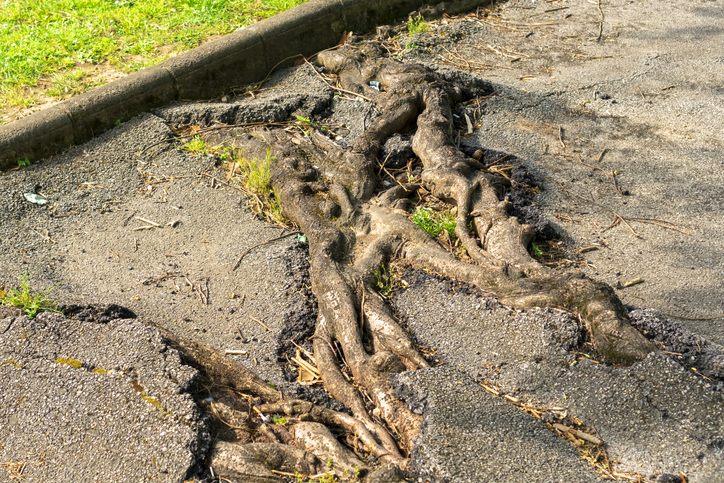
What To Do If You Trip and Fall Over Overgrown Tree Roots In Fort Myers
We see this case more than people realize. A pedestrian heading from a parking lot to a storefront catches a foot on a root that has pushed up the concrete by an inch or two, and a Saturday errand turns into a torn rotator cuff, a fractured wrist, or — in the worst version — a head injury. Live oaks, ficus, and royal poinciana along older Fort Myers corridors throw roots out far past the trunk, and the slabs lift in a way that is obvious once you know to look and almost invisible at a casual glance.
For the last twenty-five years, in addition to practicing law, I have held a Florida real estate broker license, and that broker work has shaped how we read these cases. A property owner is not surprised by tree-root heave on a property they have owned for twenty years. The condition develops on a schedule a reasonably attentive owner can predict. When we see a fall on a slab that has been sitting that way for three or four seasons, we are usually looking at a maintenance failure the owner could have caught with a quarterly walk-through.
If you fell on a sidewalk, walkway, or parking lot in Lee County over an overgrown root, this guide walks through what Florida law actually requires of the landowner, what evidence preserves the case, and what we have seen work in our practice along McGregor Boulevard, Cleveland Avenue, and the older Daniels Parkway commercial corridor.
What Florida law requires of a property owner
Premises liability in Florida sits in a few different statutes, and which one controls depends on what caused the fall.
Section 768.0710, Florida Statutes, is the one that does most of the work in a tree-root case. It governs negligent maintenance of premises by a business and applies to structural conditions on the property — cracked sidewalks, uneven pavement, lifted slabs, missing handrails. To win, we have to show the owner failed to use reasonable care in maintaining the area and that the breach caused the fall. We do not have to prove the owner had specific knowledge of that particular root, which is a meaningful difference from how slick-floor cases are handled.
The slick-floor statute, section 768.0755, applies to transitory foreign substances — a spilled drink, a leaking cooler, a wet entryway. There, the plaintiff has to prove the business had actual or constructive knowledge of the substance. That is a much higher bar. Defense counsel will sometimes try to argue a tree-root case under the slick-floor framework. It is the wrong statute, and the appellate courts have been clear about the distinction.
If your fall happened on the duty-of-care end — visitor status, invitee, licensee, trespasser — section 768.075 sets the framework. Most of our trip-and-fall clients are business invitees: a customer at a restaurant, a guest at a hotel, a shopper walking from a parking lot to a store. The duty owed to an invitee is the highest in Florida — the owner has to keep the premises in a reasonably safe condition and warn of latent hazards.
And if the fall happened on a city sidewalk or in a county park, the analysis shifts to section 768.28, which governs claims against government landowners. There is a separate written notice requirement, a sovereign-immunity cap of $200,000 per person and $300,000 per incident, and a different limitations clock. We have handled government-property claims in Lee County and Collier County, and the procedural traps in that statute are where most pro se claimants lose their case before they ever reach the merits.
Factors a court considers
When we evaluate a tree-root case at intake, we look at the same things a judge or jury will look at later:
- How far the slab had lifted — a quarter inch reads differently than two inches.
- How long the condition had been visible. Photos of Google Street View imagery from prior years often tell the story.
- Lighting at the time of the fall. A root in shadow under a magnolia at 7 p.m. is not the same hazard as the same root at noon.
- Whether the root was masked by leaf litter, mulch, or a painted line that drew the eye away.
- Prior complaints, prior falls, or work orders the owner had received and ignored.
- Whether the walkway was the obvious path a reasonable customer would take, or a back route the property tried to discourage.
None of these are dispositive on their own. They are inputs. The more of them lean the plaintiff’s way, the stronger the case.
The trivial-defect doctrine — why it is not as clean as it sounds
Defense lawyers will quote you a number — usually somewhere between half an inch and an inch — as the supposed threshold below which a sidewalk lift is “trivial” as a matter of law. They will tell you the case is over before it starts.
That is not how Florida courts have actually ruled. The trivial-defect doctrine is a totality test. Judges have let cases proceed on lifts well under an inch where the lighting was poor, where the height differential changed across the slab, where the root was hidden by debris, or where the property had a documented history of complaints. They have also tossed cases involving two-inch lifts in broad daylight on a clearly marked path. The number alone does not decide it.
I tell clients to assume the defense will raise the doctrine and to prepare evidence on every adjacent factor. The lift height is one data point. The conditions around it are five more.
What we see most in Fort Myers
Fort Myers has a particular profile for these cases. The historic neighborhoods off McGregor Boulevard sit under mature live oak and royal palm root systems that have been pushing up sidewalks for forty years. The older commercial parking lots along Cleveland Avenue and the Colonial Boulevard frontage have ficus rows planted in narrow medians with no root barrier, and the lifts there are dramatic. Strip-center walkways off Summerlin Road and Daniels Parkway show the same pattern wherever the original landscape plan put a shade tree five feet from a concrete walk.
The fall patterns are predictable. Pedestrians walking from a parking space toward a storefront, eyes on the door rather than the ground. Diners leaving a restaurant after dark. Hotel guests crossing from a pool deck back to a room. The owner has had years to put a root barrier in, grind the slab, or reroute the walk. In most of the cases we accept, they did none of those things.
A premises case that turned on the maintenance policy
One case I think about often did not involve a tree root, but the same statute and the same kind of owner failure. We represented a guest who slipped on a marble floor in the lobby of a beachfront resort on Gulf Shore Boulevard in Naples. Housekeeping had polished the floor that morning. Nobody had put out a wet-floor sign, nobody had funneled foot traffic around the work, and the marble in question is the kind that looks dry even when there is a residue on it.
The guest came down hard on her left knee. The orthopedist found a torn ACL and a torn meniscus on the MRI, and she needed reconstructive surgery followed by four months in a hinged knee brace. She is in her fifties and had never had a knee problem in her life.
The resort’s first move was the one I expected — argue the floor was open and obvious, argue the guest should have seen it, argue there was nothing they could have done differently. The policy required signs. The logs showed no signs were placed. We settled the case on terms that held the resort accountable and covered the surgical bill, the brace, the lost time, and the ongoing physical therapy.
That case is the template for how a Florida premises claim is supposed to work. The duty is the reasonably safe condition. The breach is the documented failure to follow the owner’s own policy. The causation is the medical record. The damages are real, documented, and conservative.
What a property owner is supposed to be doing
This is where the broker side of my background does the most work. I have spent twenty-five years on the commercial real estate side, in addition to representing injured Floridians, and I can tell you with some precision what a reasonably prudent property owner is supposed to be doing on tree-root maintenance.
A commercial property of any size carries a maintenance schedule. The leases typically push common-area maintenance — sidewalks, landscaping, lighting, striping — onto either the landlord or the tenants through a CAM charge. Either way, somebody is supposed to be walking the property on a regular cadence. Quarterly is common. Some property managers do it monthly. The walk-through identifies things like lifted slabs, broken pavers, burned-out lot lights, missing signage, and overgrown landscape. The items get logged, prioritized, and budgeted.
When a defense lawyer tells me their client could not possibly have known about a particular root, I ask for the maintenance logs. If there are no logs, that is its own problem — a reasonably prudent owner generates a paper trail. If there are logs and the root is on them but unaddressed, the case writes itself. If there are logs and the root never appears, we get to ask why a condition that visible never made it into the property manager’s notes.
That is the broker lens. It is also why we can sit across from defense counsel in a tree-root case and have a substantive conversation about what their client’s standard of care actually looked like, rather than a generic one about what the law says in the abstract.
What to do if you fell
What I tell clients to do, in the order I would do it:
- Get medical attention the same day, even if you feel like you can walk it off. Soft-tissue injuries take twenty-four to seventy-two hours to declare themselves, and a gap in the medical record is the first thing the carrier will use against you.
- Photograph the root from multiple angles, with something for scale — a phone, a credit card, your shoe. Get the lighting as it was. Get wide shots showing the path you were on and the angle of approach.
- Note the time and the conditions. Was it dusk? Had it just rained? Were there leaves on the ground?
- If a manager is on site, report the fall in writing. Ask for a copy of the incident report. If they will not give you one, send a follow-up email the same day so there is a written record of your report.
- Get the names and numbers of any witnesses before you leave. People are friendly in the moment and impossible to find a week later.
- Do not give a recorded statement to the property’s insurance carrier. Not before talking to a lawyer.
- Save the shoes you were wearing. Defense will want to argue your footwear contributed. Letting them see the shoes on your terms beats letting them speculate.
Key Takeaways
- Tree-root falls in Florida are governed by §768.0710, not the slick-floor statute — the proof burden is different and friendlier to the plaintiff.
- The trivial-defect doctrine is a totality test, not a bright-line number. Lift height is one factor among many.
- If you fell on a city sidewalk or county property, §768.28 requires a written notice of claim and caps the recovery — get a lawyer involved within weeks, not months.
- The strongest tree-root cases involve a documented maintenance failure: prior complaints, missing inspection logs, or a condition visible in Street View for years.
- Florida’s negligence statute of limitations is now two years for falls on or after March 24, 2023. The clock is shorter than most people think.
Frequently Asked Questions
Q1. Can I sue if I tripped over tree roots on a public sidewalk in Fort Myers?
Sometimes, but the rules are stricter. Claims against the City of Fort Myers, Lee County, or any other government landowner are governed by §768.28, Florida Statutes, which requires a written notice of claim within three years and caps the recovery at $200,000 per person and $300,000 per incident absent a claims bill. We typically file that notice within the first month of being retained so we do not lose the claim on a technicality.
Q2. What is the trivial defect doctrine and does it bar my case?
Florida courts have historically said a sidewalk lift under roughly one inch can be too minor to support a lawsuit. It is not a bright-line rule. Judges look at the whole picture: lighting, foot traffic, prior complaints, whether the root was hidden by leaf litter, and whether the height differential was consistent across the slab. A half-inch root under poor lighting at dusk has gone to a jury before.
Q3. How long do I have to file a trip-and-fall case in Florida?
Florida changed the negligence statute of limitations in March 2023. For trip-and-fall claims arising on or after March 24, 2023, the limit is two years. Older falls may still have the four-year window. Government claims require a separate written notice on top of that. Talk to a lawyer before the calendar runs.
Q4. What if I had been drinking or was looking at my phone when I fell?
Florida is a modified comparative fault state. If a jury finds you more than 50% at fault, you recover nothing. Below that, your recovery is reduced by your share. Distracted walking matters, but a hidden, overgrown root in a high-traffic area still puts most of the fault on the property owner who let it grow that way.
Q5. Should I give a recorded statement to the property owner’s insurance company?
Not without counsel. The adjuster’s job is to lock you into a version of events before you have seen all of your imaging, before swelling resolves, and before you understand the scope of your injury. We handle that conversation for our clients. There is nothing you have to say to the carrier on your own.
Talk to our firm before you talk to the insurance company
If you tripped over an overgrown tree root on a Fort Myers sidewalk, parking lot, or commercial walkway, our office handles these cases regularly and would be glad to take a look at yours. Call 239-992-8259 for a free consultation. There is no fee unless we recover for you.
About the Author

The case load at Pittman Law Firm, P.L. has been built over more than thirty years of personal injury practice in Fort Myers and across Lee County under founder David B. Pittman, Esq., with a sustained focus on personal injury and premises-liability cases. The firm’s Fort Myers presence handles a steady stream of serious-injury work along the Daniels Parkway, Six Mile Cypress, McGregor Boulevard, Cleveland Avenue, and Summerlin Road corridors, and along I-75 between Estero and Bell Tower.
David studied undergraduate at The Citadel, The Military College of South Carolina, then law at the University of South Carolina School of Law. Martindale-Hubbell rates him AV-Preeminent; the Multi-Million Dollar Advocates Forum lists him as a member.
David has held a Florida real estate broker license for twenty-five years, a credential that shapes how the firm reads the property side of premises cases. The firm handles personal injury cases across Lee and Collier Counties, serving Fort Myers, Bonita Springs, Naples, Cape Coral, Estero, and Lehigh Acres, with offices at Windsor Place in Bonita Springs (main) and Fort Myers (satellite). Call 239-992-8259 for a free consultation.
This article is attorney advertising and is provided for general information only. It is not legal advice and does not create an attorney-client relationship. Outcomes in any individual case depend on the specific facts and applicable law. Prior results do not guarantee a similar outcome.