

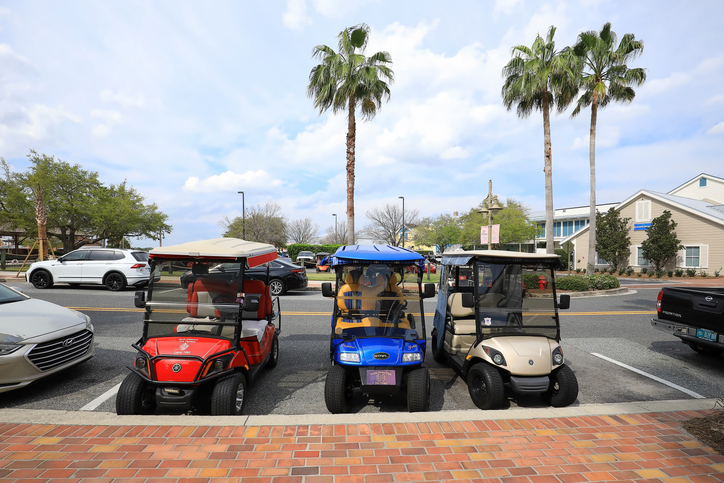
Your Next Steps After a Golf Cart Accident in Naples
Naples sits in the middle of one of the densest golf-cart populations in Florida. Carts move between gated communities, across surface streets, along Vanderbilt Beach Road and Gulf Shore Boulevard, and through the resort blocks around 5th Avenue South. They look harmless. They are not. A four-passenger cart with no doors, no airbags, and a top speed in the low twenties can throw a passenger fifteen feet onto pavement — and the injuries we see from those calls are real: broken wrists, fractured pelvises, head injuries, and on the worst days, fatalities.
Two questions come in every time: am I in trouble, and is anyone going to pay for the hospital bill. The answer almost always depends on facts the caller hasn’t yet realized are important — starting with whether that cart is a golf cart or a Low-Speed Vehicle, and whose name is on the insurance policy.
What Florida Law Actually Says About Golf Cart Crashes
Florida has a layered set of rules for golf carts, and most people we talk with have only a vague sense of any of them. Three statutes do most of the heavy lifting.
Section 316.212, Florida Statutes — where a golf cart is allowed to be. The plain-English version: a golf cart can only be on public roads where the local government has affirmatively allowed it, and even then only on roads posted at 30 mph or less. Drivers must be at least 14, and the cart must have working brakes, a reverse warning, tires in good condition, a rearview mirror, and a windshield. If the cart was on a road it shouldn’t have been on, that fact alters the liability picture from day one.
Section 320.01(22)–(23), Florida Statutes — the difference between a golf cart and a Low-Speed Vehicle. A Low-Speed Vehicle, or LSV, looks like a golf cart but has been built or upgraded to hit between 20 and 25 mph and carries a VIN, headlights, brake lights, turn signals, a parking brake, mirrors, reflectors, seat belts, and a windshield. An LSV must be titled, registered, and insured with PIP and property damage liability, the same as a car. A plain golf cart is not. That single distinction changes which insurance policy — if any — covers the crash.
The dangerous-instrumentality doctrine. Florida courts have long held that certain vehicles are dangerous enough that the owner is responsible for what the driver does with them. That doctrine was extended to golf carts in Meister v. Fisher, 462 So. 2d 1071 (Fla. 1984). The plain-English version: if you own the cart and you let someone drive it, you are on the hook for what that person does behind the wheel, even if you were sitting on your porch when it happened. That is why letting your teenage nephew take the cart out for a spin is not the small favor it feels like.
Layered on top of the cart-specific statutes is Florida’s modified comparative fault rule, codified at Section 768.81 and reshaped by the 2023 tort reform package. If a jury finds you more than 50 percent responsible for the crash, you recover nothing. If you are 50 percent or less responsible, your recovery is reduced by your share of fault. A $100,000 verdict with 30 percent fault assigned to you becomes $70,000. The 2023 changes also shortened the personal injury statute of limitations from four years to two for incidents occurring on or after March 24, 2023. Two years sounds like a long time when you’re freshly out of the ER. It is not.
Six crash patterns we see in Naples golf cart cases
Across the calls that come into our office about golf carts, the fact patterns sort into a handful of recurring shapes. Knowing which one you’re in helps you understand what the next move looks like.
- Cart vs. car on a posted-low-speed road. A driver of a passenger vehicle either didn’t see the cart or misjudged its speed and either rear-ended it or sideswiped it. The auto driver’s insurance is usually the primary source of recovery. PIP applies if the injured cart passenger was a Florida resident.
- Cart rollover with no other vehicle involved. A turn taken too fast, a curb caught wrong, or a passenger leaning out. There is no other driver to blame. Recovery, if any, comes from the cart owner’s homeowner’s umbrella policy, an LSV policy if the cart qualified, or, in tragic cases, from the manufacturer if a design defect contributed.
- Owner liability after handing the keys to a teenager or a guest. The owner stayed home. The driver crashed. The owner gets sued under the dangerous-instrumentality doctrine.
- Resort and rental-fleet crashes. A Naples hotel or resort hands a guest a cart with a quick signature. The rental contract usually pushes liability onto the guest, but those contracts often have weaknesses, and the resort’s own duty to inspect and maintain the cart is a separate question.
- Cart-on-pedestrian inside a community. A cart hits a walker on a community path. The cart driver’s homeowner’s policy sometimes responds; community rules and HOA insurance sometimes come into play.
- Cart hit by an Uber or Lyft on a surface street. Now we are in rideshare territory. Coverage depends on whether the rideshare driver was on a trip, between trips with the app on, or off the clock entirely. Each of those states triggers a different layer of the rideshare company’s commercial policy.
Why golf cart injury cases are harder to settle than they look
The legacy advice on these cases reads like it was written by someone who has never sat across from a Naples insurance adjuster. The reality is more layered.
First, the insurance picture is usually a puzzle. A passenger thrown from a cart on Pine Ridge Road may have access to her own auto PIP, the cart owner’s homeowner’s policy, an umbrella over that policy, and an LSV policy if the cart was titled. We have had cases where the recovery came from a layer the family didn’t know existed because nobody had asked for the umbrella declarations page. Until somebody walks through every policy in the household, the insurance question is open.
Second, the medical picture often takes weeks to settle. A cart passenger thrown onto pavement may walk away from the scene and then develop a herniated disc symptom set ten days later. Adjusters love a quick statement and a quick settlement; both work against the injured person if the injury has not finished revealing itself. I have seen families sign a release in the first week and then learn at the six-week mark that the rotator cuff needs surgery. Once the release is signed, there is no going back.
Third, the dangerous-instrumentality doctrine cuts both ways. It can open up the cart owner’s policy when the owner wasn’t driving. It can also pull a sympathetic homeowner into a lawsuit they never expected to face. We have represented both sides of that situation over the years, and the right approach depends on which side of the doctrine you happen to be on the day of the crash.
Fourth, the location of the crash matters a lot more than people assume. A cart in a road where carts aren’t allowed is a problem. A cart with no working tail light at dusk is a problem. A driver under the minimum age is a problem. None of these defeat the case automatically, but each gets factored into the comparative-fault analysis the jury would eventually run.
What a Naples golf-cart case can look like
A call came in from a family member of someone who had been a passenger on a golf cart in a Collier County community. The cart was being driven across a side street that connected the community to a larger surface road, the kind of crossing residents take dozens of times a week without thinking about it. A passenger vehicle came through faster than it should have, the cart driver didn’t see it in time, and our client — the passenger — ended up on the pavement.
The injuries weren’t catastrophic but they weren’t minor either: fractures that required surgery, weeks of immobilization, and a long stretch of physical therapy that interrupted her work and her ability to take care of her grandchildren. The carrier for the car driver opened with an offer that, when you ran the medical bills against the lost income, didn’t cover the hospital bill, let alone the rest. That is a posture we see all the time on these cases.
Our office worked the file the way we work all of them. We documented the medical picture from the trauma report through the discharge summaries and the PT notes. We pulled the homeowner’s and umbrella policies belonging to the cart owner and identified a layer of coverage the family hadn’t realized was available. We pushed the case forward, in deposition where it had to be, until the recovery actually fit the injuries our client had suffered. We have handled this kind of case many times across Lee and Collier Counties, and the pattern repeats: the first offer is rarely the right one, and the work is in proving the picture the carrier doesn’t want to see.
What To Do If You Have Been in a Golf Cart Crash in Naples
This is the part where most blogs hand you a generic checklist. I’d rather give you the things I have actually watched matter in real files.
- Get checked the same day, even if you feel okay. Adrenaline masks a lot. The records from a same-day ER visit or urgent care visit are worth more, evidentially, than the same exam two days later. Insurance carriers use any gap in treatment against you. Closing the gap on day one prevents that argument.
- Photograph the cart and the scene before anything is moved. Tires, mirrors, windshield condition, brake-light condition, the surface of the road, and any skid marks. If the cart was missing a required piece of equipment under Section 316.212, that fact often disappears within hours as the cart is towed or rolled back into a garage.
- Write down the cart’s serial number or VIN if it has one. If it has a VIN, it was almost certainly registered as a Low-Speed Vehicle, and there is an insurance policy somewhere. If it has no VIN, that itself tells you which side of the LSV line the cart sits on.
- Get the names and contact information of every passenger and every witness, including bystanders who weren’t in either vehicle. By the time the police report is finalized, witnesses have scattered. The neighbor who saw the whole thing from his lanai may be the most important person in your file, and you will not find him three weeks later without his name.
- Call the police even if the cart driver wants to keep it quiet. A handshake at the scene becomes a denial three days later when the other person’s spouse hears what happened. The crash report is your record.
- Save everything you wore. Torn clothing, broken eyewear, anything that hit pavement. Don’t wash it; bag it and keep it. The medical bill alone doesn’t always tell the story of how hard the impact was. The clothing does.
- Do not give a recorded statement to the other driver’s insurance carrier. You are not obligated to. Politely tell them you’d like to speak with an attorney first. That call costs you nothing and forecloses several of the carrier’s favorite moves.
- Pull every policy in the household. Auto, homeowner’s, umbrella, any LSV policy the cart might have, any health insurance with subrogation language. Don’t guess at coverage. Read the declarations pages.
- Call us, or call any attorney who handles these cases regularly in Collier County, before the two-year clock has gotten away from you. The early conversation is almost always more useful than the late one, and a free consultation costs nothing but the call.
Key Takeaways
- Florida treats a golf cart as a dangerous instrumentality, so the cart owner can be sued for what someone else does behind the wheel.
- A plain golf cart is not the same vehicle, legally, as a Low-Speed Vehicle. The LSV is titled, registered, and insured; the cart usually isn’t.
- The personal injury statute of limitations in Florida is two years for crashes on or after March 24, 2023. Wrongful death claims are also two years.
- Modified comparative fault under Section 768.81 bars recovery if you are more than 50 percent at fault. Below that line, your recovery is reduced by your fault percentage.
- The insurance picture is usually a puzzle of homeowner’s, auto, umbrella, and LSV policies. Don’t assume there is no coverage until somebody has actually read the declarations pages.
Frequently Asked Questions
Q1. Does my car insurance cover a golf cart crash in Naples?
Usually no. A standard Florida auto policy is written for registered motor vehicles and almost always excludes golf carts. Homeowner’s coverage sometimes picks up an on-property incident but typically drops off the moment the cart leaves your driveway or community path. If your cart has been upgraded to a Low-Speed Vehicle with a VIN, you can buy a dedicated LSV policy. Pull your declarations page out and read the exclusions before you assume you are covered.
Q2. Can I be sued if someone else was driving my golf cart?
Yes. Florida treats a golf cart as a dangerous instrumentality, which means the owner can be held responsible for harm caused by anyone driving the cart with the owner’s permission. That includes your teenager, your house guest, and the friend you let drive after dinner. The cart’s title is on you, and so is a chunk of the liability.
Q3. How long do I have to file a golf cart injury claim in Florida?
For most personal injury claims arising from a 2023-or-later incident, Florida gives you two years from the date of the crash under Section 95.11(4)(a) of the Florida Statutes. Wrongful death claims are also two years. Older incidents may fall under the prior four-year window. Either way, the clock starts the day of the crash, and waiting almost always hurts the case.
Q4. What if the driver who hit me was on a golf cart and I was in a car?
You can still pursue the cart driver and, in most cases, the cart’s owner. Your own PIP coverage applies if you were in a car. If the cart driver carried any liability coverage through an LSV policy or umbrella, that becomes a source of recovery. Uninsured motorist coverage on your auto policy can sometimes apply as well, depending on how the cart was classified.
Q5. Should I give a statement to the other side’s insurance company?
Not before you have talked to a lawyer. The recorded statement is rarely about gathering facts; it is about locking you into language the carrier can use to reduce the claim. You can decline politely. You are not legally required to give a recorded statement to a carrier that is not your own.
Talk to Our Office
If you or someone in your family has been hurt in a golf cart crash anywhere in Naples or across Collier County, call our office at 239-992-8259 for a free consultation. There is no fee unless we recover for you. We will pull the policies, read the exclusions, and tell you straight what the case actually looks like.
About the Author

David B. Pittman, Esq. founded Pittman Law Firm, P.L. and has spent more than thirty years handling personal injury cases in Naples and across Collier County, representing injured clients across Lee and Collier Counties, with a particular focus on commercial-vehicle, complex-liability, and serious-injury work. Naples cases run heaviest along US-41, Immokalee Road, Pine Ridge Road, and Vanderbilt Beach Road, and through the older commercial and resort properties along Gulf Shore Boulevard and 5th Avenue South.
David’s education includes The Citadel, The Military College of South Carolina, followed by the University of South Carolina School of Law. He holds an AV-Preeminent rating from Martindale-Hubbell and is a member of the Multi-Million Dollar Advocates Forum, the credentials that signal a long record of substantial recoveries for injured clients.
David has held a Florida real estate broker license for twenty-five years, a credential that shapes how the firm reads the property side of premises cases. The firm handles personal injury cases across Lee and Collier Counties, serving Fort Myers, Bonita Springs, Naples, Cape Coral, Estero, and Lehigh Acres, with offices at Windsor Place in Bonita Springs (main) and Fort Myers (satellite). Call 239-992-8259 for a free consultation.
The information on this website is for general information purposes only. Nothing on this site should be taken as legal advice for any individual case or situation. This information is not intended to create, and receipt or viewing does not constitute, an attorney-client relationship with Pittman Law Firm, P.L. This is attorney advertising.