

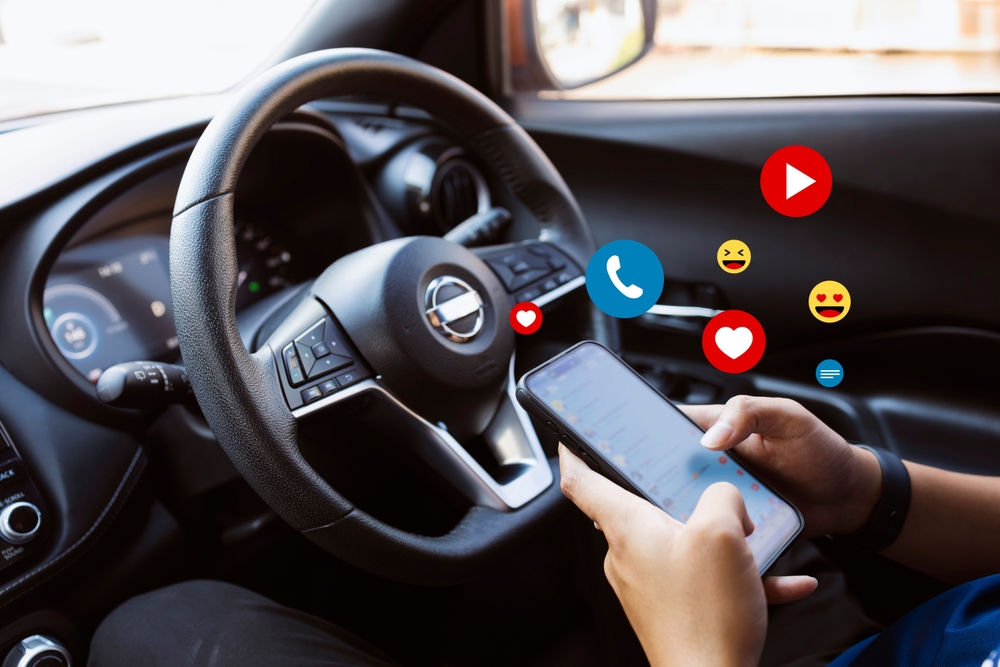
The Truth About Distracted Driving in Bonita Springs
People who have just been rear-ended on Bonita Beach Road want to know one thing before anything else: can you prove he was on his phone? They already feel it in their gut. They saw the driver’s head down. They watched him drift. They want to know whether what they saw on the road will translate into anything the insurance company has to take seriously.
The short answer is usually yes, with work. Proving phone use takes carrier subpoenas, device data, and any nearby business or dashcam video — and all three have short data-retention windows. Florida also has a new legal landscape since the 2023 tort reform: under §768.81 as amended, a 51% fault finding against you produces zero recovery. Defense lawyers now have a strong incentive to push that number, and they run that play on distracted-driving cases harder than on almost any other type of claim.
What Florida law actually says about distracted driving
Florida bans texting while driving and treats handheld phone use in school zones and construction zones as a primary offense. The bigger picture for an injured driver, though, is not the traffic citation. It is the civil negligence claim that follows. A handful of statutes do almost all of the heavy lifting in that civil claim, and every one of them deserves a plain-English unpacking.
Section 768.81 — modified comparative negligence. Florida changed this rule in March 2023, and most drivers have not caught up to what it means. A jury still assigns a percentage of fault to each party, but now, if you are found 51% or more at fault for your own injuries, you recover nothing. Zero. Before the reform, a 70%-at-fault plaintiff could still recover 30% of the verdict. That door is closed. On distracted-driving cases, defense lawyers spend real money trying to push the injured driver across that 50% line — arguing speed, arguing inattention on your side, arguing you should have seen it coming. That fight is now an everything-or-nothing fight.
Section 95.11(4)(a) — two-year statute of limitations. The same 2023 reform cut the negligence statute of limitations from four years to two. If your crash happened on or after March 24, 2023, you have two years from the date of the crash to file suit. Miss that window and the case is gone, no matter how badly hurt you are and no matter how clear the other driver’s fault.
Section 627.736 — PIP. Florida is a no-fault state for the first dollar of medical care. Your own auto policy’s Personal Injury Protection pays up to $10,000 in medical bills and lost wages regardless of who caused the crash, as long as you see a doctor within 14 days. People miss that 14-day window all the time because they think they will walk it off. Don’t. Even if you feel fine the day of, get evaluated. Neck and back symptoms from a 35-mph rear-end often show up on day three.
Section 627.727 — uninsured/underinsured motorist coverage. Florida does not require bodily injury liability coverage on a personal auto policy. Read that sentence again. Plenty of the drivers you share the road with on US-41 carry the state minimum, which does not include BI at all. UM coverage on your own policy is the answer to that problem, and it is the single piece of insurance advice I give the most often. If you do not have it, call your agent today.
Section 316.066 — crash reports. A long-form crash report is required if anyone is injured or any vehicle has to be towed. The responding officer’s narrative on that report is the cheapest piece of evidence we have access to, and it routinely contains an observation about a phone in the driver’s lap, an admission at the scene, or witness statements that the at-fault driver was looking down. We pull the long-form, not the short form, on every file.
Five distracted-driving patterns on the Bonita Springs road grid
The legal academy classifies driving distractions into visual, manual, and cognitive. That framework is fine for a textbook. It is not how cases come in the door. In our office, the recurring fact patterns look like this:
- Texting at a red light, foot eases off the brake. Driver is stopped at the light at Bonita Beach Road and Imperial Parkway, head down on a message. The light is still red, the car creeps, and they rear-end the car in front of them. Low speed, but the head-down posture means no braking and no bracing, and we routinely see cervical sprain and disc injuries out of these.
- Following too close on US-41, eyes on a screen. Tamiami Trail through Bonita is a 45-50 mph corridor with frequent signal stops. A driver glancing at a map app or a text misses the brake lights ahead and never lifts off the gas. These are the high-impact rear-enders — the ones that send our clients to the orthopedist and sometimes to the operating room.
- The drift-and-correct on Old 41. Old 41 is a two-lane stretch in spots, and a distracted driver who drifts across the line tends to overcorrect when they look back up. Sideswipes turn into head-ons, and what should have been a fender-bender becomes a serious injury case.
- Commercial drivers on dispatch screens. Delivery drivers, rideshare drivers, and contractors driving company trucks all have screens in the cab they are required to read while moving. When one of them hits you, there is often a second insurance policy in play and a real argument about whether the employer set the driver up to fail. We work those cases differently from a personal-auto file.
- Older drivers with hearing-aid Bluetooth and infotainment menus. Bonita has a meaningful retiree population, and the newest generation of in-dash screens is, to put it bluntly, not friendly to a 78-year-old hand. We see crashes that the driver swears were not “texting,” and they are not, but the eyes were off the road for the same six seconds it would have taken to send a text.
Why proving distracted driving is harder than it looks from the outside
Liability looks clear from the outside. The other driver was on the phone, you were sitting at the light, you were hit. Open and shut. The defense lawyer’s job is to make it less clear, and they have a playbook.
The first move is to question whether the phone was actually in use at the moment of impact. A subpoena to the carrier will show calls and text-message records, but app activity, scrolling, and passive video watching often live with the device manufacturer and the apps themselves, not the carrier. We pursue all three sources and we move fast, because carriers and apps purge data on their own retention schedules. By the time a case is a year old, the cleanest version of that evidence may already be gone.
The second move is the comparative-negligence push. Defense will argue you were speeding, that you should have seen the drift earlier, that you were on your own phone, that you had inattention of your own. Under the post-2023 50%-bar rule in §768.81, that fight is no longer about shaving a percentage off your recovery — it is about pushing the case across the line where you recover nothing at all. We treat that argument with the seriousness it now deserves, which means we collect your phone records, your dashcam if you have one, and any video pointing at the roadway from nearby businesses, before the defense ever asks for it.
The third complication is the policy-limits problem. The at-fault driver might be carrying a $25,000 bodily injury policy, or none at all, and a serious injury can blow through that in a single hospital stay. The case becomes about finding additional sources of recovery — your own UM coverage, an employer policy if the driver was working, an umbrella policy if one exists. These are the conversations I have with families almost weekly. The crash is the obvious problem. The coverage stack is the actual case.
A child-pedestrian case near our Windsor Place office
One of my earlier cases involved a six-year-old boy who chased a ball into a residential street in our service area. He was hit so hard he came out of his shoes and landed on his head on the pavement. He spent months in the hospital. He came out of it with moderate, permanent brain damage. His mother was a single parent, working long hours, trying to be in two places at once.
I would drive over to the hospital to sit with them. She would bring food on the days the mom could not think about cooking. That was not legal work. It was being a neighbor in a situation no one is ready for. The legal work came alongside it. The driver’s policy limit was modest, and we settled the case at that limit because there was no realistic path to more from that driver. The case was about a child, though, so the settlement could not just be handed to the family.
In Florida, a settlement on behalf of a minor over a certain amount has to be approved by a circuit judge in what we call a minor-court settlement, with the money held in a court-supervised account until the child turns 18. That is the rule, and in a case like this it is a good rule. The money sat. It earned. By the time the now-young-man turned 18, there was enough in that account to pay for college and give him a real start. He took it. He went.
I think about that case when families call our Windsor Place office on the worst day of their lives. The legal mechanics are not the whole story. The protection of a child’s future is.
What to do if a distracted driver hits you in Bonita Springs
This is the part of the post most distracted-driving articles get wrong. They give a generic action list. Generic action lists do not protect you. After three decades of this work, here is what I tell people, in the order I tell them:
- Call 911 from the scene and ask specifically for the long-form crash report. The short-form citation is not enough. The long-form report under §316.066 is where the officer’s narrative lives, and that narrative is the cheapest, most useful piece of evidence we will ever get our hands on. If the officer mentions a phone, an admission, or a witness saying the at-fault driver was looking down, it gets written down right there.
- Photograph the inside of both cars, not just the outside damage. A phone on the passenger seat, a coffee cup in the cupholder, a screen still lit up on the dash — those interior photos disappear the moment the car gets towed. I have settled cases on the strength of a single phone-on-the-seat photo a client took before the wrecker arrived.
- Get yourself to a doctor within 14 days, even if you feel fine. The PIP statute under §627.736 cuts you off at 14 days. If you do not see a provider in that window, your own insurance does not have to pay the first $10,000 of medical care. We have watched people lose that coverage by trying to walk it off.
- Save your phone, your dashcam card, and any vehicle infotainment data before you trade the car in. Modern cars log a surprising amount — speed, brake input, hard-deceleration events. That data is gone the moment the vehicle is sold or scrapped. If the car is totaled, ask the salvage yard to preserve the event data recorder.
- Do not give a recorded statement to the other driver’s carrier. They will call within 48 hours. They are pleasant. They want a quick recorded statement “to close the file.” Decline politely and tell them you will be represented. Anything you say in that recording will be parsed later by a defense lawyer looking for a comparative-fault hook to push you over the 50% line.
- Call a lawyer before you call the body shop. The car will get fixed. The case has a two-year shot clock under §95.11(4)(a), and the evidence that wins it — phone records, video, EDR data — has a much shorter shelf life than that.
Key Takeaways
- Florida’s modified-comparative rule changed in 2023 — 51% at fault and you recover nothing. The defense will spend real money trying to push you over that line on distracted-driving facts.
- The statute of limitations on a Florida negligence claim is now two years from the crash date under §95.11(4)(a), not four. The clock starts the day of the wreck.
- PIP under §627.736 pays the first $10,000 of medical bills regardless of fault, but only if you see a doctor within 14 days. Don’t walk it off.
- Proving phone use takes carrier subpoenas, device data, and any nearby video. All three have short retention windows. Speed matters.
- If the distracted driver was working, there is often a second insurance policy and a viable negligent-hiring or negligent-retention claim against the employer. Always ask the question.
Frequently Asked Questions
Q1. Is the other driver automatically at fault if they were on their phone when they hit me in Bonita Springs?
Phone use is strong evidence of negligence, but Florida still applies modified comparative negligence under §768.81. The jury can assign a percentage of fault to both drivers based on what each one did or failed to do. If you are found 51% or more at fault, you recover nothing. We have seen carriers try to pin partial fault on a hurt driver even where the other driver was clearly texting, so the phone records are the starting point, not the finish line.
Q2. How long do I have to file a distracted-driving injury claim in Florida?
Two years from the date of the crash, under §95.11(4)(a). The Florida Legislature cut the negligence statute of limitations from four years to two in March 2023. There are narrow exceptions for minors and for wrongful death, but the default rule on a Bonita Springs car accident is two years, and once it runs the case is gone.
Q3. Does PIP cover me if a distracted driver hits me?
Yes. Under §627.736, your own auto policy’s Personal Injury Protection pays the first $10,000 of medical bills and lost wages regardless of who caused the crash, as long as you get to a doctor within 14 days. PIP is the floor, not the ceiling. To recover for pain, suffering, and the rest of your medical care from a serious crash, you have to step outside PIP and pursue the at-fault driver and any available coverage.
Q4. How do you actually prove the other driver was on a phone?
Two main ways. First, a subpoena to the carrier for that driver’s cell records covering the minutes around the crash. Second, the driver’s own device data — the phone itself, app timestamps, vehicle infotainment logs, and any dashcam or business surveillance video pointing at the roadway. The crash report under §316.066 captures the responding officer’s observations, which often note an admission or a phone in the lap. We move quickly on those subpoenas because carriers purge call detail records on their own retention schedule.
Q5. What if the distracted driver was working — driving for a delivery service or a company vehicle?
Then there is usually a second avenue of recovery against the employer or the platform, and the insurance limits are typically higher than a personal auto policy. Florida recognizes vicarious liability where an employee causes a crash within the course and scope of work, and it recognizes direct negligent-hiring and negligent-retention claims where the company knew or should have known the driver had a history. We investigate that angle on every commercial-vehicle distracted-driving file.
If a distracted driver hit you in Bonita Springs, call our office
Our main office is at Windsor Place, 3525 Bonita Beach Rd, Suite 107, a few minutes from Old 41, US-41, and the residential corridors off Imperial Parkway. We also keep a satellite office in Fort Myers. If a distracted driver has hurt you or someone in your family, call 239-992-8259 for a free consultation. There is no fee unless we recover for you.
About the Author

Three decades of personal injury practice from the firm’s Windsor Place office on Bonita Beach Road put David B. Pittman, Esq., the founder of Pittman Law Firm, P.L., in a position to write candidly about the cases that come into the office, with a sustained focus on serious-injury auto and complex-liability work. Bonita Springs is home for the firm, and most of its child-pedestrian, premises, and family-injury cases come from the residential corridors off Old 41 and Imperial Parkway, the school zones around the Bonita Beach Road corridor, and the surrounding Lee County neighborhoods around Pelican Landing, Bonita Bay, and Spanish Wells.
David graduated from The Citadel, The Military College of South Carolina, took his JD from the University of South Carolina School of Law, holds an AV-Preeminent rating from Martindale-Hubbell, and is a member of the Multi-Million Dollar Advocates Forum.
David has held a Florida real estate broker license for twenty-five years, a credential that shapes how the firm reads the property side of premises cases. The firm handles personal injury cases across Lee and Collier Counties, serving Fort Myers, Bonita Springs, Naples, Cape Coral, Estero, and Lehigh Acres, with offices at Windsor Place in Bonita Springs (main) and Fort Myers (satellite). Call 239-992-8259 for a free consultation.
The information on this website is for general information purposes only. Nothing on this site should be taken as legal advice for any individual case or situation. This information is not intended to create, and receipt or viewing does not constitute, an attorney-client relationship.