

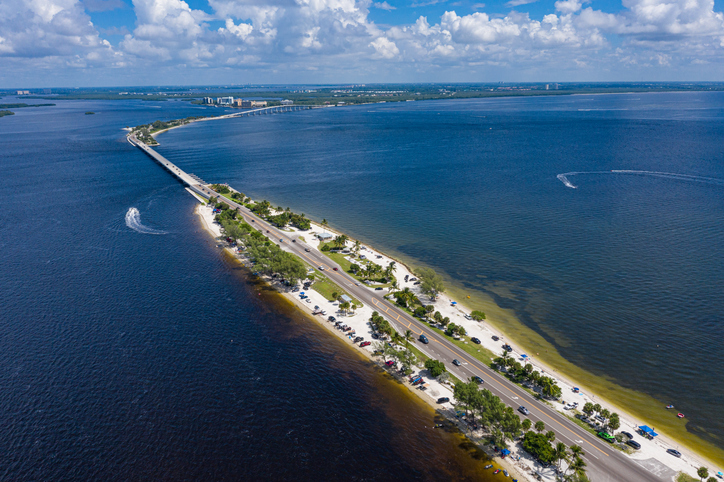
Sanibel Causeway Traffic Is Causing Headaches and Crashes for Visitors and Residents
The Sanibel Causeway is a two-lane bridge with no shoulder to speak of, traffic that backs up past the toll plaza on weekend mornings, and construction equipment parked in positions that drivers have not seen before. When something goes wrong out there, witnesses scatter fast — a tourist from Ohio who saw the whole thing is on a flight home by Sunday night. That is the first thing a lawyer thinks about when a Sanibel Causeway case comes through our office on Bonita Beach Road.
The second thing is insurance. A Florida resident hit by a rental car driven by an out-of-state visitor has at least three layers of coverage to sort through — their own PIP, the at-fault driver’s liability, and the rental-car company’s minimum coverage that often bottoms out at the state floor. Florida law governs all of it, regardless of where the at-fault driver lives. Here is what the statutes actually say, and what to do in the first hour if a wreck finds you between the toll plaza and Periwinkle Way.
What Florida law actually says about a causeway crash
Two statutes do most of the heavy lifting in any wreck on the Sanibel Causeway, and a third one usually shows up by the time the medical bills start arriving.
The first is §768.81, Florida Statutes — modified comparative negligence. In 2023 the legislature changed the rule. Before, even a driver who was 80 percent at fault could still collect a sliver of damages. Now, if a jury finds you more than 50 percent at fault for your own wreck, you recover nothing. Fifty percent and below, you recover, but the amount is reduced by your share of fault. In plain English: if a jury says you are 30 percent at fault and your damages are $100,000, you take home $70,000.
The second is §95.11(4)(a), Florida Statutes — the statute of limitations. Same 2023 reform. Negligence claims that accrued on or after March 24, 2023 must be filed within two years. Before, you had four. I have seen more than one good case die in our office because someone waited, assuming the old rule still applied. In plain English: the calendar is half what it used to be. Treat it that way.
The third is §627.736, Florida Statutes — Personal Injury Protection. Florida is a no-fault state for the first layer of medical bills. Your own auto policy pays the first $10,000 of medical and lost wages regardless of who caused the wreck, but only if you see a doctor within fourteen days of the crash. In plain English: if you walk away from a causeway fender-bender feeling fine and a stiff neck shows up ten days later, you have four days left to get into an emergency room or a primary care office before your PIP benefits are at risk.
One more worth knowing — §316.066, Florida Statutes — the crash report rule. Any wreck involving injury, death, a hit-and-run, a DUI, a commercial vehicle, or property damage that looks like it will exceed the statutory threshold has to be investigated by law enforcement and documented in a written report. On the causeway, that means Sanibel Police, with Florida Highway Patrol or Lee County Sheriff backing up the mainland side.
Five crash patterns we see from the causeway toll plaza to Periwinkle Way
The legacy version of this article walked through construction timelines and live traffic cameras. Those are useful. What it left out was the part our firm sees — the actual injury patterns. Here are the five that show up most often in our intake calls:
- Low-speed rear-end chains in stop-and-go traffic. The causeway crawls to twenty miles per hour, then five, then zero. Three cars stack up. The drivers feel fine that night, and three weeks later one of them is in a pain-management clinic with a cervical disc injury. These cases are real and they are routinely under-insured.
- Shoulder-passing rollovers. Someone runs out of patience, tries the shoulder, clips a guardrail or a stationary vehicle, and the result is a single-car rollover that takes two lanes out for an hour. The driver who tried the shoulder is almost always the at-fault party, but the passengers riding with them have a claim too.
- Construction-vehicle crashes. Trucks pulling on and off the causeway during the night-paving windows, flaggers waving slow-moving equipment into live traffic. When a contractor’s truck causes a wreck, we are looking at the contractor’s commercial policy, possibly a state or county contract, possibly a subcontractor sitting underneath the prime — and that is a different liability picture from a Honda-on-Honda fender-bender.
- Tourist driver, unfamiliar vehicle. Rental cars, oversized SUVs the renter has never driven, drivers who have never crossed a long causeway before. Sudden lane changes, panic braking at the toll plaza, missed exits onto Periwinkle. The wrecks tend to be low-speed but the liability fights are sharp because the at-fault driver is gone by Tuesday.
- Pedestrian and bicycle incidents on the approach. The Sanibel side of the causeway is closed to bikes and pedestrians during the active construction phase. The mainland approach on McGregor Boulevard, near the toll plaza, is not. We have seen cyclists clipped by vehicles trying to merge into the causeway flow.
Why causeway crash cases are harder to build than a standard Lee County claim
Most personal injury cases turn on three questions. Who was at fault. What are the damages. And who is going to pay. On the causeway, each of those gets complicated by the geography.
Fault is harder because witnesses scatter. A driver from Ohio who saw the whole thing is on a flight home Sunday night, and you may never find them again. Police reports written in the middle of a four-hour traffic backup are often shorter than they would be on a calm Tuesday on the I-75 corridor through Lee and Collier Counties. The investigating officer has cars stacked up behind the scene and is moving fast.
Damages are harder because the medical care often gets fragmented. A visitor flying home to Michigan is not getting follow-up MRIs at a Fort Myers orthopedic group. They are starting over with a doctor up north who has no relationship with the Florida insurer and no incentive to write the kind of narrative report that supports a claim. We spend real time on the phone coordinating those out-of-state records.
The payment side is harder because of the insurance mix. A Florida resident hit on the causeway is dealing with their own PIP, an at-fault driver who may be from another state, and a rental-car liability layer that is often the bare minimum the rental company will sell. Uninsured Motorist coverage — §627.727 — sometimes saves these cases when the at-fault driver carries a $10,000 policy and the injuries are $80,000.
What to do if you are in a wreck on the Sanibel Causeway
Practical, in the order I would tell my own family:
- If you can move the vehicle, move it. Causeway shoulders are narrow and the construction-zone speed limit is twenty miles per hour. A stopped car in a live lane on that bridge is a second wreck waiting to happen. Move to a crossover or a safety bay if your vehicle is drivable.
- Hazard lights on, then call 911. Do not wait for the other driver to call. Tell dispatch you are on the causeway and roughly how far from the toll plaza you are. Sanibel Police, Lee County Sheriff, or FHP will respond.
- Photograph everything before vehicles get moved. All four corners of every vehicle. The lane position. Skid marks. Any flagger, cone, or work-zone sign within sight. License plates. The other driver’s insurance card. Their driver’s license. The construction company logo on any commercial truck involved.
- Get the other driver’s full name, phone number, address, and policy number. If they are a tourist, get their home-state license number and a photograph of the rental agreement.
- See a doctor within fourteen days. PIP requires it. Even if you feel fine. Causeway crashes are low-speed and they hide injuries — soft-tissue neck and back damage often shows up at day five, day eight, day twelve. Your fourteen-day clock starts the moment metal touches metal.
- Do not give a recorded statement to the other driver’s insurer. They will call within forty-eight hours, friendly, helpful, offering to “wrap this up quickly.” Tell them you will follow up after you have talked to a lawyer. Then talk to a lawyer.
- Save the crash report number. Ask the responding officer for it at the scene. The written report usually takes seven to ten days to post but the number gets you tracking.
Key Takeaways
- Florida’s statute of limitations for most negligence cases is now two years, not four. The 2023 reform changed the calendar in a way most people still do not realize.
- Modified comparative negligence under §768.81 means a jury can assign you some fault and you still recover, but not if your share is more than 50 percent.
- PIP pays the first $10,000 of medical bills regardless of fault, but only if you see a doctor within fourteen days of the wreck. Do not skip that visit because you feel fine.
- Causeway crashes involving construction trucks, rental cars, or out-of-state tourists carry layered insurance questions that need to be investigated early, before witnesses scatter.
- Photographs at the scene — vehicle positions, flagger signage, commercial-vehicle markings, the other driver’s documents — are the single most useful thing you can do for your own case in the first hour.
Frequently Asked Questions
Q1. If I am hurt in a wreck on the Sanibel Causeway, which agency writes the crash report? The Sanibel Police Department handles wrecks on the causeway and on the island itself. On the mainland approach near McGregor Boulevard you may see Lee County Sheriff or Florida Highway Patrol. Whoever responds, ask for the crash report number at the scene and write down the responding officer’s name and badge.
Q2. Do I have to file my Florida injury claim within two years now, or do I still have four? Two years for most negligence claims that accrued on or after March 24, 2023, under §95.11(4)(a). Older claims may still be governed by the four-year rule. Do not guess. Have the date of your wreck looked at by an attorney before you assume you still have time.
Q3. The other driver was from out of state. Does Florida law still apply to my Sanibel Causeway wreck? Yes. Florida law governs a crash that happens on a Florida road, including the causeway. Your own PIP coverage applies first for the initial $10,000 in medical bills, and a tourist’s home-state insurer often has to answer in Florida court.
Q4. I rear-ended someone who slammed on the brakes for no reason in causeway traffic. Am I automatically at fault? Not automatically. Florida uses modified comparative negligence under §768.81. A jury can assign fault to the front driver for an unjustified panic stop, an inoperable brake light, or sudden lane-change behavior. If you are found 50 percent or less at fault, you can still recover, reduced by your share.
Q5. I was hit by a contractor truck working on the causeway project. Is that handled differently from a regular car wreck? Often, yes. A commercial vehicle pulls in employer liability, possibly a state or county contract, and a higher insurance layer. Preserve the truck’s company name, DOT number, and any flagger or work-zone signage photos. Those details matter early.
If a Sanibel Causeway wreck has put you in pain, call our office
I have handled personal injury cases across Lee and Collier Counties for more than thirty years. We answer the phone. We meet at your kitchen table if getting to our office is hard. The consultation is free, and there is no fee unless we recover for you. Call us at 239-992-8259 or reach us through dontgethittwice.com.
About the Author

Pittman Law Firm, P.L. — founded by David B. Pittman, Esq. — has handled personal injury cases across Southwest Florida for more than thirty years. The firm represents injured clients across Lee and Collier Counties — Bonita Springs, Fort Myers, Naples, Estero, Cape Coral, and Lehigh Acres — with offices in Bonita Springs and Fort Myers, and a particular focus on commercial-vehicle, complex-liability, and serious-injury cases.
David holds an AV-Preeminent rating from Martindale-Hubbell and belongs to the Multi-Million Dollar Advocates Forum. His undergraduate degree is from The Citadel, The Military College of South Carolina, and his JD is from the University of South Carolina School of Law.
David has held a Florida real estate broker license for twenty-five years, a credential that shapes how the firm reads the property side of premises cases. The firm handles personal injury cases across Lee and Collier Counties, serving Fort Myers, Bonita Springs, Naples, Cape Coral, Estero, and Lehigh Acres, with offices at Windsor Place in Bonita Springs (main) and Fort Myers (satellite). Call 239-992-8259 for a free consultation.
The information on this website is for general information purposes only. Nothing on this site should be taken as legal advice for any individual case or situation. This information is not intended to create, and receipt or viewing does not constitute, an attorney-client relationship. This is attorney advertising.