

Who Is At Fault If You Are Rear Ended And Pushed Into Another Vehicle in Fort Myers?
Three vehicles, three insurance carriers, three sets of bumper damage, and everyone pointing at someone else. Chain-reaction crashes on Daniels Parkway, Six Mile Cypress, and McGregor Boulevard are a regular part of our practice. The fault question in those cases almost always lands in the same place: the driver at the back of the chain is responsible for everything that follows. The harder work is proving it and making sure the 2023 reform changes — especially the 50 percent comparative-fault bar — do not get used against the middle driver who got pushed into someone else.
This article walks through what Florida law actually says, the scenarios our office sees most often, and what to do in the first few days after a chain-reaction crash. None of it is a substitute for a conversation with an attorney about your own facts, but it should give you a working sense of where you stand.
What Florida law actually says about chain-reaction rear-end fault
Florida law has a long-standing rule of thumb in rear-end cases. The driver who hits the car in front is presumed negligent. The presumption is rebuttable, which is a fancy way of saying the rear driver can fight it, but the burden is on them to produce evidence that something other than their own following distance caused the impact. A sudden, unexpected stop with no brake lights is one of the few defenses that has any real traction. In a chain, that presumption walks down the line — the rear-most driver is the one who set the dominoes in motion, so the rear-most driver carries the fault unless they can show otherwise.
Three statutes do most of the work in these cases. §768.81 governs how fault gets divided. Florida used to be a pure comparative state, where a driver who was 70 percent at fault could still recover 30 percent of their damages. The 2023 reform changed that to a modified comparative system. If your share of fault is more than 50 percent, you take nothing. At exactly 50 percent you take nothing. At 49 percent and below your recovery is reduced by your share. That 50-percent line is the most important number in a modern Florida personal-injury case, and it is the reason insurers fight so hard to put any percentage on a plaintiff in a chain-reaction crash.
§95.11(4)(a) sets the deadline. Two years from the date of the crash to file a lawsuit. That number was four years before the 2023 reform, and I still meet people who think they have four years. They do not. §627.736 is the PIP statute. It gives you $10,000 of no-fault medical and wage coverage from your own policy, but only if you seek initial care within 14 days of the crash. Miss that window and PIP is gone. §627.727 covers Uninsured Motorist, which is the policy provision that saves clients when the rear driver flees the scene or carries a $10,000 bodily injury limit against a $90,000 medical bill.
Four chain-reaction patterns our office handles most often
After thirty years on this kind of file, the patterns repeat. The same four fact patterns show up over and over in our office, and each one has its own fault map.
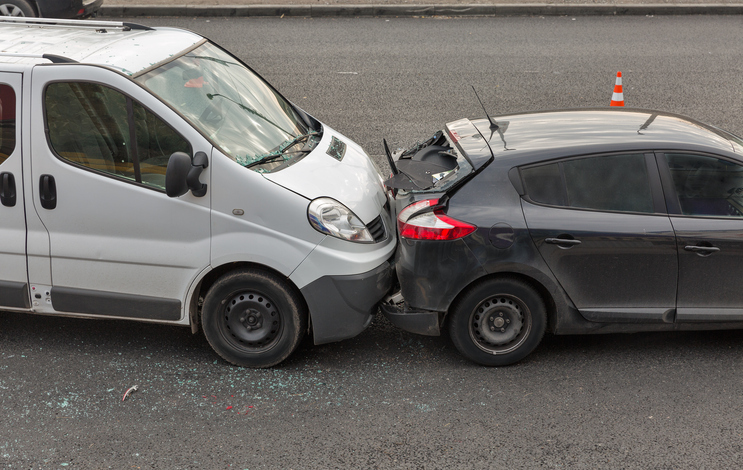
- The straight chain push. Three cars, all stopped at a light at Cleveland Avenue or in the queue exiting Summerlin Road. The rear driver looks down at a phone, hits the third car at speed, shoves it into the second, which gets pushed into the first. The fault almost always sits entirely with the rear driver. Bumper-damage geometry on the second car is the giveaway — heavy rear damage, lighter front damage, with the front crush pattern matching a low-speed push rather than a high-speed strike.
- The “I tapped them, then they hit something else” claim. The rear driver concedes a light tap but insists the middle driver overreacted, accelerated, or failed to brake in time. This is the scenario where the insurance adjusters try hardest to put a percentage on the middle driver. Photographs and the police narrative do most of the work here. So does the testimony of any witness who saw the brake lights.
- The simultaneous chain. Two or three impacts close enough in time that the police diagram cannot cleanly separate them. Common on I-75 near Alico Road in heavy rain, where visibility collapses and a half-dozen cars stack up in under five seconds. Fault here often splits among multiple rear drivers, and that is where the modified comparative system under §768.81 starts to bite.
- The hit-and-run rear-end. The rear driver hits, panics, and flees. We see this on US-41, on Pine Island Road, and on the I-75 ramps. The client has no defendant to sue and no policy to claim against from the at-fault driver. The only path to a recovery is the client’s own UM policy under §627.727, and the value of the case is capped at the UM limit.
Why fault in a chain push is contested harder than people expect
The presumption that the rear driver is at fault is real, but a presumption does not write itself onto a check. The insurer for the rear driver has every incentive to put a percentage on you — the middle driver — because every point of fault above zero reduces what they owe, and every point above 50 wipes the case out entirely. The arguments come in a predictable order. You stopped too suddenly. You did not have working brake lights. You were following the front car too closely yourself. You were distracted. You accelerated when you should have braked.
Most of those arguments are not supported by the physical evidence, but they all sound plausible to a jury if no one rebuts them. That is the harder part. The work in a chain-reaction case is not proving the rear driver hit you. It is keeping your own percentage of fault at zero, or as close to zero as the facts allow, so that the §768.81 math comes out in your favor.
The medical side runs in parallel. Cervical strain from a rear-end is the most common diagnosis in our practice. It often does not feel serious in the first 48 hours, which is the worst possible feature for a Florida case. Clients tell the ER they feel fine, decline imaging, get discharged, and then start having neck pain three days later. By that point the defense has a record that says no acute injury, and PIP has a clock running on the 14-day initial-care requirement.
A rear-end client we represented in Fort Myers
A few years back our office represented a client who was rear-ended on US-41 in Fort Myers. The driver who hit her did not stop. By the time the deputies arrived, the other vehicle was long gone, and there were no witnesses who got a plate. The client had stopped at a red light, gotten hit hard enough that her airbags did not deploy but her head and neck snapped back, and was sitting in her car waiting for somebody to come back and check on her. Nobody did.
She drove herself home, started feeling worse overnight, and went to the ER the next morning. The diagnosis was chronic cervical strain. The next several months were physical therapy three times a week and a pain-management course of cervical injections. She was not the same driver afterward — she would not get on US-41 without a passenger in the car for almost a year.
With no at-fault driver to identify, the only path was her own Uninsured Motorist policy. The carrier initially offered a fraction of the policy limit on the theory that the medical care was conservative and the prognosis was open. We pushed back with the treating physician’s records and the documented gap between her pre-crash and post-crash driving life. The case resolved at the full UM policy limit. She used a piece of the recovery to take a defensive-driving refresher course, which I have always remembered as a small detail that said a lot about who she was as a person.
What to do in the first week after a chain-reaction rear-end
The advice below comes from watching what works and what does not over thirty years. None of it is generic. Every item on this list has a specific reason behind it.
- Get medical care within 14 days, even if you think you are fine. PIP under §627.736 closes after 14 days without initial care, and the soft-tissue injuries from a rear-end are the most likely to surface on a delay. An urgent-care visit with documented neck and back complaints is enough to keep the window open.
- Photograph all three bumper sets, not just the one that hit you. In a chain push, the geometry of the middle car’s front bumper damage is what tells the story. A push-shove looks different than a strike, and the photos are the only place that distinction lives.
- Ask the responding deputy for the crash report number before you leave the scene. The §316.066 long-form crash report is the document the insurance adjusters all start from. Without the number you are waiting two weeks for it to land in the public system.
- Do not give a recorded statement to the rear driver’s insurer. Florida law does not require it. You are required to cooperate with your own insurer; that is a contractual obligation. You are not required to be recorded by the other side, and what you say in those calls almost always gets used to put a percentage of fault on you later.
- Save your phone’s location history. If the rear driver claims you stopped suddenly, your phone’s GPS log usually shows the deceleration profile and the location data lines up with the police diagram. We have used this twice in the last year to defeat a “sudden stop” argument.
- Call before PIP runs out. Once PIP is exhausted, the at-fault carrier and your UM carrier are the only sources of money on the table. Knowing the size of those policies early shapes every decision you make about treatment and settlement.
Key Takeaways
- Florida treats the rear-most driver in a chain push as presumptively at fault. The presumption is rebuttable, but the burden sits with the rear driver.
- Under §768.81, if your share of fault exceeds 50 percent you recover nothing. The whole game in a chain-reaction case is keeping the percentage assigned to you at or below that line.
- The deadline to file suit is two years from the crash under §95.11(4)(a), down from four years before the 2023 reform.
- If the rear driver flees or is uninsured, your own UM policy under §627.727 becomes the case. UM is the most undervalued coverage on a Florida auto policy.
- Initial medical care within 14 days is the rule that protects PIP under §627.736. Miss it and the no-fault $10,000 disappears.
Frequently Asked Questions
If I was the middle car in a three-car chain on Daniels Parkway, am I liable to the driver in front of me?
Usually no, if you were stopped or slowing normally and got pushed forward by the rear vehicle. Florida treats the rear-most driver as the presumptively negligent party in a chain push. The insurer for the front car will look at your bumper damage pattern and the police report. If your front bumper damage is consistent with being shoved into the car ahead rather than striking it under your own power, the rear driver’s policy is typically on the hook.
What if the driver who hit me had no insurance or fled the scene on US-41?
Your own Uninsured Motorist coverage under §627.727 steps in. UM is the single most useful coverage on a Florida auto policy and almost no one understands they have it until they need it. We have recovered full UM policy limits for clients whose rear-driver was a hit-and-run or had a minimum bodily injury policy that did not come close to covering the medical bills.
Do I still get paid if the insurer says I share some of the blame?
Under Florida’s 2023 negligence reform (§768.81), yes, as long as your share of fault is 50 percent or less. Above 50 percent you recover nothing. Below 50 percent your recovery is reduced by your percentage. So if a jury says you were 20 percent at fault on a $200,000 case, you take home $160,000. That 50 percent line is the difference between a settlement and a closed file, which is why fault arguments in chain-reaction cases are worth fighting hard.
How long do I have to file a claim after a Fort Myers rear-end crash?
Two years from the date of the crash under §95.11(4)(a). That window used to be four years before the 2023 reform, and a lot of people still operate on the old number. Two years sounds like a long time, but between PIP exhaustion, MMI on the medical side, and the back-and-forth with the insurer, it goes quickly. Calling early protects the file.
Will my own PIP cover me even though the other driver caused it?
Yes. Florida is a no-fault state for medical bills up to the first $10,000 under §627.736. Your PIP pays 80 percent of reasonable medical care and 60 percent of lost wages, regardless of who hit whom. You have to seek initial care within 14 days, which is the rule that trips up the most clients. After PIP is exhausted, that is when the at-fault driver’s bodily injury coverage and your UM coverage come into play.
Talk to our office about your rear-end case
If you were rear-ended and pushed into another vehicle anywhere in Fort Myers, Bonita Springs, Naples, Cape Coral, Estero, or Lehigh Acres, our firm would be glad to talk through the facts with you at no charge. Call 239-992-8259 for a free consultation. There is no fee unless we recover for you.
About the Author

David B. Pittman, Esq. is the founder of Pittman Law Firm, P.L., and has practiced personal injury law in Fort Myers and across Lee County for more than thirty years, with a sustained focus on serious-injury auto and complex-liability cases. The firm’s Fort Myers presence handles a steady stream of serious-injury work along the Daniels Parkway, Six Mile Cypress, McGregor Boulevard, Cleveland Avenue, and Summerlin Road corridors, and along I-75 between Estero and Bell Tower.
David’s training track runs from The Citadel, The Military College of South Carolina, where he completed his undergraduate degree, to the University of South Carolina School of Law, where he earned his JD. He carries an AV-Preeminent peer-review rating from Martindale-Hubbell and is a member of the Multi-Million Dollar Advocates Forum.
David has held a Florida real estate broker license for twenty-five years, a credential that shapes how the firm reads the property side of premises cases. The firm handles personal injury cases across Lee and Collier Counties, serving Fort Myers, Bonita Springs, Naples, Cape Coral, Estero, and Lehigh Acres, with offices at Windsor Place in Bonita Springs (main) and Fort Myers (satellite). Call 239-992-8259 for a free consultation.
The information on this website is for general information purposes only and should not be taken as legal advice for any individual case or situation. Viewing this information does not create an attorney-client relationship. Past results do not guarantee a similar outcome.