

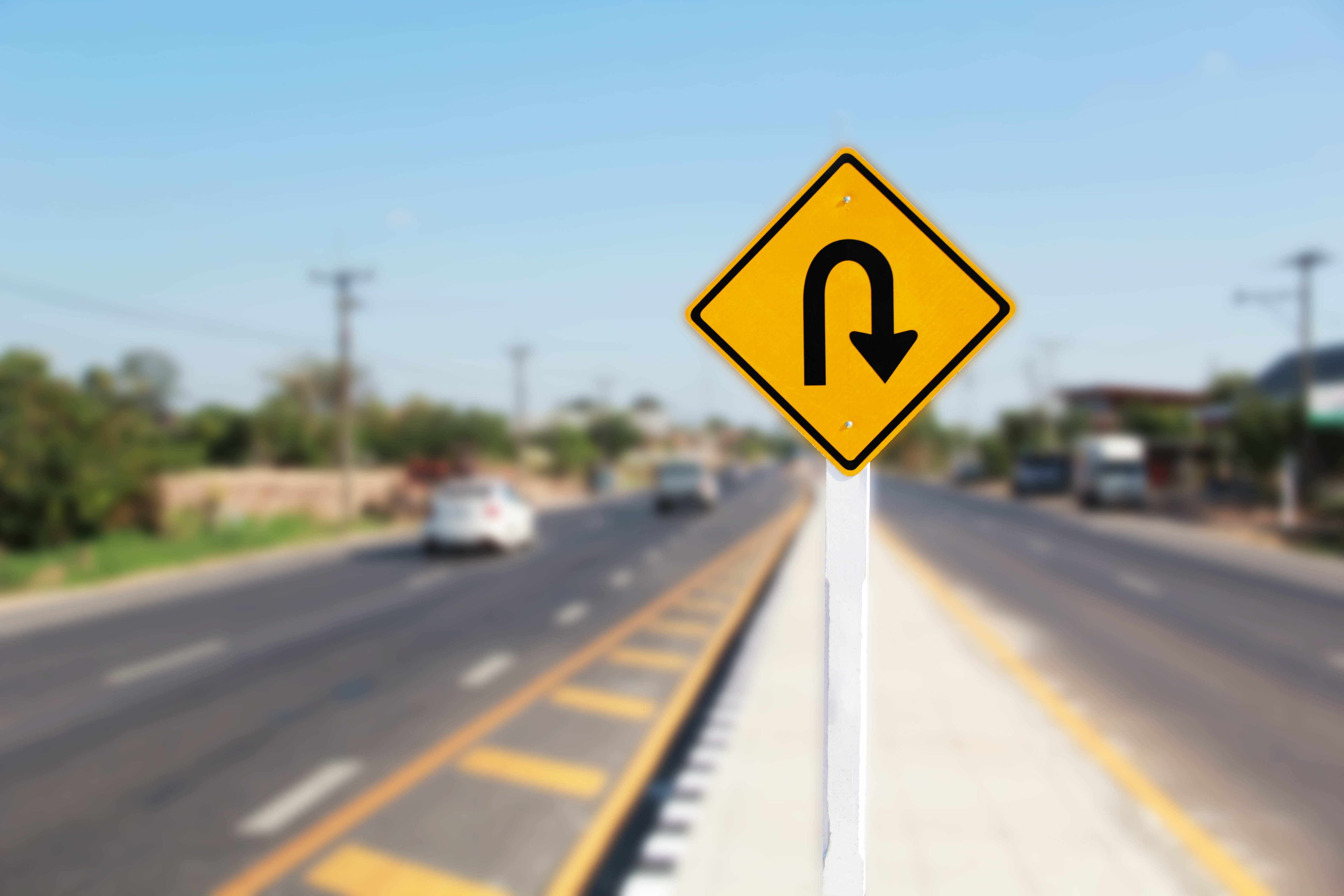
Why Car Accidents Happen During U-Turns in Fort Myers
Florida Statute §316.1515 says a U-turn is legal wherever it can be completed safely and without interfering with other traffic — and where no sign says otherwise. That statute is also how the driver who turned in front of you will try to win your case. The yield duty runs with the U-turn: whoever makes the maneuver has to clear oncoming traffic first. When they misjudge the gap on Cleveland Avenue or swing across three lanes on Colonial Boulevard, that yield duty is usually where fault gets settled. The difference between a clean recovery and a denied claim almost always comes down to a few details the at-fault driver’s carrier hopes you never bring up.
This is the long-form version of the answer I give over the phone every week. What Florida law actually says, the patterns we see again and again on roads like Cleveland Avenue and McGregor Boulevard, why these cases are harder than they look, and the steps we want our clients taking before they ever call us.
What Florida law actually says about U-turns
The starting point is Florida Statute §316.1515. It says a U-turn is allowed wherever it can be completed “in safety and without interfering with other traffic,” and where no sign prohibits the maneuver. That’s it. There is no Florida-wide list of intersections where U-turns are banned. Instead, the rule operates intersection by intersection, and the local DOT or city posts the “No U-turn” signs where the data tells them to.
Plain English: if you can complete the U-turn safely and there’s no sign telling you not to, you are inside the law. The moment you cause another driver to brake hard, swerve, or change lanes to avoid you, you are outside it — and the burden of proving the turn was safe shifts to you.
Two other statutes shape every Fort Myers U-turn case I handle.
§768.81 is Florida’s modified comparative negligence rule. After the 2023 tort reform, if a jury decides you were 50 percent or more at fault for the crash, you recover nothing. Forty-nine percent and below, your damages are reduced by your share. On U-turn crashes the at-fault analysis is almost never 100/0. The U-turning driver had the yield duty, yes — but if the oncoming driver was twenty over the limit or looking at a phone, the carriers will fight to push that percentage as high as they can. Getting it back down is most of the work.
§95.11(4)(a) is the statute of limitations. Two years from the date of the crash for a negligence claim. The four-year window many people still believe in was eliminated by the 2023 reform for any wreck after March 24 of that year. Two years sounds like a lot until you have surgery, finish therapy, and finally get medical records ordered. We have turned away cases where people called us at month twenty-two and there simply was not enough runway left to investigate properly.
And then there is the no-fault layer. §627.736 — Personal Injury Protection — pays the first $10,000 of your medical and lost wages regardless of who caused the crash, but only if you sought treatment within fourteen days. Miss the fourteen-day window and your own PIP carrier denies the bills. I have watched that fourteen-day rule cost people thousands of dollars they should never have had to spend out of pocket.
Five U-turn crash types we handle in Fort Myers
U-turn collisions on paper look identical. In practice they fall into a handful of recurring patterns. After thirty years, I can usually tell which one we’re dealing with from the first ten minutes of a phone call.
- The mid-block driveway U-turn on a six-lane arterial. Cleveland Avenue and Colonial Boulevard are the worst offenders. A driver pulls out of a parking lot intending to go the other direction, sees a gap, and tries to sweep across all six lanes in one motion. They almost always miss the speed of the vehicle in the far lane. The far-lane car is doing 45 in a 40 zone, the U-turning driver has maybe 70 feet less than they thought, and the impact lands on the U-turning car’s passenger side or rear quarter panel.
- The signalized-intersection U-turn that conflicts with a right-turn-on-red. This is the one almost nobody understands. A driver in the leftmost lane gets a green left arrow and decides to swing it all the way around into a U-turn. At the same instant, a driver coming from the cross street has a red and is turning right on red into what they think is an open lane. Both drivers think they had the right of way. Under Florida law the U-turn driver usually did — but unless witnesses or a camera caught the sequence, the insurance carriers will spend months arguing about it.
- The protected-U-turn lane on a divided highway. Many newer Fort Myers intersections have a dedicated U-turn bay on Daniels Parkway and along Six Mile Cypress Parkway. They feel safer than they are. The driver completing the U-turn has to merge directly into the rightmost through lane on the other side, and through-traffic in that rightmost lane is rarely slowing down for them. Rear-end and sideswipe wrecks at these bays are routine.
- The U-turn that becomes a head-on. A driver attempting a U-turn on a two-lane road like the older sections of McGregor Boulevard misjudges the radius, can’t complete the turn in one motion, and ends up perpendicular across the centerline while oncoming traffic is bearing down. These crashes produce the worst injuries we see in this category — full frontal impacts at combined closing speeds of 70 or 80 miles per hour.
- The hit-and-run after a botched U-turn. Far more common on US-41 and Cleveland Avenue than people realize. A driver causes a wreck attempting an illegal U-turn, panics, and leaves. The injured driver is left with cervical and lumbar injuries and an empty driver’s seat to point at when the insurance adjuster calls. The fix for that scenario is uninsured motorist coverage under §627.727, which is the conversation I want every Florida driver to have with their agent at least once a year.
What makes U-turn cases genuinely hard to win
The instinct after a U-turn crash is to assume the case is simple. The other driver was making a U-turn, the other driver had the yield duty, the other driver pays. In practice three things complicate almost every one of these files.
First, the geometry is hard to reconstruct. Unlike a stop-sign or red-light wreck, there is no fixed reference point that says where each car was at the moment of impact. The U-turning car was, by definition, in the middle of changing direction. Without a dashcam or a Lee County Sheriff’s Office traffic homicide reconstruction, we are often working from the resting positions of the vehicles, the debris field, and whatever the witnesses remember. Carriers know this and use it.
Second, the injuries are deceptive. A U-turn impact is almost always a side or quarter-panel hit at moderate speed. Vehicles hold up surprisingly well, the airbags often do not deploy, and people walk away from the scene thinking they are fine. Two weeks later the neck pain that everyone assumed was a strain has become a chronic cervical injury with radicular symptoms down one arm. By then the at-fault carrier’s adjuster has already taken a recorded statement in which the client said they “felt okay.” Pulling that recorded statement back out of the file takes work.
Third, the comparative-fault attack is constant. Even when the U-turning driver clearly caused the wreck, the at-fault carrier will hunt for any percentage of fault they can hang on you — were you over the limit, were you in the rightmost lane when the law requires you to use the leftmost for a continuing through movement, were you texting. Under §768.81 every percentage point they hang on you reduces what we recover. And if they can push you past 50, the case is over.
That is why these files take patience. The Fort Myers U-turn cases I have brought to resolution all looked simple on day one and got complicated by day thirty. The cases where the client called early, treated consistently, and let us control the carrier communication are the ones that resolved well.
A Fort Myers rear-end injury claim from our files
One we worked recently came in as a rear-end on US-41 just south of the Edison Mall stretch. Our client was at a near-stop in a traffic queue. The car behind her never braked — clipped her rear bumper hard enough to throw her forward into her shoulder belt, then swung out and accelerated north on Cleveland. She got the partial plate and a description. Fort Myers Police Department took the report under §316.066. The other driver was never located.
She came to us about a week later because her neck pain had stopped getting better and started getting worse. ER imaging at the scene had been clean, but by day five she had numbness down the left arm and could not turn her head past about thirty degrees. We sent her to a physical therapist we have worked with for years and then to a pain management physician when the PT plateaued. The diagnosis settled at chronic cervical strain with myofascial involvement.
Because the at-fault driver was a phantom — gone, unidentified, unreachable — the case had to be built against her own uninsured motorist coverage under §627.727. The carrier tried the predictable moves: argued the gap between the ER visit and the PT start meant the injuries were not crash-related, argued the pain management referral was overtreatment. We pushed back with the imaging timeline and the consistent treatment records.
The case resolved at the full UM policy limits. The client kept her car, kept her job, finished her therapy, and walked away with the medical paid and a recovery that reflected what she actually went through. Not every case ends that cleanly. This one did because she called us early, treated consistently, and let us handle the carrier from week two forward.
What to do if you’re hit during a U-turn in Fort Myers
The instructions I give people on the phone are almost always the same. They come from watching what works.
- Call 911 from the scene, even if you think you’re fine. A Florida Highway Patrol or Fort Myers Police crash report under §316.066 is the spine of the entire case later. Without it, the U-turning driver and their carrier will rewrite the geometry of the wreck. I have seen carriers claim a U-turning driver was “already straight in the lane” when the impact happened — a police diagram on scene closes that door.
- Photograph the resting positions before you move the cars. Wide shots showing the relationship between the two vehicles, the lane markings, and any signage. Then photograph the damage on both cars from at least four angles each. These photos win the comparative-fault fight months later.
- Get the names and phone numbers of every witness yourself. Police reports list witnesses inconsistently. We have lost contact with cooperative witnesses because the officer wrote a phone number down wrong. Get them yourself, on your own phone.
- See a doctor within fourteen days. Not eight days, not ten — get in fast. The fourteen-day PIP window under §627.736 is a hard cutoff. Miss it and your own no-fault carrier denies the medical. I have watched that one rule cost people thousands of dollars in out-of-pocket treatment.
- Do not give a recorded statement to the other driver’s insurance company. They will call within forty-eight hours. They will be friendly. The questions are designed to lock in a version of the facts before you have your medical picture or a lawyer. Tell them you will be in touch through counsel and hang up.
- Save everything in one folder. The crash report number, the ER paperwork, the photos, the witness contacts, the medical bills as they arrive. When you call us, bring the folder. The cases that move fastest are the ones where the client kept the records together from day one.
Key Takeaways
- Florida §316.1515 allows U-turns wherever they can be completed safely and no sign prohibits them — the U-turning driver carries the yield duty, and that yield duty is usually how fault gets sorted out in a crash.
- Modified comparative negligence under §768.81 means a jury can assign a share of fault to you; cross 50 percent and you recover nothing, which is why these cases hinge on holding the comparative-fault percentage down.
- The statute of limitations on a negligence claim is now two years under §95.11(4)(a) after the 2023 reform — call early; cases that come in at month twenty-two are hard to investigate properly.
- See a doctor within fourteen days of the wreck or your PIP under §627.736 denies the medical — this rule blindsides more Fort Myers drivers than any other.
- If the at-fault driver flees or is uninsured, your own UM coverage under §627.727 carries the case — review it with your agent at least once a year.
Frequently Asked Questions
Q1. Are U-turns legal in Fort Myers?
Yes, in most places. Florida Statute 316.1515 permits a U-turn anywhere a driver can complete it safely and without interfering with other traffic, and where no sign prohibits it. The catch is the yield duty: a driver making a U-turn has to yield to oncoming and cross traffic, and if a crash happens, that yield duty is usually how fault gets sorted out.
Q2. If I was hit by a driver making a U-turn, who is at fault under Florida law?
Most of the time the U-turning driver carries the larger share of fault, because they had the yield duty. But Florida runs on modified comparative negligence under §768.81. A jury can assign a percentage of fault to you too — for speeding, for distraction, for missing a signal — and if your share lands above 50 percent you recover nothing. Below 50 percent, your damages get reduced by your percentage.
Q3. How long do I have to file a U-turn injury case in Florida?
Two years from the date of the crash for a negligence claim, under §95.11(4)(a) as amended by the 2023 tort reform. The old four-year window is gone for crashes after March 24, 2023. Wrongful-death claims have their own two-year clock. The shorter window is why we tell people to call early — evidence on these cases disappears fast.
Q4. Does my own insurance pay if a U-turning driver hits me?
Florida is a no-fault state. Your PIP under §627.736 pays the first $10,000 in medical and lost wages regardless of who caused the crash. If your injuries cross the verbal threshold — permanent injury, significant scarring, that kind of thing — you can step outside no-fault and pursue the at-fault driver’s bodily injury liability coverage. If the at-fault driver has no insurance, your own uninsured motorist coverage under §627.727 is what carries the case.
Q5. Do I have to report a U-turn crash to police in Fort Myers?
Yes if anyone is hurt, if a vehicle has to be towed, or if total damage looks like it tops $500. Florida §316.066 requires a written police crash report in those situations. The report becomes the spine of any insurance claim later — without it, the U-turn driver and their carrier will often try to rewrite the geometry of the wreck.
Talk to Pittman Law Firm About Your Fort Myers U-Turn Crash
If you were hit by a driver making a U-turn anywhere on Cleveland Avenue, McGregor Boulevard, Daniels Parkway, Six Mile Cypress, Summerlin Road, or along I-75 near Alico Road, I would like to hear from you. We handle these cases on contingency, which means there is no fee unless we recover for you. The first call is free and we will tell you straight whether we think the case has a path. Call 239-992-8259 or reach us through the contact page on dontgethittwice.com. We answer the phones ourselves.
About the Author

David B. Pittman, Esq., the founder of Pittman Law Firm, P.L., has represented injured Floridians in Fort Myers and across Lee County for more than thirty years, concentrating on serious-injury auto and complex-liability cases. The firm’s Fort Myers practice covers the Daniels Parkway, Six Mile Cypress, McGregor Boulevard, Cleveland Avenue, and Summerlin Road corridors, and I-75 between Estero and Bell Tower.
David holds a JD from the University of South Carolina School of Law and a degree from The Citadel, The Military College of South Carolina. He carries an AV-Preeminent rating with Martindale-Hubbell and is a member of the Multi-Million Dollar Advocates Forum.
David has held a Florida real estate broker license for twenty-five years, a background that shapes how the firm reads the property side of premises cases. The firm handles personal injury cases across Lee and Collier Counties, serving Fort Myers, Bonita Springs, Naples, Cape Coral, Estero, and Lehigh Acres, with offices at Windsor Place in Bonita Springs (main) and Fort Myers (satellite). Call 239-992-8259 for a free consultation.
Disclaimer: This article is general information about Florida personal injury law and is not legal advice for any particular case. Reading it does not create an attorney-client relationship with Pittman Law Firm, P.L. Outcomes described are based on the facts of individual cases and do not guarantee similar results in other matters. For advice about your own situation, please contact our office directly.