

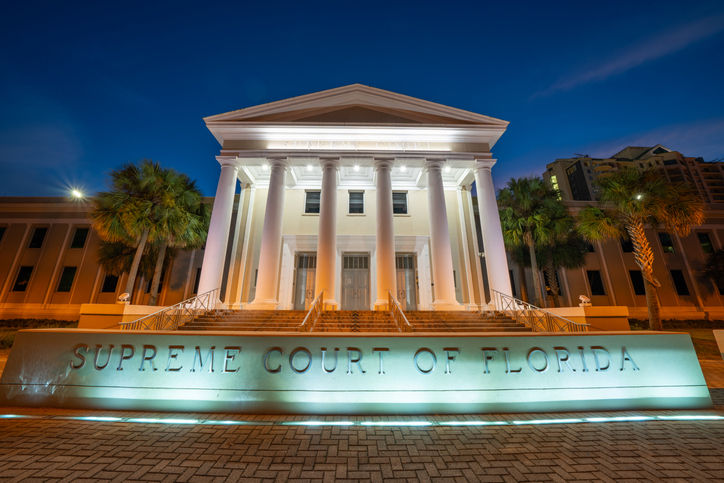
Florida Supreme Court’s Landmark Ruling on Medical Malpractice Caps: What Fort Myers Residents Need to Know
Florida’s statutory cap on noneconomic damages in medical malpractice cases is no longer good law. The Florida Supreme Court struck it down twice — first for wrongful-death cases in 2014, then for personal-injury cases in 2017. A family calling our Fort Myers office after a hospital harm, still carrying the idea that there is a $500,000 ceiling, has been operating on information that is roughly a decade out of date.
I want to walk through where the law really stands after those rulings, what the 2023 and 2024 legislative sessions changed around the edges, and what any of this means if you or a family member was harmed by a doctor or a hospital here in Lee County. I have practiced personal injury law in Fort Myers and across Southwest Florida for more than thirty years, and I will share how we actually work these cases out of our office on Bonita Beach Road and our Fort Myers location off McGregor Boulevard.
What Florida law actually says about medical malpractice caps
In 2003 the Florida Legislature passed a statute capping noneconomic damages in medical malpractice cases. The headline numbers were $500,000 per claimant against a practitioner, rising to $1,000,000 in cases of permanent vegetative state or death, with a separate set of higher figures against non-practitioner defendants such as hospitals. The stated reason was a perceived malpractice insurance crisis. The legislative findings argued that physicians were leaving Florida because premiums had become unaffordable.
The Florida Supreme Court took two large bites at those caps. In Estate of McCall v. United States, 134 So. 3d 894 (Fla. 2014), the Court struck down the wrongful-death caps under Article I, Section 2 of the Florida Constitution — the state equal-protection clause. The plurality held that the cap arbitrarily reduced recovery for families with multiple survivors and that the empirical basis for the supposed crisis had not held up. Three years later, in North Broward Hospital District v. Kalitan, 219 So. 3d 49 (Fla. 2017), the Court extended that reasoning to personal-injury med-mal cases. The same equal-protection problem applied: the cap operated most harshly on the most severely injured.
Plain English: a Florida jury can now return a verdict for pain and suffering, loss of capacity for the enjoyment of life, mental anguish, and the other categories of noneconomic harm without a statutory ceiling artificially trimming the number on the way out the door. The cap statute is still on the books at Fla. Stat. § 766.118, but the binding decisional law from the Florida Supreme Court controls.
The 2023 legislative session brought HB 837, which made sweeping changes to personal injury practice in Florida — shortened the general negligence statute of limitations from four years to two, restructured bad-faith law, modified the admissibility of medical bills. Most of HB 837 does not touch the med-mal cap holding, but it shortened other timelines around it. In 2024, the Legislature repealed the so-called Free Kill carve-out in Fla. Stat. § 768.21 that had blocked adult children of unmarried parents and parents of adult children from recovering noneconomic damages in wrongful-death med-mal cases. That repeal applies to incidents on or after its effective date, which means the date of the death dictates which rule governs your family’s claim.
Two other procedural rules matter as much as the cap question, and they trip more cases than the cap ever did:
- Statute of limitations. Fla. Stat. § 95.11(4)(b) gives you two years from the date the incident was discovered, or reasonably should have been discovered, with a four-year outer repose period and a seven-year limit when fraud or concealment is shown. Children under eight have their own rule. Two years runs faster than people think.
- Chapter 766 presuit. Before a med-mal complaint can be filed in Florida, the plaintiff must conduct a presuit investigation, serve a Notice of Intent on every prospective defendant, and attach a corroborating affidavit from a qualified medical professional. The defendants get ninety days to investigate and respond. The statute of limitations tolls during that window. None of this is optional, and an affidavit from a witness whose qualifications do not match the defendant’s practice area will get a case dismissed.
The four med-mal call patterns we recognize immediately
After three decades of personal injury practice in Lee and Collier Counties, the med-mal calls our office receives fall into a small number of recognizable patterns:
- Missed or delayed diagnosis. The cancer that was not caught on the imaging that the radiologist signed off on, the stroke sent home from the emergency department as a migraine, the sepsis missed in a post-op patient on Colonial Boulevard. The harm is real but the proof problem is causation — would the outcome have been different with timely diagnosis?
- Surgical error. Wrong-site, retained foreign body, nerve injury, vascular injury, anesthesia complication. These cases tend to have cleaner causation and harder defense arguments.
- Medication and dosing errors. Often a pharmacy or nursing-staff issue more than a physician issue. Documentation is everything in these.
- Birth injury and obstetric harm. Florida’s NICA program (Fla. Stat. §§ 766.301–766.316) creates a no-fault path for certain birth-related neurological injuries, which removes some severe cases from the tort system entirely. NICA eligibility is the threshold question.
Why a bad outcome is not always malpractice — and why these cases are fought hard
The first thing I tell a family at the kitchen-table conversation is that a bad outcome and malpractice are not the same thing. Medicine carries known risks. A complication that was disclosed on the consent form, occurred within the recognized rate, and was managed reasonably afterward is generally not a case, no matter how devastating the result. What we are looking for is a deviation from the standard of care — what a reasonably prudent practitioner in the same field, with the same training, would have done in the same circumstances — and a causal link between that deviation and the harm.
Two things make these cases harder than ordinary auto cases. First, every med-mal claim needs a qualifying witness under Fla. Stat. § 766.102. That witness has to be in the same specialty as the defendant if the defendant is board-recognized, or a similar field for general practitioners. Finding the right witness — and one who will hold up on cross-examination — is often the single biggest gating item in deciding whether to take a case. Second, the carriers that insure Florida physicians and hospitals do not soften their positions on the courthouse steps. They try these cases. Settlement, when it comes, tends to come late, and only after a credible threat of trial has been built.
That is why presuit matters so much. The ninety-day Chapter 766 window is the only structured discovery you get before you have to commit to filing. We use it to lock down records, pin down the witness’s opinions in writing, and read the carrier’s response carefully. The response often tells us more about the defense than the defense intends.
What to do if you think a doctor or hospital harmed you or a family member
Practical, in the order we work them in our office:
- Get the records, all of them. Not the discharge summary. The full chart. Hospital records, imaging on disc, lab results, nursing notes, the consent form, the operative report, anesthesia records, the medication administration record. Florida law (Fla. Stat. § 395.3025 for hospitals, § 456.057 for physicians) gives patients a right to their records on written request, typically within thirty days. Pay the copying fee. Do not let cost talk you out of completeness.
- Write down what happened while it is fresh. Dates, times, names of staff, who said what. Memory degrades. I have used the same approach with families in catastrophic-injury cases and the timeline they write in week one is almost always more useful than the one they try to reconstruct in month six.
- Do not post on social media about it. The carrier will pull every public post you have made. I have seen sympathy posts on Facebook used to argue that a client’s pain was exaggerated.
- Watch the calendar. Two years from discovery, four years from incident as an outer limit, shorter in certain wrongful-death contexts. If you are anywhere near a year out, do not wait another month.
- Talk to a personal injury attorney before you sign anything from the hospital’s risk-management office. A patient-relations apology call is one thing. A written release in exchange for a payment is another, and they sometimes show up in the same envelope.
Key Takeaways
- The Florida Supreme Court struck down the statutory caps on noneconomic damages in med-mal wrongful-death cases (McCall, 2014) and personal-injury cases (Kalitan, 2017) on state equal-protection grounds.
- Fla. Stat. § 95.11(4)(b) gives you two years from discovery to file, with a four-year outer repose and longer windows only in fraud or concealment situations.
- Chapter 766 requires a Notice of Intent, a presuit investigation, and a qualified-witness affidavit before any med-mal complaint can be filed.
- The 2024 repeal of the Free Kill carve-out in Fla. Stat. § 768.21 expanded who can recover noneconomic damages in wrongful-death med-mal cases, but only for incidents on or after the effective date.
- The cap question is real but it is rarely the deciding factor in whether a case is viable. Records, the qualifying witness, and the calendar matter more.
Frequently Asked Questions
Q1. Did the Florida Supreme Court strike down all medical malpractice damage caps?
The Court has struck down the statutory caps on noneconomic damages on equal-protection grounds, first in the wrongful-death context (McCall, 2014) and later in personal-injury med-mal cases (Kalitan, 2017). The 2023 legislative session added new wrinkles in HB 837 and the so-called Free Kill repeal debate, so the practical answer for any given case depends on the year of the injury and the theory of recovery.
Q2. What is Florida’s two-year statute of limitations on medical malpractice?
Under Fla. Stat. § 95.11(4)(b), you generally have two years from the date the incident was discovered, or should have been discovered with the exercise of due diligence, to file a med-mal suit, with an outer statute of repose of four years and a longer window in fraud or concealment situations. Children under eight have a separate rule. Two years is short, and we have seen good cases lost because the file sat on a kitchen counter.
Q3. Do I have to send a Notice of Intent before filing a medical malpractice suit in Florida?
Yes. Chapter 766 requires a Notice of Intent to Initiate Litigation, a presuit investigation, and a corroborating affidavit from a qualified medical professional before a complaint can be filed. This is a strict procedural hurdle, and skipping any step can sink a case before it starts.
Q4. What is the Free Kill law and is it still in effect?
Florida’s wrongful-death statute (Fla. Stat. § 768.21) historically barred adult children of unmarried decedents over 25, and parents of adult decedents over 25, from recovering noneconomic damages in med-mal wrongful-death cases. That carve-out was repealed in the 2024 session for incidents arising after the effective date, but it still controls older claims, so the date of the death matters a great deal.
Q5. What is the typical settlement range for a Florida medical malpractice case?
There is no typical number, and any blog that gives you one is guessing. Outcomes turn on the strength of the causation proof, the severity of the harm, the available insurance, and the venue. We have handled cases that resolved in the low six figures and cases that resolved in the eight figures. A consultation is the only way to give you a range.
Talk to our office about your medical malpractice case
If you or someone in your family was harmed by a doctor, a hospital, or a long-term-care facility in Fort Myers, Bonita Springs, Naples, or anywhere across Lee and Collier Counties, call 239-992-8259 for a free consultation. We work medical malpractice cases on contingency. There is no fee unless we recover for you.
About the Author

David B. Pittman, Esq. is a thirty-plus-year personal injury attorney in Fort Myers and across Lee County and the founder of Pittman Law Firm, P.L., representing injured clients across Lee and Collier Counties, with a particular focus on commercial-vehicle, complex-liability, and serious-injury cases. The firm’s Fort Myers presence handles a steady stream of serious-injury work along the Daniels Parkway, Six Mile Cypress, McGregor Boulevard, Cleveland Avenue, and Summerlin Road corridors, and along I-75 between Estero and Bell Tower.
David trained at The Citadel, The Military College of South Carolina before earning his JD at the University of South Carolina School of Law. He is AV-Preeminent at Martindale-Hubbell and a Multi-Million Dollar Advocates Forum member.
David has held a Florida real estate broker license for twenty-five years, a credential that shapes how the firm reads the property side of premises cases. The firm handles personal injury cases across Lee and Collier Counties, serving Fort Myers, Bonita Springs, Naples, Cape Coral, Estero, and Lehigh Acres, with offices at Windsor Place in Bonita Springs (main) and Fort Myers (satellite). Call 239-992-8259 for a free consultation.
Disclaimer: The information on this page is provided for general educational purposes and is not legal advice for any particular situation. Reading this page does not create an attorney-client relationship with Pittman Law Firm, P.L. Prior results do not guarantee a similar outcome. This page is attorney advertising under the Rules Regulating The Florida Bar.