

By David B. Pittman, Attorney At Lae and Founder of Pittman Law Firm, P.L.
A slip and fall case in Florida does not come with a standard baseline payout. Settlement values range from minor settlements covering basic medical visits to six-figure recoveries for permanent injuries.
In Southwest Florida—whether a fall occurs in a grocery store along Tamiami Trail in Bonita Springs or a commercial plaza in Estero—the financial value of a claim relies heavily on the severity of your injuries, your medical expenses, and your ability to prove property owner negligence under Florida law.
Evaluating a claim requires analyzing nine core factors that dictate what a Florida slip and fall settlement is worth.
1. Is There an Average Florida Slip and Fall Settlement?
There is no true “average” settlement figure. A case involving a minor wrist sprain might settle for a modest sum to cover emergency room expenses and short-term care, while a slip and fall resulting in a traumatic brain injury or spinal surgery can reach hundreds of thousands of dollars.
Insurance companies do not use a fixed payout formula. They calculate settlement offers based on concrete financial losses, permanent physical impairment, and the strength of the evidence proving the property owner was at fault.
2. Does Injury Severity Affect Case Value?
Injury severity is the primary driver of non-economic damages, often referred to as pain and suffering. Permanent, life-altering injuries carry significantly higher settlement values than soft-tissue injuries that heal within a few weeks.
- High-Value Injury Claims: Spinal cord damage, herniated discs requiring surgery, traumatic brain injuries, complex fractures, and torn ligaments requiring surgical reconstruction.
- Lower-Value Injury Claims: Strains, sprains, minor bruises, and soft-tissue injuries that resolve quickly with short-term physical therapy.
When an injury causes lasting physical limitations, chronic pain, or permanent scarring, the property owner’s insurer must account for the lifelong impact on your quality of life.
3. How Do Surgery, Medical Bills, and Future Treatment Change Value?
Your total medical expenses establish the financial baseline of your economic damages. Every bill related to your injury increases the minimum settlement required to make you whole.
Medical documentation that drives value includes:
- Emergency treatment at regional facilities like Gulf Coast Medical Center or NCH.
- Diagnostic imaging, including MRIs, CT scans, and X-rays.
- Surgical procedures, hospital stays, and anesthesia costs.
- Ongoing physical therapy, chiropractic care, and pain management.
If your treating physician determines you will require long-term care, ongoing therapy, or future surgeries, a life care planner or medical economist projects those future costs into your total claim demand.
4. How Does Florida’s Comparative Negligence Law Affect Compensation?
Under Florida’s modified comparative fault rule (Florida Statute § 768.81), your financial recovery depends on your percentage of fault for the fall.
- The 51% Bar Rule: If a Lee County or Collier County jury determines you were more than 50% at fault for your injury (for example, failing to look at clear warning signs or stepping over an obvious hazard), you are barred from recovering any compensation from the property owner.
- Proportional Reductions: If you are found 20% at fault and your total damages are $100,000, your final recovery is reduced by 20%, resulting in a $80,000 payout.
Insurance adjusters routinely attempt to assign partial or total blame to the injured party to reduce what they have to pay.
5. Why Does Proving Property Owner Notice Matter?
Under Florida Statute § 768.0755, the burden of proof rests entirely on the injured person to show that a business establishment had actual or constructive knowledge of the dangerous condition and failed to take action.
To establish constructive knowledge, you must prove either:
- The dangerous condition existed for such a length of time that the business should have known about it through ordinary care.
- The condition occurred with regularity and was therefore foreseeable.
Without evidence proving the business knew or should have known about the floor hazard, an insurance company can legally deny liability entirely.
6. Does the Absence of a Warning Sign Increase Case Value?
Yes. Property owners and commercial businesses owe a legal duty of care to keep their premises reasonably safe and to warn visitors of hidden dangers.
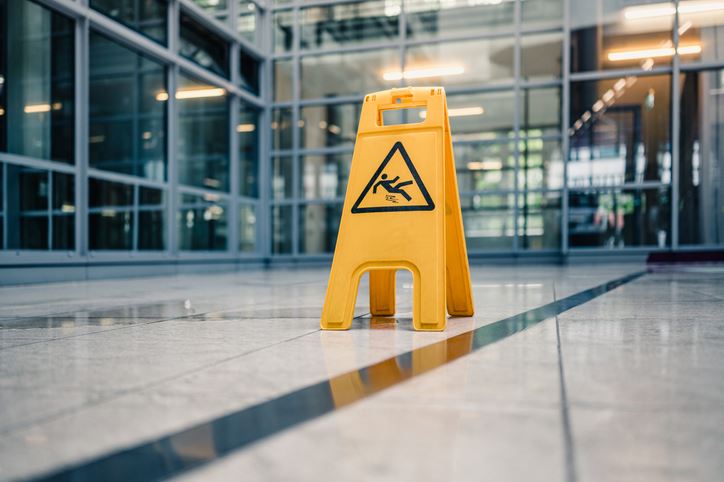
If a business owner or employee knows about a wet floor, a leaking refrigeration unit, or a cracked walkway on their property and fails to place a visible “Wet Floor” sign or temporary barrier, they breach their duty of care. Demonstrating this failure directly strengthens your liability argument and forces the insurance company to take the claim seriously.
7. What Evidence Makes a Slip and Fall Case Stronger?
Physical evidence disappears quickly in premises liability cases. Floors get mopped, leaks get repaired, and surveillance footage gets overwritten.
Key evidence that directly increases case leverage includes:
- Immediate Photographs: Clear photos showing the liquid, grease, damaged walkway, or lack of lighting before the scene is altered.
- Surveillance Footage: Store security video proving how long the hazard sat unaddressed and showing property staff walking past the danger without fixing it.
- Formal Incident Reports: A written report completed with store management immediately after the fall occurred.
- Witness Statements: Contact details and testimonies from third-party bystanders who saw the condition of the floor or witnessed the fall.
8. How Do Prior Injuries Affect the Claim?
Insurance companies frequently attempt to lower settlement values by claiming your physical symptoms stem from an old sports injury, a past car crash, or age-related degeneration.
Having a pre-existing condition does not disqualify you from compensation under Florida law. If a fall on commercial property aggravates, accelerates, or worsens a prior condition, the property owner remains responsible for the degree of worsening caused by the fall. Detailed medical records comparing your health before and after the incident are required to counter insurance defenses.
9. How Long Do Florida Slip and Fall Cases Take to Settle?
Timeline depends on the complexity of the medical treatment and whether the property owner disputes liability.
- Clear Liability & Minor Treatment: Claims with straightforward evidence and short-term medical care can resolve within 3 to 6 months.
- Severe Injury & Disputed Liability: Cases requiring surgery, long-term rehab, or formal litigation against commercial property owners often take 12 to 18 months or longer.
Statute of Limitations Deadline: Following Florida’s 2023 legal reforms, you have two years from the date of the fall to file a personal injury lawsuit. Missing this hard deadline forfeits your right to seek compensation permanently.
Real Southwest Florida Case Example
I represented a client who slipped on a clear puddle in Bonita Springs caused by a leaking display cooler inside a supermarket off US-41. The fall resulted in a severe lower back injury requiring a spinal fusion procedure.
The store’s insurance company initially denied the claim, asserting that the fluid had just spilled seconds prior. Our office acted immediately to preserve and audit the store’s overhead surveillance footage. The video revealed the cooler had been leaking onto the tile floor for over an hour, with store personnel walking past the puddle multiple times without placing warning signs.
By proving constructive knowledge under Florida Statute § 768.0755, we resolved the case for a $450,000 settlement to cover past and future surgical costs, lost income, and physical rehabilitation.
Talk to a Bonita Springs Premises Liability Attorney
If you were injured in a fall on commercial or private property in Southwest Florida, taking immediate action to preserve evidence is vital. Contact Pittman Law Firm, P.L. today for a straightforward evaluation of your case.
- Office: 3525 Bonita Beach Rd, Suite 107, Bonita Springs, FL 34134
- Phone: 239-992-8259
- Website: dontgethittwice.com
About David B. Pittman, Esq.
David B. Pittman, Esq. is the founder of Pittman Law Firm, P.L., bringing over 30 years of dedicated personal injury practice to clients throughout Lee and Collier counties, including Bonita Springs, Estero, Fort Myers, and Naples. A graduate of The Citadel and the University of South Carolina School of Law, David is recognized with the Martindale-Hubbell AV-Preeminent rating and is a member of the Multi-Million Dollar Advocates Forum.
In addition to his legal practice, David has held a Florida Real Estate Broker license for over 25 years. This deep, practical background in property management, commercial leasing, and real estate standards gives him a distinct advantage when evaluating property owner duties, maintenance responsibilities, and liability in Florida slip and fall claims.
Disclaimer: The information provided in this blog post is for educational and informational purposes only and does not constitute formal legal advice. Reading this content does not create an attorney-client relationship with Pittman Law Firm, P.L. Personal injury laws and statutes of limitations are subject to change. If you have been injured, consult directly with a licensed Florida personal injury attorney regarding the specific facts of your case.