

By David B. Pittman, Esq. | Founder, Pittman Law Firm, P.L. | 30+ Years of Personal Injury Practice & 25-Year Licensed Florida Real Estate Broker
Yes, you can pursue a premises liability claim in Florida even if you never actually hit the floor. Florida law does not require your body to strike the ground to hold a negligent property owner accountable. If a property defect or floor hazard along Bonita Beach Road or US-41 causes you to stumble, twist, or wrench your body while catching yourself, the property owner is just as responsible for the resulting torn meniscus, herniated disc, or rotator cuff tear as if you had fallen flat on your back.
Over the past 30+ years practicing personal injury law in Southwest Florida—and over 25 years as a licensed Florida Real Estate Broker—I have spoken with dozens of injured neighbors who almost talked themselves out of calling our office. They felt embarrassed because they managed to grab a shopping cart, a handrail, or a store display at the last second. Then, two days later, they could barely get out of bed or lift their arm, and an orthopedic surgeon at NCH Bonita Baker Hospital or Lee Health told them they needed surgery. Insurance adjusters love to call these “stumble and catch” incidents minor, hoping you will walk away quietly. They aren’t minor when you are the one facing six months of physical therapy.
Key Takeaways: “Near-Fall” Injuries in Southwest Florida
- Ground Contact Is Not Required: Under Florida negligence and premises liability law, liability hinges on whether a property owner’s negligence caused your physical injury—not whether your knees or back touched the floor.
- The Biomechanics Are Often Worse: Violent, reflexive muscle contractions used to stop a fall place massive torque on a single planted knee, the lumbar spine, or an outstretched shoulder grabbing a railing.
- Two Different Legal Standards Apply: Liquid spills in commercial stores fall under Florida Statutes § 768.0755, while structural trip hazards (broken concrete, loose tiles, bad lighting) fall under Florida common-law premises duties and the Florida Building Code.
- Florida’s 51% Fault Rule Is the Favorite Defense: Since the 2023 tort reform changes to Florida Statutes § 768.81, if an insurer convinces a jury you were more than 50% at fault for not watching your step, you recover $0.
- Security Video Overwrites Fast: Store cameras at plazas along Tamiami Trail and Bonita Beach Road often overwrite footage in 7 to 30 days—and because no crowd gathered around a person lying on the floor, proving the incident happened requires fast action.
How Do You Get Seriously Hurt Without Actually Hitting the Ground?
People who have never experienced a violent stumble often wonder how someone can tear cartilage or rupture a spinal disc without impact. In our office, we see the medical reality of this all the time. When you lose your footing on a slick tile floor or catch your toe on an uneven concrete slab, your brain triggers an immediate, involuntary survival reflex to protect your head and neck from striking a hard surface.
Instead of distributing force across your body on impact, all of your body weight, momentum, and corrective muscle force get channeled into one or two joints in a fraction of a second.
The Specific Injuries We See from “Catching Yourself”
- Rotator Cuff Tears and Shoulder Labral Injuries (SLAP Tears) When your foot slips out from under you on a wet stairwell or walkway and you reach out to grab a handrail, a grocery store endcap, or a heavy door frame, your entire falling body weight yanks against a single shoulder joint. We routinely see full-thickness supraspinatus tears and torn labrums from clients who saved themselves from pitching down a flight of stairs, only to destroy their dominant shoulder in the process.
- Meniscus Tears and ACL/MCL Ruptures When you trip over an unmarked curb or a buckled entryway mat, your lead foot shoots forward to catch your balance while your upper body twists to stay upright. Planting a single leg hard while your femur rotates over a stationary tibia is the textbook mechanism for a bucket-handle meniscus tear or a blown anterior cruciate ligament (ACL).
- Lumbar and Cervical Disc Herniations Wrenching your torso backward to counter a forward trip—or whipping your neck while trying to stay upright on a greasy restaurant floor—creates severe axial loading and shearing force on the spine. If you already have age-related wear and tear in your lower back (which almost every adult in Bonita Springs over 45 has), that sudden whip-like torque can push an L4-L5 or L5-S1 disc right into the sciatic nerve root, causing radiating leg pain, numbness, and weakness.
- Achilles Tendon Ruptures and Lisfranc (Midfoot) Fractures Stepping unexpectedly into a pothole, a sunken storm drain grate, or an unlevel transition between a parking lot and a sidewalk forces the ankle into sudden, extreme dorsiflexion or inversion. You stay on your feet, limping to your car, assuming it is just a bad sprain—until an X-ray or MRI reveals a ruptured Achilles tendon or torn Lisfranc ligaments requiring surgical hardware.
How Do “Trip-and-Catch” Accidents Happen Around Bonita Springs?
Having held a Florida Real Estate Broker license for 25 years alongside my legal practice, I look at commercial and residential properties differently than someone who only reads police reports. Property owners, commercial landlords, and HOA management companies in Lee and Collier Counties have specific maintenance responsibilities. When they cut corners on property upkeep to save money, predictable hazards develop:
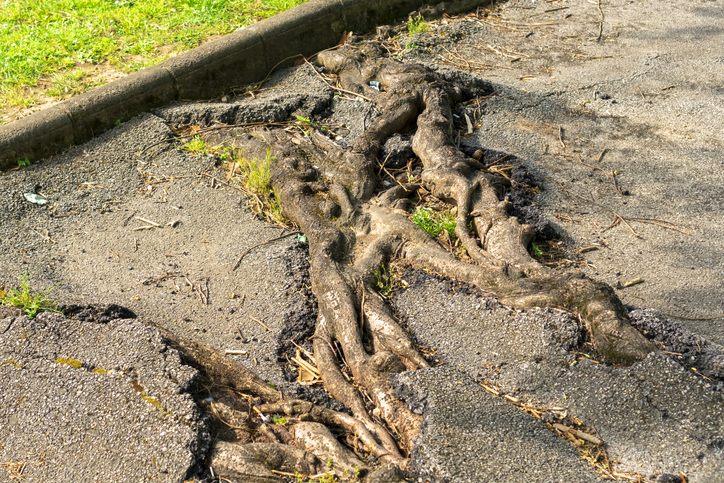
- Unmarked Elevation Changes & Sunken Pavers: Outdoor shopping centers and dining areas from the Promenade at Bonita Bay down to Old 41 Road love decorative brick pavers. Over time, Southwest Florida’s heavy summer rains wash out the sand base beneath those pavers, or tree roots push them up. A vertical lip of just half an inch is enough to catch the toe of a sneaker or sandal.
- Buckled or Saturated Entryway Mats: During our afternoon downpours, commercial stores along Bonita Beach Road throw down heavy carpet runners at the front doors. When the rubber backing wears out, the corners curl up. A shopper steps through the sliding glass doors, catches a foot under the curled edge of the mat, and lunges into a checkout lane or shopping cart to stay upright.
- Grocery Store Condensation and Produce Spills: Leaking refrigeration cases, freshly mopped tile transitions without warning cones, or tracked-through rainwater near the customer service desk create invisible slick spots. You slide three feet, do an involuntary split, grab your shopping cart handle for dear life, and feel an immediate pop in your groin, hip, or lower back.
- Code-Violating Stairwells and Loose Handrails: At vacation rentals near Bonita Beach or two-story condominiums in Estero and North Naples, outdoor stairs take a beating from salt air and humidity. Under the Florida Building Code, stair riser heights must be uniform, treads must have proper slip resistance, and handrails must be anchored securely. If a step is uneven or a handrail gives way when you grab it to steady yourself, that is a structural maintenance failure.
- Parking Lot Wheel Stops and Potholes: Poorly lit parking lots at night, crumbling asphalt near drainage grates, or concrete parking bumpers placed directly in pedestrian walkways with rusted rebar sticking out are classic trip-and-catch traps.
How Does Florida Law Treat a Trip or Slip Without a Fall?
Whether you fell to the tile or caught yourself on a counter, your case will be governed by Florida’s negligence statutes and premises liability standards. However, the exact legal test depends on what caused you to lose your balance.
1. Liquid Spills and Temporary Debris: Florida Statutes § 768.0755
If your foot slipped on liquid, food, grease, or a loose item inside a business establishment (like a supermarket, big-box store, or restaurant), your claim falls under Florida Statutes § 768.0755.
Notice that while people casually call this the “slip and fall statute,” courts apply premises liability principles to any injury caused by a dangerous transitory foreign substance. To win, we must prove the business had actual or constructive knowledge of the hazard and failed to clean it up or warn you. We prove constructive knowledge in two ways:
- Time on the floor: Showing the puddle or debris was there long enough that employees exercising ordinary care should have spotted it (for example, dirty footprints, shopping cart wheel tracks running through a spill, or a puddle that has already started drying around the edges).
- Regularity: Showing the hazard happens regularly and was foreseeable (such as an ice machine or produce cooler that leaks onto the aisle floor every single week).
2. Structural Property Defects: Common-Law Premises Liability & Building Codes
If you tripped on broken concrete, an uneven step, bad lighting, a torn carpet, or a code violation, § 768.0755 does not apply. Instead, your claim is governed by Florida common-law premises liability. As a business invitee, the property owner owes you two distinct legal duties:
- To use reasonable care to maintain the property in a reasonably safe condition.
- To warn you of concealed dangers that the owner knows about (or should know about through regular property inspections) that you cannot easily discover on your own.
When a commercial landlord lets a sidewalk crack sit unpatched for eight months or installs a step that violates Florida Building Code height tolerances, they have breached their duty to maintain the property.
3. The 2023 Tort Reform Hurdle: Modified Comparative Negligence (§ 768.81)
Every injured person in Southwest Florida needs to understand two strict rules passed by the Florida Legislature in March 2023:
- Two-Year Statute of Limitations (Fla. Stat. § 95.11): You have exactly two years from the date of your accident to file a negligence lawsuit in Lee County or Collier County court. Wait two years and one day, and your claim is barred forever.
- The 51% Bar Rule (Fla. Stat. § 768.81): Florida now follows a modified comparative fault system. The property’s insurance company will argue that you were looking at your phone, carrying bags, or wearing improper footwear. If a jury decides you were 30% at fault and the store was 70% at fault, your recovery is reduced by 30%. If a jury finds you were 51% at fault, you get nothing.
Why “No-Fall” Claims Are Harder to Prove—And How Our Firm Handles Them
I want to be direct with you about the practical challenge of a “trip-and-catch” case. When someone falls flat on their back in the middle of an aisle at a Bonita Springs grocery store, people gasp, bystanders walk over to help, a manager runs out with a clipboard, and sometimes Lee County EMS rolls a stretcher right through the front doors. Nobody can deny the event occurred.
When you trip or slip, wrench your knee or back, and catch yourself on a shelf, almost nobody notices. Worse yet, most people feel a flash of embarrassment, tell a passing employee “I’m okay, just tripped!”, limp out to the parking lot, and drive home hoping the pain will fade after some ice and Advil.
When you wake up 48 hours later with a swollen knee or shooting sciatica and finally go to the doctor, the property owner’s insurance company will immediately raise three defenses:
- “We have no incident report showing this ever happened on our property.”
- “Even if they stumbled, they didn’t even fall down—how could a mere stumble tear a rotator cuff?”
- “They probably hurt their back lifting groceries at home and are trying to blame our store.”
To defeat those insurance defenses, our office moves immediately to lock down two things: surveillance video and medical causation. We send a formal spoliation preservation letter to the property owner and their commercial insurer demanding they preserve all CCTV camera angles before the system overwrites the hard drive. A video showing your foot sliding out, your body jerking violently, and you grabbing your lower back or limping away is worth ten witness statements. We then work with your treating orthopedic specialists to explain the exact biomechanics of how high-torque eccentric muscle loading tears tendons and herniates discs without ground contact.
What Should You Do Immediately After a Trip-and-Catch Injury in Bonita Springs?
If you hurt yourself catching a fall at a store, restaurant, hotel, or apartment complex in Southwest Florida, take these five steps right away to protect your health and your legal claim:
- Report It Before You Leave the Property: Do not let embarrassment push you out the door. Find the store manager or property manager immediately, ask them to fill out a written incident report, and make sure they write down what caused you to trip or slip. Ask for a copy or take a photo of the report with your phone before they walk away.
- Photograph the Hazard Right Away: Pull out your cell phone and take wide-angle and close-up photos of the exact spot. If it is a liquid spill, photograph the track marks, footprints, or leaking cooler. If it is an uneven sidewalk paver or curled floor mat, hold a coin, car key, or credit card next to the lip to show the exact height difference.
- Never Say “I’m Fine”: Adrenaline masks soft-tissue and spinal injuries for hours. Tell the manager the truth: “I tripped on this hazard, I wrenched my knee/back catching myself, and I am going to get checked out by a doctor.”
- Get Medical Evaluation Within 24–48 Hours: Do not wait three weeks to see if the pain goes away. Every day of delay gives the insurance adjuster ammunition to argue your injury happened somewhere else. Go to an urgent care clinic, NCH Bonita Emergency Department, or your physician, and make sure the intake nurse writes down exactly how and where you wrenched your body.
- Keep the Shoes You Were Wearing: Put the exact shoes or sandals you wore that day in a closet and stop wearing them. Defense lawyers routinely ask to inspect footwear in premises cases to claim worn-out soles caused your slip.
Frequently Asked Questions About Trip-Without-Falling Claims in Florida
1. Can I really sue a business in Florida if I didn’t hit the ground?
Yes. Nowhere in Florida Statutes § 768.0755 or Florida common-law premises liability does the law state a person must make contact with the floor to recover damages. The legal elements of a negligence claim are duty, breach of duty, causation, and damages. If a hazardous property condition caused you to violently twist or catch yourself, and a doctor confirms that motion caused a physical injury, you have a valid claim.
2. What if I left the Bonita Springs store without making an incident report because I thought it was just a minor tweak?
You can still bring a claim, though we have to move quickly to close the evidentiary gap. If you left without reporting it, call the store manager as soon as possible to report the date, exact time, and aisle or doorway where it happened—or better yet, have an attorney send an immediate preservation letter to secure the security camera footage and checkout receipts that prove you were on the premises at that exact timestamp.
3. Does Florida’s 14-day PIP rule apply to a slip, trip, or near-fall injury?
No. The 14-day Personal Injury Protection (PIP) medical rule under Florida Statutes § 627.736 applies strictly to motor vehicle accidents. However, waiting two weeks to see a doctor after a premises injury is still a major mistake. In a Lee County or Collier County courtroom, insurance defense lawyers use any gap in medical treatment to argue you weren’t really hurt on their property.
4. Can I use the property’s “MedPay” coverage even if the store denies fault?
Many commercial retail stores, restaurants, and condominium associations in Bonita Springs carry Medical Payments (MedPay) coverage on their commercial general liability policies—typically between $1,000 and $10,000. MedPay is no-fault coverage designed to pay initial out-of-pocket medical bills, copays, and MRI costs for anyone hurt on the property, regardless of whether you fell all the way down or whether the owner was negligent. Our office checks for MedPay coverage on every premises claim we handle.
5. What if the insurance company says my torn meniscus or herniated disc is “degenerative” or pre-existing?
That is the single most common defense in Southwest Florida, especially given our active adult and retiree population. Under Florida law (reflected in Florida Standard Jury Instruction 501.5), if a property owner’s negligence aggravates or activates a pre-existing condition that was previously asymptomatic, they are legally responsible for the aggravation and resulting damages. Having pain-free “wear and tear” on an MRI does not give a negligent property owner a free pass when their hazard turns a quiet spine or knee into a surgical case.
6. Who is responsible if I tripped and caught myself on a sidewalk in a gated HOA community or shopping plaza?
It depends on who controlled and maintained that specific strip of property. In a shopping center along US-41 or Bonita Beach Road, an indoor spill is usually the retail tenant’s responsibility, while a broken sidewalk, pothole, or faulty exterior staircase is often the responsibility of the commercial landlord, the property management company, or a contracted maintenance vendor. As a 25-year Florida Real Estate Broker, I routinely examine commercial lease agreements, plat maps, and HOA maintenance contracts to identify every single policy responsible for the area where you were hurt.
7. What types of compensation can I recover for a near-fall injury?
If we prove the property owner or business was negligent, you can pursue compensation for past and future medical bills (including surgery, injections, and physical therapy), lost wages if your injury keeps you out of work, loss of earning capacity, and non-economic damages for physical pain, suffering, and loss of enjoyment of your normal Southwest Florida lifestyle.
8. How much does it cost to have Pittman Law Firm investigate my premises claim?
It costs nothing upfront. Our firm handles personal injury and premises liability cases on a contingency fee basis, which means we advance all costs to investigate the property, secure surveillance footage, and litigate the claim, and we only collect a fee if we recover money for you.
Don’t Let an Insurance Adjuster Dismiss Your Injury Because You Stayed on Your Feet
If you caught yourself from falling at a business, shopping plaza, restaurant, or residential complex in Bonita Springs, Fort Myers, Naples, or Estero and are now dealing with real joint or spine pain, don’t let an insurance company tell you that staying upright means they don’t owe you a dime. Before you give a recorded statement to a commercial claims adjuster—and before the property’s security cameras erase the proof of what happened—talk to our office first.
Call Pittman Law Firm, P.L. today at 239-992-8259 or visit our main office at Windsor Place on Bonita Beach Road for a free, no-obligation consultation. We treat every client like a neighbor, and you pay nothing unless we win your case.
About the Author
David B. Pittman, Esq. is the founder of Pittman Law Firm, P.L. in Bonita Springs, Florida. A Cum Laude graduate of The Citadel and a 1994 graduate of the University of South Carolina School of Law, David has spent more than 30 years concentrating on personal injury litigation on behalf of injured clients across Lee and Collier Counties. In addition to holding an AV-Preeminent peer rating from Martindale-Hubbell and lifetime membership in the Multi-Million Dollar Advocates Forum, David has been a licensed Florida Real Estate Broker since 2000—giving him 25+ years of firsthand knowledge of commercial property standards, lease maintenance obligations, and premises liability across Southwest Florida.
Legal Disclaimer
The information provided in this blog post is for general educational and informational purposes only and does not constitute formal legal advice. Reading this article or contacting Pittman Law Firm, P.L. through this website does not create an attorney-client relationship. Every premises liability claim depends on its own specific facts, evidence, and applicable Florida statutes. Past case results do not guarantee a similar outcome in future cases. If you have been injured in an accident in Southwest Florida, call 239-992-8259 to speak directly with Florida licensed attorney David B. Pittman regarding the specific circumstances of your claim.
{